You've converted the user. You've optimized the plan they're on. Now comes the phase that decides whether any of that was worth it: retention.
Many D2C subscription brands still treat churn as an inevitability rather than a solvable problem. Common warning signs include failed payments that go undetected, subscribers who disappear before ever forming a habit, and win-back programs that don't exist at all. These are signs that your retention engine needs a rebuild, not a patch.
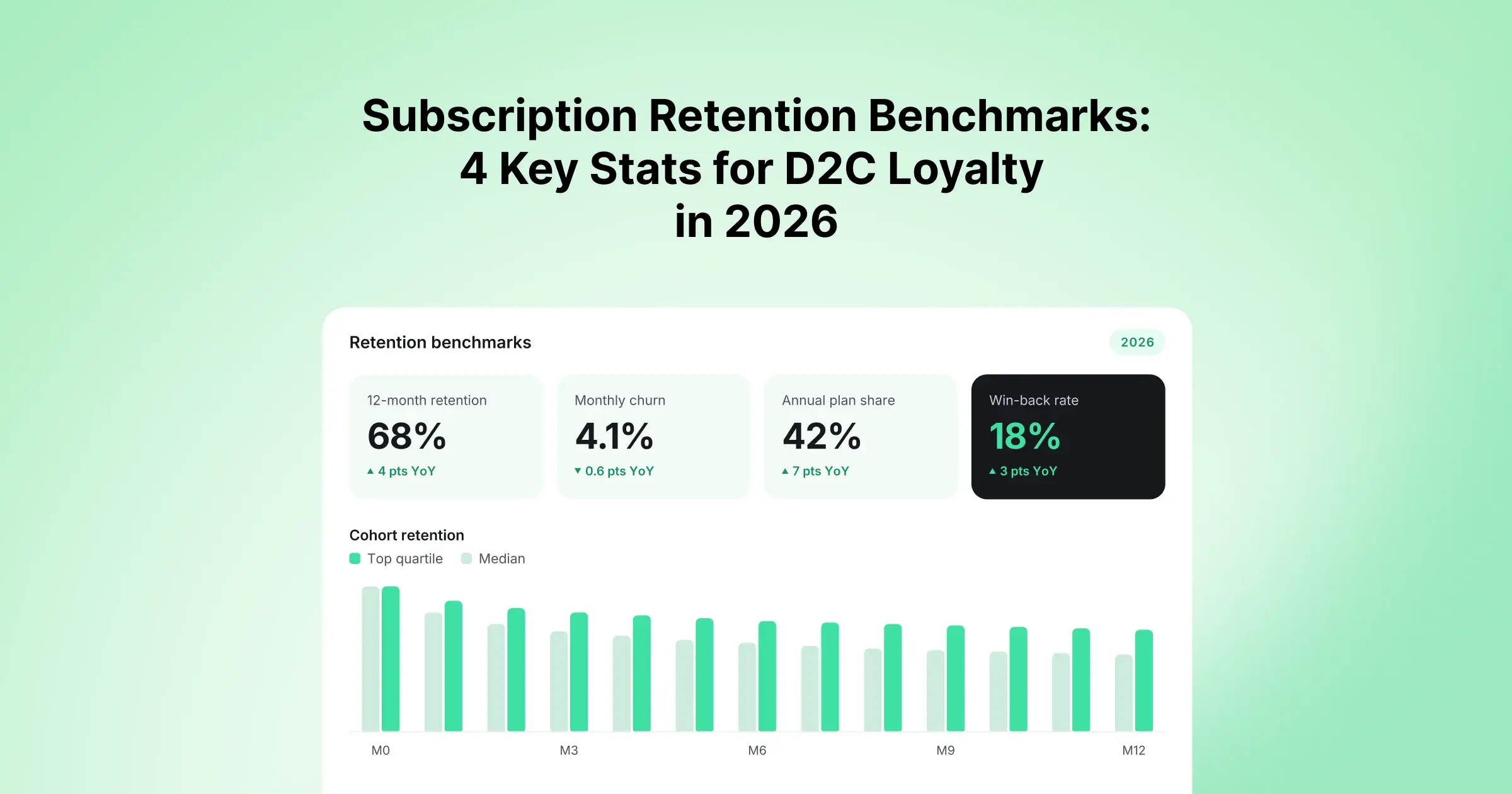
Drawing on data from millions of subscriber touchpoints across Cleeng's global client base, we've compiled the 2026 Retention Benchmarks to help you master the third phase of the subscriber lifecycle: retention and loyalty. By comparing your performance against industry Leaders (top 25%) and Followers (bottom 25%), we'll break down the metrics that separate brands that keep subscribers from brands that just keep acquiring them.
Read more:
Subscription Conversion Benchmarks: 5 Key Stats for Better Acquisition
Subscription Revenue Optimization: 4 Key Benchmarks for 2026 Growth
Why do subscribers really leave?
Even high-performing subscription brands struggle to keep users around. Four pain points quietly erode long-term growth:
- Passive churn blind spots. Failed in-app payments go undetected until the subscriber is already gone, often due to limited retry logic and no automated payment recovery.
- Short subscriber lifetimes. Without onboarding that builds habits fast, users disappear before they experience real value.
- Missed win-back opportunities. Most brands stop engaging the moment a subscriber cancels, leaving one of the cheapest growth levers on the table.
- Retention in the dark. Without granular churn analytics, brands can't answer the basic question of why users left, let alone whether they could have been saved.
Addressing these requires the right data and the right systems. Let's look at where Leaders pull ahead.
Key subscriber retention metrics explained
- Benchmark 1: Subscriber Lifetime: The average duration a subscriber stays active before churning.
- Benchmark 2: Retention Rate: The percentage of subscribers who continue their subscription over a defined period.
- Benchmark 3: Resubscription Rate: The percentage of churned subscribers who are successfully won back.
- Benchmark 4: Recurring Payment Success Rate: The percentage of recurring payments successfully processed on their scheduled billing date.
What is the average subscriber lifetime for D2C brands in 2026?
In 2026, the average D2C subscriber stays active for 381 days before churning. Industry Leaders stretch that to 502 days – nearly three times longer than Followers, who lose subscribers after just 185 days.
The longer a subscriber sticks around, the more lifetime value they deliver, which is exactly why this is the foundational retention metric. Leaders get there through proactive dunning strategies and intelligent retry logic that automatically recovers failed payments, lifecycle messaging that targets at-risk users before they cancel, and a frictionless early experience that prevents churn before it starts.
How to increase subscriber lifetime
- Fix billing before it becomes churn. Implement intelligent retry logic and dunning sequences that recover failed payments automatically – involuntary churn is one of the most preventable causes of subscriber loss.
- Segment for risk, not just revenue. Use behavioral and usage data to flag at-risk accounts before they show obvious cancellation signals.
- Nail the first-week experience. A smooth, engaging early journey is critical for preventing the early drop-off that shortens average lifetime the most.
What is a good subscriber retention rate in 2026?
The average subscription retention rate in 2026 is 86%. Leaders retain 89.9% of subscribers, while Followers hold onto just 82.4% – a gap that compounds significantly at scale.
Top performers prove that small changes in lifecycle messaging, product experience, and cancellation friction add up to major long-term revenue gains. The difference comes down to churn segmentation using behavioral data to identify at-risk users, tailored messaging that addresses specific pain points by segment, and fast, localized support that resolves friction before it becomes a reason to cancel.
How to improve subscription retention rate
- Segment churn by behavior, not just tenure. Different subscribers churn for different reasons – treat them differently.
- Design cancellation flows that listen. Use exit surveys and targeted save offers to address the specific objection, not a generic discount.
- Resolve friction fast. Localized, responsive support during early usage prevents small frustrations from escalating into cancellations.
What is a competitive resubscription (win-back) rate for 2026?
The average resubscription rate (the share of churned subscribers a brand successfully wins back) is 31% in 2026. Leaders re-engage 38.8% of churned users, nearly four in ten, compared to just 21.1% for Followers.
Win-backs aren't rare for Leaders – they're strategic. This gap shows how critical timely, well-targeted outreach is to reclaiming lost revenue, rather than treating a cancellation as the end of the relationship.
How to improve your win-back and resubscription rate
- Analyze churn by segment first. Understanding why different groups left is what makes a win-back offer relevant instead of generic.
- Automate win-back triggers. Re-engage churned subscribers automatically at the optimal moment with a message tailored to their reason for leaving.
- Personalize the offer, not just the discount. Reactivation offers tied to a subscriber's history and past behavior convert far better than one-size-fits-all promotions.
What is a healthy recurring payment success rate?
The average recurring payment success rate (the share of subscription payments processed successfully on their scheduled billing date) is 93%. Leaders push this to 96.8%, compared to 91.7% for Followers.
This metric matters because unrecovered failed payments are pure involuntary churn – subscribers who didn't choose to leave but lost access anyway. Leaders close this gap with advanced dunning strategies, smart retry logic that adapts based on the failure reason, support for multiple payment methods as a backup, and real-time alerts for upcoming card expirations.
How to improve recurring payment success rate
- Use adaptive retry logic. Smart retries that respond to why a payment failed recover meaningfully more revenue than fixed retry schedules.
- Support backup payment methods. Give subscribers more than one card or method on file to reduce single-point-of-failure declines.
- Alert before expiration. Proactively flagging upcoming card expirations lets subscribers fix billing issues before they ever become a failed payment.
The table below summarizes the 2026 subscription retention benchmarks for D2C brands across four key loyalty metrics.
| Metric | Leaders (Top 25%) | Average | Followers (Bottom 25%) |
|---|---|---|---|
| Subscriber Lifetime | 502 days | 381 days | 185 days |
| Retention Rate | 89.9% | 86.0% | 82.4% |
| Resubscription Rate | 38.8% | 31.0% | 21.1% |
| Recurring Payment Success Rate | 96.8% | 93.0% | 91.7% |
How to build a stronger subscriber retention strategy
Understanding these subscription retention benchmarks is the first step toward turning loyalty into your primary growth engine. To close the gap with market Leaders:
- Deliver frictionless access: Seamless sign-up and instant, real-time-payment-tied access across web, mobile, and CTV reduce early drop-off.
- Make checkout painless, permanently: Tailored UX by device and location, built-in retry logic, and support for dynamic pricing and trials keep payment friction from becoming churn.
- Unify your retention data: Aligning payment, support, and marketing teams around one set of behavioral data lets you target lifecycle messaging and combine churn prediction with personalized action. Cleeng's SRM® suite is built to close exactly this kind of gap between issue detection and resolution.
- Automate win-backs: Don't rely on manual outreach — trigger reactivation campaigns automatically based on churn segment and timing.
- Watch plan-level retention continuously: Retention isn't static. Track it by plan and segment to catch drift before it becomes a trend.
Conclusion
Retention isn't about plugging a leaky bucket after the fact – it's about building a subscriber experience so frictionless that churn becomes the exception, not the norm. By benchmarking subscriber lifetime, retention rate, resubscription rate, and payment recovery, you can pinpoint exactly where you're losing subscribers you shouldn't be.
Ready to see where you stand? Download the full Retention Playbook 2026.
Cleeng is designed specifically to help D2C subscription brands master every stage of the subscriber journey, from acquisition to long-term loyalty. Create your free account to start exploring our suite of tools and see how simply you can turn retention into your growth engine.