---
title: 7 OTT Monetization Software Factors for Churn Reduction
description: Discover 7 key factors streaming broadcasters should evaluate in OTT video monetization software to reduce churn and grow subscriber retention.
image: https://blog.cleeng.com/hubfs/7%20ott%20monetization%20software%20factors%20for%20churn%20reduction%20cleeng.webp
---
Products
What it does
[Core Subscriber Management and Billing](https://cleeng.com/subscriber-management-system) [Merchant of Record Payments, Tax and Compliance](https://cleeng.com/merchant-checkout-optimization) [ChurnIQ Smart and Predictive Churn Analytics](https://cleeng.com/products/subscription-churn-analytics) [Hi5 AI-Enhanced Customer Care](https://cleeng.com/customer-care-digital-subscriptions)
AI Products
[Cleeng AI Ask questions in plain language](https://cleeng.com/ai) [Cleeng MCP Server Connect Cleeng to your own AI tools](https://cleeng.com/ai/mcp) [Data Intelligence Enriched context for every subscriber](https://cleeng.com/ai/subscriber-data) [Trust & Governance Complete control and auditability](https://cleeng.com/ai/legal)
Solutions
By industry
[Streaming and OTT](https://cleeng.com/solutions/streaming) [Sports](https://cleeng.com/solutions/subscription-management-for-sports) [Wellness](https://cleeng.com/solutions/wellness) [Creators](https://cleeng.com/solutions/youtube-creators) [Gaming](https://cleeng.com/solutions/gaming) [Memberships](https://cleeng.com/solutions/memberships)
By scale
[Enterprise](https://cleeng.com/solutions/enterprise) [Small and Medium Businesses](https://cleeng.com/pro)
For partners
[Agencies & Integrators](https://cleeng.com/solutions/agencies) [B2B2C Platforms](https://cleeng.com/solutions/b2b2c-platforms)
Developers
[Launch Subscriptions](https://developers.cleeng.com/docs/launch-subscriptions) [Build with LLMs](https://developers.cleeng.com/docs/build-with-llms) [Integrate apps](https://developers.cleeng.com/docs/payments_on_mobile_tv_apps_intro) [System status](http://status.cleeng.com/) [Integrations Hub](https://cleeng.com/integrations-connectors) [Migration guide](https://cleeng.com/migrate-to-cleeng) [Certified Partner Program](https://publisher.support.cleeng.com/hc/en-us/articles/22272169788188-Cleeng-Certified-Partner-Program)
Resources
[Publisher Help Center](https://publisher.support.cleeng.com/hc/en-us) [Blog](https://blog.cleeng.com/) [Customer stories](https://cleeng.com/clients) [Events](https://cleeng.com/events) [Research & reports](https://cleeng.com/resources) [Demo Hub](https://cleeng.com/demohub)
[Pricing](https://cleeng.com/pricing)
[Login](https://srm.cleeng.com/auth) [Get started free](https://srm.cleeng.com/auth/register)
[Blog](https://cleeng.com/blog)
# 7 OTT Monetization Software Factors for Churn Reduction
Churn & Retention | Kamila Palka | Aug 14, 2026
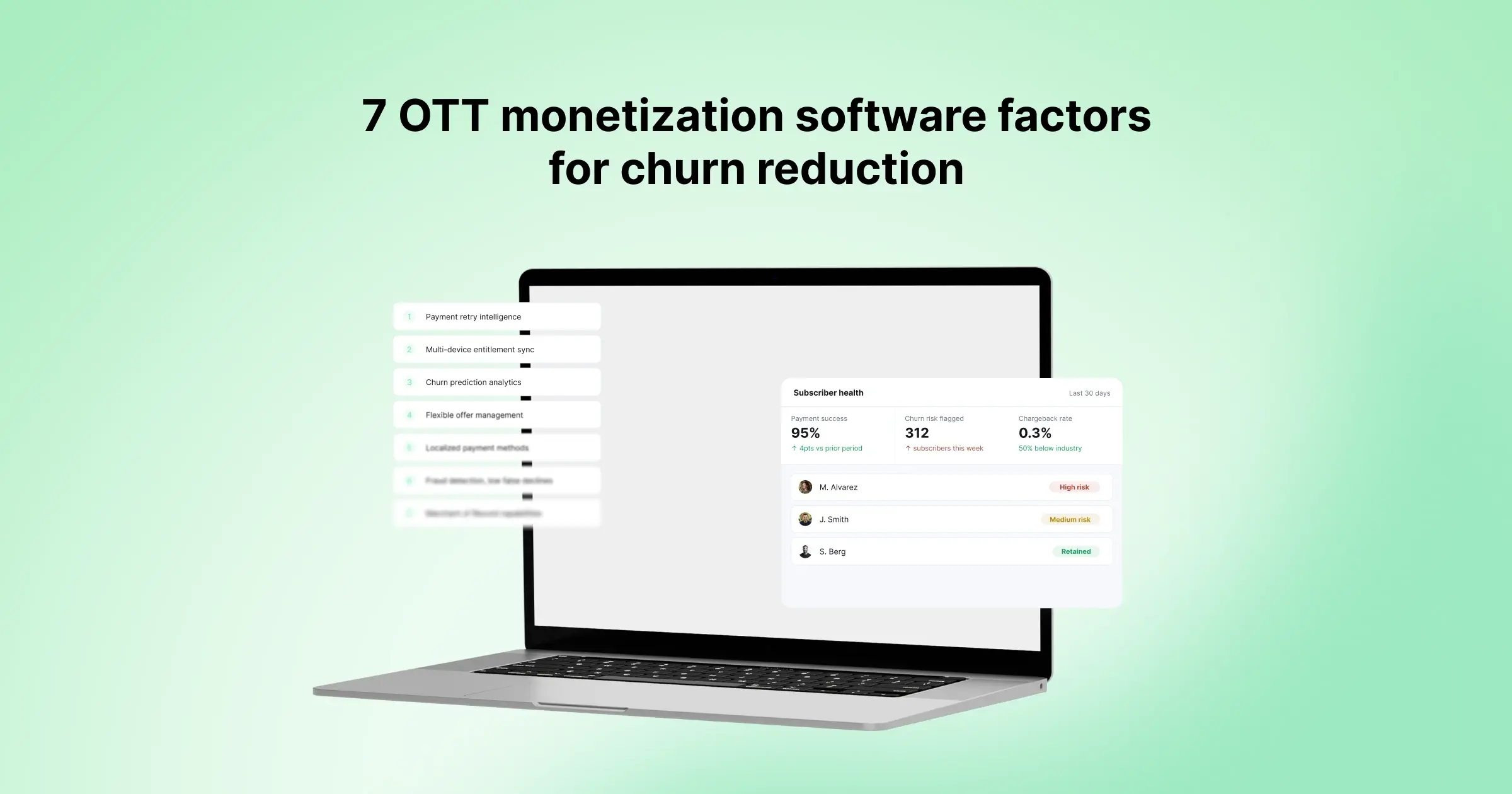
## TL;DR – 7 factors for evaluating OTT monetization software
1. Payment retry intelligence. Automated dunning strategies that recover failed transactions before they become lost subscribers.
2. Multi-device entitlement sync. Unified subscriber data across web, mobile, and connected TV platforms,
3. Churn prediction analytics. AI-powered insights that flag at-risk subscribers before they cancel.
4. Flexible offer management. The ability to create and test pricing, bundles, and promotions without engineering support.
5. Localized payment methods. Support for regional payment preferences that increase conversion and reduce payment failures.
6. Fraud detection with low false declines. Protection that blocks bad actors without rejecting legitimate subscribers.
7. Merchant of Record capabilities. Outsourced tax compliance and liability that removes operational burden from your team.
### How we chose these evaluation factors
When streaming broadcasters evaluate [OTT video monetization](https://blog.cleeng.com/ott-monetization) software, the conversation often starts with acquisition features. But for D2C content publishers running subscription businesses, the real question is: what happens after someone subscribes?
We focused on factors that directly impact subscriber retention because that's where long-term revenue lives. These criteria emerged from analyzing what separates [platforms that help broadcasters grow from those that simply process payments](https://blog.cleeng.com/cleeng-recurly-chargebee-paddle-which-platforms-wins-at-global-subscription-payments).
- Revenue recovery potential**.** How much failed payment revenue can the platform win back through intelligent retry logic?
- Subscriber visibility. Does the platform give you a unified view of each subscriber's journey across all devices and touchpoints?
- Operational efficiency. Can your team launch new offers, adjust pricing, or run promotions without waiting on developers?
- Global scalability. Does the platform handle multi-currency billing, local payment methods, and tax compliance across jurisdictions?
- Risk management. How effectively does the platform balance fraud prevention with minimizing false declines that frustrate legitimate subscribers?
- Data-driven retention. What tools does the platform offer for identifying churn risk and intervening before cancellations happen?
## 7 key factors for reducing churn with OTT monetization software
### 1. Payment retry intelligence
Failed payments represent one of the largest sources of [involuntary churn](https://blog.cleeng.com/involuntary-churn-how-to-prevent-lost-revenue-from-failed-subscription-payments) for streaming services. When a subscriber's card declines, most platforms simply retry at fixed intervals. The result? Lost revenue and subscribers who never intended to cancel.
The most effective OTT monetization platforms use intelligent retry logic that considers factors like local paydays, historical transaction patterns, and issuer behavior. This approach can recover up to 35% of failed renewal payments.
Cleeng's Merchant of Record solution maintains a 95% average recurring payment success rate by dynamically routing transactions and optimizing retry schedules based on real-time data. For broadcasters, this translates directly to retained subscribers and protected revenue.
Read more about Cleeng's [payment recovery strategies](https://blog.cleeng.com/payment-recovery-strategy-dunning-settings).
### 2. Multi-device entitlement sync
Your subscribers watch content on phones during commutes, laptops at work, and smart TVs at home. If their subscription status doesn't sync instantly across all these touchpoints, you create friction that damages the viewing experience.
Look for platforms that maintain a single source of truth for [subscriber entitlements](https://cleeng.com/subscriber-management-system) across web, mobile apps, and connected TV. When someone upgrades their plan on their phone, that change should reflect immediately everywhere else.
Cleeng's high-availability infrastructure captures every transaction and interaction in one centralized data set. This means no subscriber ever faces the frustration of being locked out of content they've paid for, regardless of which device they're using.
Learn more about [Multi-Channel Billing](https://blog.cleeng.com/multi-channel-billing-digital-subscriptions) and entitlement sync.
### 3. Churn prediction analytics
By the time a subscriber clicks "cancel," you've already lost them. Effective retention starts with identifying at-risk subscribers weeks or months before they make that decision.
AI-powered [churn prediction tools](https://cleeng.com/churniq-churn-intelligence) analyze viewing patterns, payment history, and engagement signals to surface subscribers who show early warning signs. This gives your team time to intervene with targeted offers, personalized content recommendations, or proactive outreach.
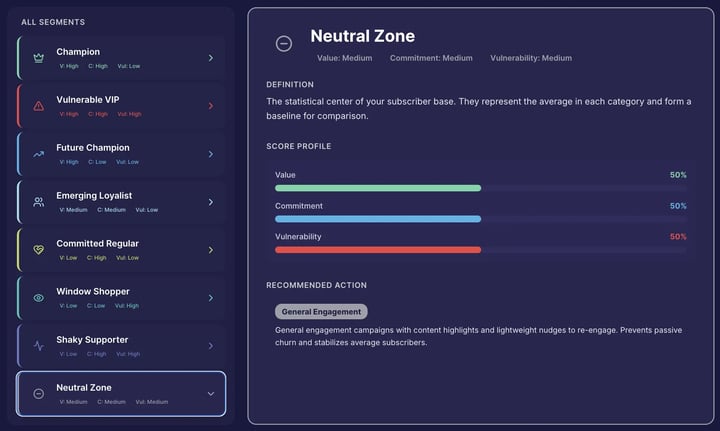
Cleeng offers 80+ data dimensions in a purpose-built subscriber data lake, along with pre-built segments designed to drive action. Rather than drowning in data, you get actionable intelligence that helps you protect your most valuable subscribers.
Learn more about [subscriber segmentation](https://blog.cleeng.com/subscriber-segmentation).
### 4. Flexible offer management
Streaming markets move fast. When a competitor launches a new pricing tier or you want to test a promotional bundle for a sports season, waiting weeks for development resources isn't an option.
Evaluate whether your monetization platform allows non-technical team members to create new offers, adjust pricing, and configure promotions. The ability to experiment quickly with subscriptions, day passes, pay-per-view events, and seasonal packages gives you the agility to respond to market conditions.
Cleeng enables broadcasters to launch flexible offers in minutes and test pricing without engineering involvement. Mix and match monetization models across all devices with the freedom to experiment, ensuring your tech stack never limits your business ambitions.
### 5. Localized payment methods
A subscriber in Germany expects to pay with SEPA direct debit. In Spain, Bizum dominates. Brazilian viewers prefer [Pix](https://press.cleeng.com/vbtv-launches-pix-automatico-cleeng). When you only offer credit cards, you're leaving money on the table and creating unnecessary friction.
The right monetization platform connects you with [local payment methods](https://blog.cleeng.com/local-payment-methods-for-global-subscription-growth) that match subscriber preferences in each market. This isn't just about convenience. Offering familiar payment options increases conversion rates and reduces the payment failures that lead to involuntary churn.
Cleeng integrates 200+ payment methods across 230 countries and territories, supporting 37+ currencies. This global reach, combined with intelligent payment routing, ensures subscribers can pay in whatever way works for them.
### 6. Fraud detection with low false declines
[Fraud prevention](https://blog.cleeng.com/payment-fraud-detection-prevention) is essential, but overly aggressive fraud rules create a different problem: false declines. When legitimate subscribers get blocked, they don't just fail to convert. They leave frustrated and unlikely to return.
Effective fraud prevention balances protection with precision. Look for platforms that use AI-driven pattern analysis and customizable risk settings rather than blunt rules that treat every unusual transaction as suspicious.
Cleeng maintains a chargeback rate of just 0.3%, which is 50% lower than the industry average. This comes from advanced fraud detection that stops bad actors while keeping the door open for legitimate subscribers, protecting both your revenue and your customer relationships.
See how [regional AI reduced fraud by 97%](https://blog.cleeng.com/regional-ai-fraud-prevention-tool-case-study).
### 7. Merchant of Record capabilities
Global expansion sounds exciting until you're managing tax compliance across 13,000+ jurisdictions, handling chargebacks, and navigating PCI requirements. For many streaming businesses, these operational burdens consume resources that should go toward content and growth.
A [Merchant of Record](https://cleeng.com/products/merchant-of-record) takes on the legal and financial responsibility for selling to your subscribers. They handle tax calculation, collection, and remittance. They manage fraud liability and chargebacks. They ensure compliance with local regulations.
Cleeng's Merchant of Record solution covers tax compliance across 13,000+ jurisdictions and can reduce total cost of ownership by up to 50%. This frees your team to focus on what actually differentiates your service: the content and experience you deliver to subscribers.
## How do payment failures impact OTT subscriber churn?
Payment failures trigger a significant portion of subscriber losses in streaming businesses, and most of these departures are completely preventable. When a credit card expires, a bank flags a transaction, or a subscriber's account has insufficient funds, the result is the same: a paying customer suddenly loses access to content they want.
The challenge is that many payment processing systems treat all declines identically. They retry at fixed intervals, send generic emails, and eventually cancel the subscription. But different decline reasons require different responses.
A card that's declined for insufficient funds on the 28th of the month might succeed on the 1st when the subscriber gets paid. An expired card needs a reminder email prompting the subscriber to update their payment method. A fraud flag requires verification, not repeated retry attempts.
Cleeng addresses this through intelligent payment orchestration that considers subscriber behavior, local payment patterns, and historical transaction data. The platform achieves a 95% recurring payment success rate by adapting its approach to each situation, recovering revenue that would otherwise be lost to involuntary churn.
## What role does subscriber data play in retention?
Subscriber data only reduces churn if you can act on it. Many streaming businesses collect mountains of information across different systems, but struggle to turn that data into timely interventions that save subscribers.
The key is having normalized data across all channels. When viewing behavior from your connected TV app, payment history from your billing system, and support interactions from your customer care platform all live in separate silos, you can't build a complete picture of subscriber health.
Unified [subscriber analytics](https://blog.cleeng.com/what-is-subscription-analytics-how-it-facilitates-growth-retention) let you identify patterns that predict churn. Maybe subscribers who haven't watched content in 14 days are 5x more likely to cancel. Perhaps viewers who only use one device have higher churn rates than multi-device users. These insights enable targeted retention campaigns.
Cleeng's platform normalizes subscriber lifecycle data across all channels, offering 80+ data dimensions for analysis. Pre-built segments surface actionable insights rather than requiring your team to build reports from scratch. The goal is intelligence that drives decisions, not dashboards that sit unused.
## Why Cleeng is the best OTT monetization software for churn reduction
Cleeng approaches [OTT monetization](https://cleeng.com/solutions/streaming) differently than general-purpose billing platforms. Built specifically for D2C subscription businesses in media and entertainment, every feature is designed with subscriber retention in mind.
The platform combines subscriber management, payment processing, analytics, and AI-powered customer care into a unified infrastructure. This eliminates the fragmented tool stacks that create data silos and operational complexity. Instead of managing separate vendors for identity, payments, tax, and support, you get one integrated system.
Cleeng's Subscriber Retention Management (SRM®) suite has helped numerous broadcasters reduce churn significantly within months. The platform serves 12.3 billion API requests annually with 99.998% availability, providing the enterprise-grade reliability that major media brands require.
For streaming broadcasters evaluating monetization software, the question isn't just which platform can process payments. It's which platform will help you keep the subscribers you've worked so hard to acquire. Cleeng's specialized focus on retention makes it the right choice for D2C video businesses serious about reducing churn.
[](https://blog.cleeng.com/hs/cta/wi/redirect?encryptedPayload=AVxigLJ1ovml9rY1G%2B8xlFvkON2vl5pvd3MStoAVwkQv%2B2UmAn4qt5XX%2BaWIiPHa0t0SBesbXLGhBcMJbkECNYN28hy9jKTUN52fGx%2FL7u3F2MhESwHagItVMq1wtlCGM7HSdS2wydetkBNDnH6j%2BtMRJNBS0slMTSpEqndZ6zEqYQ3U2eyRLpV4QTTXR16N5fSdE2po2WoF&webInteractiveContentId=219463895882&portalId=5813983)
### FAQs about OTT monetization software for churn reduction
#### What is OTT video monetization software?
OTT video monetization software helps streaming businesses manage subscriptions, process payments, and retain subscribers. Unlike basic payment processors, these platforms handle the full subscriber lifecycle, including offer management, multi-device entitlements, and retention analytics.
Cleeng's platform exemplifies this approach by combining billing, identity management, and churn prediction tools into one integrated system designed specifically for media and entertainment companies.
#### How does intelligent payment retry reduce subscriber churn?
Intelligent payment retry recovers failed transactions by timing retries based on subscriber behavior and local payment patterns. Rather than using fixed retry schedules, these systems consider factors like paydays and issuer behavior.
Cleeng's intelligent retry approach recovers up to 35% of failed renewal payments, turning potential churn into retained revenue.
#### Why do streaming services need a Merchant of Record?
A Merchant of Record takes on legal responsibility for subscriber transactions, including tax compliance, fraud liability, and chargeback management. This removes operational burden from your team and reduces the complexity of global expansion.
Cleeng's Merchant of Record handles tax remittance across 13,000+ jurisdictions while maintaining a 0.3% chargeback rate.
#### What subscriber analytics matter most for churn reduction?
The most valuable analytics for churn reduction identify at-risk subscribers before they cancel. This includes viewing engagement trends, payment failure patterns, and support interaction history combined into predictive churn scores.
Cleeng offers 80+ data dimensions and pre-built segments that surface actionable retention opportunities.
#### How quickly can OTT monetization software impact churn rates?
Implementation timelines vary, but platforms designed for rapid deployment can show results within weeks. Payment optimization improvements often appear immediately, while retention analytics require some data accumulation to generate predictions.
Cleeng customers have reduced churn by up to 60% within three months of implementation, with initial improvements visible much sooner.
### Popular posts
#### [Seasonal Subscriptions: How Sports Streaming Platforms Beat Off-Season Churn Read more →](https://blog.cleeng.com/seasonal-subscriptions-for-sports-streaming)
#### [App Store Connect Now Tracks Subscription Analytics: What It Means for Multi-Platform Operators Read more →](https://blog.cleeng.com/app-store-connect-now-tracks-subscription-analytics)
#### [How to Recover Subscription Revenue: 3 Gaps Subscription Brands Ignore Read more →](https://blog.cleeng.com/how-to-recover-subscription-revenue)
#### [Subscriber Segmentation: How to Identify VIPs and Predict Churn Read more →](https://blog.cleeng.com/subscriber-segmentation)
### See your whole business clearly.
Connect your data and watch your live dashboard fill in — no credit card required.
[Start free](https://srm.cleeng.com/register)
### Related posts
#### [ Churn & Retention Seasonal Subscriptions: How Sports Streaming Platforms Beat Off-Season Churn **Kamila Palka** · Sep 30, 2026, 7:33:48 AM](https://blog.cleeng.com/seasonal-subscriptions-for-sports-streaming)
#### [ Churn & Retention App Store Connect Now Tracks Subscription Analytics: What It Means for Multi-Platform Operators **Kübra Güven** · May 13, 2026, 10:19:17 AM](https://blog.cleeng.com/app-store-connect-now-tracks-subscription-analytics)
#### [ Churn & Retention How to Recover Subscription Revenue: 3 Gaps Subscription Brands Ignore **Sebastian Boruch** · Apr 23, 2026, 12:26:36 PM](https://blog.cleeng.com/how-to-recover-subscription-revenue)
Your Subscriber Retention Management® solution
[Contact us](https://cleeng.com/contact)
#### Ask AI for info
- [ChatGPT](https://chatgpt.com/?q=...)
- [Gemini](https://gemini.google.com/app?q=...)
- [Claude](https://claude.ai/new?q=...)
- [Perplexity AI](https://www.perplexity.ai/?q=...)
#### Products
- [Subscriber management and billing](https://cleeng.com/subscriber-management-system)
- [Merchant of Record](https://www.cleeng.com/products/merchant-of-record)
- [Churn Analytics](https://cleeng.com/churniq-churn-intelligence)
- [AI-Enhanced Customer Care](https://cleeng.com/pro)
#### Solutions
- [Streaming and OTT](https://www.cleeng.com/solutions/streaming)
- [Sports](https://cleeng.com/subscription-management-for-sports)
- [Wellness](https://cleeng.com/wellness)
- [Creators](https://www.cleeng.com/solutions/youtube-creators)
- [Enterprise](https://cleeng.com/solutions/enterprise)
- [Small and Medium Businesses](https://cleeng.com/pro)
#### Developer
- [API Reference](https://developers.cleeng.com/reference/apireference-overview)
- [Sandbox](https://srm-sandbox.cleeng.com/register)
- [Tutorials](https://developers.cleeng.com/docs/getting-started-with-cleeng)
- [Integrations](https://cleeng.com/integrations-connectors)
- [Migration](https://cleeng.com/integrations-connectors)
#### About
- [Company](https://cleeng.com/about-us)
- [Blog](https://blog.cleeng.com/)
- [Sustainability](https://cleeng.com/sustainability)
- [Careers](https://cleeng.com/careers)
#### Explore
- [Pricing](https://cleeng.com/pricingpro)
- [My Dashboard](https://srm.cleeng.com/login)
- [FAQ & support](https://publisher.support.cleeng.com/hc/en-us)
#### Customers
- [Who are Cleeng](https://cleeng.com/who-are-cleeng)
- [Get Support](https://cleeng.zendesk.com/hc/en-us/)
Copyright © 2026 Cleeng | All Rights Reserved | [Terms & Conditions](https://cleeng.com/master-service-agreement)
```json
{
"@context" : "https://schema.org",
"@type" : "BlogPosting",
"author" : {
"@type" : "Person",
"name" : "Kamila Palka"
},
"dateModified" : "2026-08-26T07:41:07Z",
"datePublished" : "2026-08-14T13:43:34Z",
"description" : "Discover 7 key factors streaming broadcasters should evaluate in OTT video monetization software to reduce churn and grow subscriber retention.",
"headline" : "7 OTT Monetization Software Factors for Churn Reduction",
"image" : "https://5813983.fs1.hubspotusercontent-na1.net/hubfs/5813983/7%20ott%20monetization%20software%20factors%20for%20churn%20reduction%20cleeng.webp",
"mainEntityOfPage" : {
"@id" : "https://blog.cleeng.com",
"@type" : "WebPage"
},
"publisher" : {
"@type" : "Organization",
"logo" : {
"@type" : "ImageObject",
"url" : "https://cdn.prod.website-files.com/624eb5c51026869311f0668a/66b09c7ffb2cada498b8a184_Cleeng%20logo%20-%20tagline%20bottom%20-%20transparent.svg"
},
"name" : "Cleeng"
}
}
```
```json
{
"@context" : "https://schema.org",
"@id" : "https://blog.cleeng.com/ott-monetization-software-factors-for-churn-reduction#article",
"@type" : "BlogPosting",
"articleSection" : "OTT Monetization",
"author" : {
"@type" : "Person",
"jobTitle" : "Content Marketing Strategist",
"name" : "Kamila Palka",
"worksFor" : {
"@type" : "Organization",
"name" : "Cleeng"
}
},
"dateModified" : "2026-08-14",
"datePublished" : "2026-08-14",
"description" : "A breakdown of 7 key OTT monetization software factors that reduce subscriber churn, including payment retry intelligence, entitlement sync, churn prediction, and Merchant of Record capabilities.",
"headline" : "7 OTT Monetization Software Factors for Churn Reduction",
"image" : {
"@type" : "ImageObject",
"url" : "https://blog.cleeng.com/ott-monetization-software-factors-for-churn-reduction#post-image"
},
"keywords" : "OTT monetization software, subscriber churn, payment retry, Merchant of Record, subscription retention, SRM",
"mainEntityOfPage" : {
"@id" : "https://blog.cleeng.com/ott-monetization-software-factors-for-churn-reduction",
"@type" : "WebPage"
},
"publisher" : {
"@type" : "Organization",
"logo" : {
"@type" : "ImageObject",
"url" : "https://5813983.fs1.hubspotusercontent-na1.net/hubfs/5813983/assets/cleenglogo.svg"
},
"name" : "Cleeng"
},
"url" : "https://blog.cleeng.com/ott-monetization-software-factors-for-churn-reduction"
}
```
```json
{
"@context" : "https://schema.org",
"@id" : "https://blog.cleeng.com/ott-monetization-software-factors-for-churn-reduction#faq",
"@type" : "FAQPage",
"mainEntity" : [ {
"@type" : "Question",
"acceptedAnswer" : {
"@type" : "Answer",
"text" : "OTT video monetization software helps streaming businesses manage subscriptions, process payments, and retain subscribers. Unlike basic payment processors, these platforms handle the full subscriber lifecycle, including offer management, multi-device entitlements, and retention analytics. Cleeng's platform exemplifies this approach by combining billing, identity management, and churn prediction tools into one integrated system designed specifically for media and entertainment companies."
},
"name" : "What is OTT video monetization software?"
}, {
"@type" : "Question",
"acceptedAnswer" : {
"@type" : "Answer",
"text" : "Intelligent payment retry recovers failed transactions by timing retries based on subscriber behavior and local payment patterns, rather than using fixed retry schedules, considering factors like paydays and issuer behavior. Cleeng's intelligent retry approach recovers up to 35% of failed renewal payments, turning potential churn into retained revenue."
},
"name" : "How does intelligent payment retry reduce subscriber churn?"
}, {
"@type" : "Question",
"acceptedAnswer" : {
"@type" : "Answer",
"text" : "A Merchant of Record takes on legal responsibility for subscriber transactions, including tax compliance, fraud liability, and chargeback management, which removes operational burden from your team and reduces the complexity of global expansion. Cleeng's Merchant of Record handles tax remittance across 13,000+ jurisdictions while maintaining a 0.3% chargeback rate."
},
"name" : "Why do streaming services need a Merchant of Record?"
}, {
"@type" : "Question",
"acceptedAnswer" : {
"@type" : "Answer",
"text" : "The most valuable analytics for churn reduction identify at-risk subscribers before they cancel, combining viewing engagement trends, payment failure patterns, and support interaction history into predictive churn scores. Cleeng offers 80+ data dimensions and pre-built segments that surface actionable retention opportunities."
},
"name" : "What subscriber analytics matter most for churn reduction?"
}, {
"@type" : "Question",
"acceptedAnswer" : {
"@type" : "Answer",
"text" : "Implementation timelines vary, but platforms designed for rapid deployment can show results within weeks. Payment optimization improvements often appear immediately, while retention analytics require some data accumulation to generate predictions. Cleeng customers have reduced churn by up to 60% within three months of implementation, with initial improvements visible much sooner."
},
"name" : "How quickly can OTT monetization software impact churn rates?"
} ]
}
```
```json
{
"@context" : "https://schema.org",
"@type" : "Blog",
"description" : "Insights and strategies on subscriber retention and D2C subscriptions from Cleeng.",
"name" : "Cleeng Blog",
"publisher" : {
"@type" : "Organization",
"logo" : {
"@type" : "ImageObject",
"url" : "https://cdn.prod.website-files.com/624eb5c51026869311f0668a/66b09c7ffb2cada498b8a184_Cleeng%20logo%20-%20tagline%20bottom%20-%20transparent.svg"
},
"name" : "Cleeng"
},
"url" : "https://blog.cleeng.com"
}
```