---
title: "Subscription Revenue Optimization: 4 Key Benchmarks for 2026 Growth"
description: Optimize your 2026 subscription revenue with key benchmarks and strategies for increasing ARPU, long commit rates, web channel share, and Lifetime Value Ratio.
image: https://blog.cleeng.com/hubfs/subscription%20benchmarks%20revenue%20optimization.webp
---
Products
What it does
[Core Subscriber Management and Billing](https://cleeng.com/subscriber-management-system) [Merchant of Record Payments, Tax and Compliance](https://cleeng.com/merchant-checkout-optimization) [ChurnIQ Smart and Predictive Churn Analytics](https://cleeng.com/products/subscription-churn-analytics) [Hi5 AI-Enhanced Customer Care](https://cleeng.com/customer-care-digital-subscriptions)
AI Products
[Cleeng AI Ask questions in plain language](https://cleeng.com/ai) [Cleeng MCP Server Connect Cleeng to your own AI tools](https://cleeng.com/ai/mcp) [Data Intelligence Enriched context for every subscriber](https://cleeng.com/ai/subscriber-data) [Trust & Governance Complete control and auditability](https://cleeng.com/ai/legal)
Solutions
By industry
[Streaming and OTT](https://cleeng.com/solutions/streaming) [Sports](https://cleeng.com/solutions/subscription-management-for-sports) [Wellness](https://cleeng.com/solutions/wellness) [Creators](https://cleeng.com/solutions/youtube-creators) [Gaming](https://cleeng.com/solutions/gaming) [Memberships](https://cleeng.com/solutions/memberships)
By scale
[Enterprise](https://cleeng.com/solutions/enterprise) [Small and Medium Businesses](https://cleeng.com/pro)
For partners
[Agencies & Integrators](https://cleeng.com/solutions/agencies) [B2B2C Platforms](https://cleeng.com/solutions/b2b2c-platforms)
Developers
[Launch Subscriptions](https://developers.cleeng.com/docs/launch-subscriptions) [Build with LLMs](https://developers.cleeng.com/docs/build-with-llms) [Integrate apps](https://developers.cleeng.com/docs/payments_on_mobile_tv_apps_intro) [System status](http://status.cleeng.com/) [Integrations Hub](https://cleeng.com/integrations-connectors) [Migration guide](https://cleeng.com/migrate-to-cleeng) [Certified Partner Program](https://publisher.support.cleeng.com/hc/en-us/articles/22272169788188-Cleeng-Certified-Partner-Program)
Resources
[Publisher Help Center](https://publisher.support.cleeng.com/hc/en-us) [Blog](https://blog.cleeng.com/) [Customer stories](https://cleeng.com/clients) [Events](https://cleeng.com/events) [Research & reports](https://cleeng.com/resources) [Demo Hub](https://cleeng.com/demohub)
[Pricing](https://cleeng.com/pricing)
[Login](https://srm.cleeng.com/auth) [Get started free](https://srm.cleeng.com/auth/register)
[Blog](https://cleeng.com/blog)
# Subscription Revenue Optimization: 4 Key Benchmarks for 2026 Growth
Payments, Tax & Compliance | Kamila Palka | Feb 3, 2026
*This article breaks down the [2026 subscription revenue benchmarks for D2C subscription brands](https://cleeng.com/resources/d2c-retention-benchmarks-2026), covering ARPU, long-term commitment rates, web channel performance, and lifetime value ratios, based on data from Cleeng’s global subscriber base. These benchmarks are most relevant for D2C subscription businesses selling digital products or services with recurring billing across web, mobile, or CTV.*
As a subscription professional, you already know that acquiring subscribers is only half the battle. In the 2026 subscription landscape, the new benchmark for success is sustainable subscription growth driven by retention. For[D2C subscription brands](https://blog.cleeng.com/d2c-subscription-model-how-to-build-a-future-proof-subscription-platform), **revenue optimization** is where resilience is built – or lost.
Many businesses leave significant money on the table by overlooking simple strategies. Common warning signs include over-reliance on short-term subscription plans, underperforming high-margin web channels, or static pricing strategies that fail to account for economic headwinds and[subscription fatigue](https://blog.cleeng.com/how-to-deal-with-subscription-fatigue). These are clear signs that your monetization engine needs a tune-up.
Drawing on data from millions of touchpoints across Cleeng’s global client base, we’ve compiled the[2026 Retention Benchmarks](https://cleeng.com/resources/d2c-retention-benchmarks-2026) to help you master the subscriber lifecycle during this second crucial phase: **revenue optimization**. By comparing your performance against industry Leaders (top 25%) and Followers (bottom 25%), we’ll break down the key metrics that distinguish top-tier brands.
Read more:[Subscription Conversion Benchmarks: 5 Key Stats for Better Acquisition](https://blog.cleeng.com/subscription-conversion-benchmarks)
## **Are you leaving subscription revenue on the table?**
Even successful D2C subscription businesses struggle with monetization, often facing common pain points such as:
- Short-term plan bias, which leads to unpredictable revenue and higher churn risk.
- Low channel profitability **from high-margin web sales**.
- An imbalance between Lifetime Value (LTV) and Customer Acquisition Cost (CAC), often caused by over-investing to unprofitable acquisition channels without sufficient retention.
- Inconsistent pricing strategies that ignore local demand or fail to use A/B testing to find the optimal price point.
To grow effectively, you need to address these challenges head-on. Let's dive in!
## **Key subscription revenue metrics explained**
- [Benchmark 1: Average Revenue Per User (Monthly ARPU)](https://blog.cleeng.com/d2c-subscription-revenue-optimization-4-key-benchmarks-for-growth#benchmark1): The average monthly revenue generated per paying subscriber.
- [Benchmark 2: Long Commit Rate](https://blog.cleeng.com/d2c-subscription-revenue-optimization-4-key-benchmarks-for-growth#benchmark2): The percentage of subscribers on plans longer than one month.
- [Benchmark 3: Web Channel Development](https://blog.cleeng.com/d2c-subscription-revenue-optimization-4-key-benchmarks-for-growth#benchmark3): The proportion of subscribers acquired directly via web checkout.
- [Benchmark 4: Lifetime Value Ratio (Annual:Monthly)](https://blog.cleeng.com/d2c-subscription-revenue-optimization-4-key-benchmarks-for-growth#benchmark4): The revenue multiple between annual and monthly subscribers.
## **What is the average ARPU for D2C subscription brands in 2026?**
In 2026, the average monthly [ARPU](https://blog.cleeng.com/what-is-average-revenue-per-user-arpu-explained) for D2C subscription brands is $14.23. However, industry "Leaders" (top 25%) achieve a benchmark of $16.55 by leveraging flexible pricing and behavior-triggered upsells. Brands in the bottom quartile typically see an ARPU of **$8.01**, highlighting a significant gap in monetization efficiency.
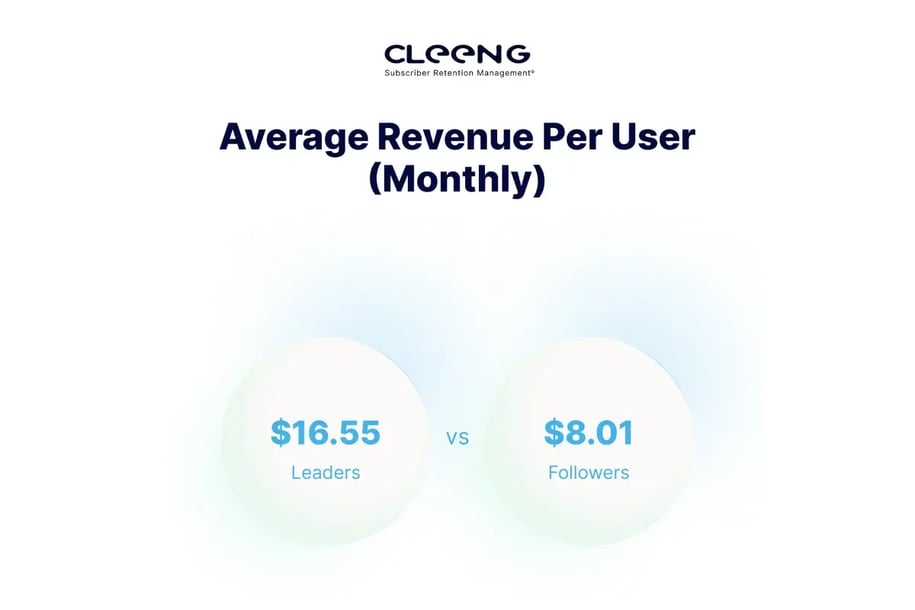
To reach Leader status, move beyond static pricing. Implement flexible tiers (monthly, annual, and [**seasonal**](https://cleeng.com/seasonal-subscriptions)) and use real-time data to trigger upsells during moments of high user engagement. Align incentives with perceived value, such as exclusive content or extended access, rather than relying solely on price discounts.
### **How to increase ARPU for digital subscriptions in 2026**
To bridge the gap between Followers and Leaders, consider these high-impact operational levers highlighted in our report:
- Implement flexible pricing tiers**:** Offer a mix of monthly, annual, and seasonal plans to cater to different user commitment levels.
- Trigger behavior-based upsells**:** Use real-time data to identify moments of high engagement and present subscribers with relevant offers for higher-value plans.
- Execute revenue diagnostics**:** Regularly analyze your subscriber base to find underperforming segments and apply localized checkout optimizations to boost performance.
- Optimize the web checkout**:** Focus on a seamless web user experience to bypass app store fees for subscriptions.
[](https://blog.cleeng.com/hs/cta/wi/redirect?encryptedPayload=AVxigLLZlwjoRaA5ezSJL6Qw9Jc3BOUm9BkiNiRVf6eNSHTPTaTyWj5eyV9BnIfORI9t1x1TBOjpivwhKLSeyIIsx9DBteoWd%2Bg%2BoZWFN%2BlEFjBNDj52sxecM0DsuofGtk8UX8RmpT%2BQoRjP%2FifsAwkiQP%2B3NZXrl0uDW1YlwQd717TLrT0FEUhi4EMQBN%2FMfiGyWmH%2FR1M%3D&webInteractiveContentId=206416139338&portalId=5813983)
## What is a good subscription "Long Commit Rate" in 2026?
A competitive Long Commit Rate for D2C brands in 2026 averages 26%. Industry Leaders significantly outperform the market with a 35.6% rate, while "Followers" struggle at **10.7%**. High long-commit rates are driven by strategic plan packaging and visual cues that emphasize the value of annual versus monthly options.
Design annual plans as the "default smart choice." Use clear visual incentives and communicate savings effectively to nudge users away from short-term plans. Align incentives with perceived value, such as exclusive content or extended access, rather than relying solely on price discounts.
### **Strategies for increasing annual subscription LTV in 2026**
- Design long-term plans as the default smart choice**.** Instead of presenting annual plans as optional upgrades, structure your offer hierarchy so longer commitments feel like the most logical option. This means visually emphasizing annual plans, clearly communicating savings or added value, and reducing the effort required to compare plans.
- Align incentives with perceived value, not just price**.** Discounts alone rarely drive sustainable commitment. Pair long-term plans with tangible benefits such as extended access, exclusive content, or bundled features that reinforce why committing longer delivers more value, not just a lower monthly cost.
- Localize pricing to reflect regional purchasing power and expectations. Analyze LTV by geography, device and plan, and tailor offers locally. With **Cleeng's**[**offer localization**](https://blog.cleeng.com/offer-localization-multi-currency-pricing-for-subscriptions), you can create offers and different pricing for specific locations. Remember, a subscriber in Egypt likely won't pay the same price as one in the US.
## What percentage of D2C subscribers should come from web channels?
For D2C brands seeking high-margin growth, the average web channel share is 52%. Top-tier Leaders acquire 74.8% of their subscribers via the web, bypassing high app store fees. Conversely, Followers only capture **29.3%** through web channels, often due to friction-heavy checkout experiences and lack of payment localization.
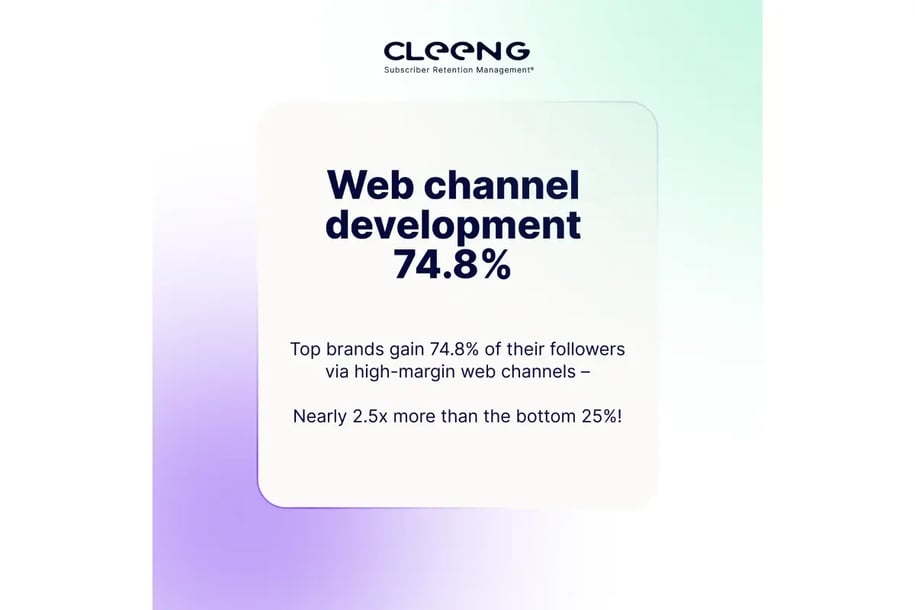
Treat your web checkout as a flagship product. It must be as seamless and trustworthy as an in-app purchase to encourage direct-to-consumer transactions. Remove payment friction by supporting local currencies and [region-preferred payment methods](https://blog.cleeng.com/offer-localization-multi-currency-pricing-for-subscriptions) to increase global completion rates.
Additionally, Leaders achieve a 96.8% recurring payment success rate!
### How to optimize web channel performance for D2C subscriptions:
- Treat web checkout as a primary product experience**.** Your web checkout should feel as trustworthy and seamless as in-app purchasing. This means optimizing load times, simplifying navigation, and ensuring consistent branding so users don’t perceive the web flow as a less secure or secondary option.
- Remove payment friction through localization**.** Support local currencies and region-preferred payment methods to meet users where they are. When subscribers see familiar payment options, hesitation drops and completion rates rise, directly improving web channel performance. For example, Cleeng's payment localization solutions give merchants access to 37+ currencies and 200+ payment methods, allowing for a better pricing strategy and user experience.
- Create a consistent cross-device journey**.** Many subscribers start on one device and finish on another. Ensuring checkout experiences remain consistent across desktop, mobile, and CTV prevents drop-off caused by confusion or mismatched expectations.
Keen to find out more? [Download our eBook](https://cleeng.com/resources/d2c-retention-benchmarks-2026) for instant access to all the benchmarks!
## What is the ideal Annual-to-Monthly Lifetime Value (LTV) Ratio?
The benchmark LTV ratio for 2026 is 1.8:1. Market Leaders achieve a 2.2:1 ratio, extracting more than double the value from annual subscribers compared to monthly ones. This is achieved through region-specific pricing and plan structures that reward long-term loyalty with premium features and exclusive access.
Focus on making annual plans feel rewarding rather than restrictive. Use extended trials or early access to reinforce the value proposition throughout the subscriber lifecycle. Monitor plan-level retention continuously. Identify exactly where annual subscribers disengage and iterate on your renewal messaging to maximize lifetime value.
[](https://blog.cleeng.com/hs/cta/wi/redirect?encryptedPayload=AVxigLJJyWAARjbGjekDJ5YF0XgbnC1yDRKTxsW3ZPFP3ycQryWgormezOxNsyHJrg%2BTwOOm0CaX7Ex2ecuCFqT8o0%2FmzAdahAndwHUhOLqvy5ClnH6asWNkMBWHXvEc36LBzgh%2FNXs2wH7lz3mYrt%2B1ge3%2BWnb%2F1eZYniYA%2F7AOEa0q1tuQ6VcaZgtWTo9K0913Bz2yBacVaeNZKtM%2Frblw1Kf%2BMIH7WLbPpgich0MUpmnb&webInteractiveContentId=206416139310&portalId=5813983)
### How to improve Lifetime Value Ratio for digital subscriptions
- Make annual plans feel rewarding, not restrictive**.** Subscribers commit longer when annual plans offer clear advantages beyond price. This can include early access, premium features, or extended trial periods that reinforce the sense of value throughout the subscription lifecycle.
- Optimize pricing and packaging at the regional level**.** Annual LTV grows when pricing reflects local demand and willingness to pay. Regularly review retention and renewal behavior by region to ensure annual plans are priced and packaged in a way that supports long-term engagement.
- Monitor plan-level retention and iterate continuously**.** LTV ratios are not static. Track churn and engagement by plan type to identify where annual subscribers disengage and refine incentives, messaging, or renewal flows to maximize lifetime value over time.
*The table below summarizes the 2026 subscription revenue benchmarks for D2C brands across four key monetization metrics.*
| **Metric** | **Leaders (Top 25%)** | **Average** | **Followers (Bottom 25%)** |
| --- | --- | --- | --- |
| **Monthly ARPU** | $16.55 | $14.23 | $8.01 |
| **Long Commit Rate** | 35.6% | 26.0% | 10.7% |
| **Web Channel Share** | 74.8% | 52.0% | 29.3% |
| **Annual:Monthly LTV Ratio** | 2.2:1 | 1.8:1 | 1.5:1 |
## **How to optimize your subscription revenue strategy**
Understanding the **subscription revenue benchmarks** is the first step toward building a more profitable subscription model. To close the gap with market leaders, you must balance pricing, plan structure, and user experience:
- Offer flexible plans**:** Support monthly, annual, and seasonal options to cater to different commitment levels and promote upgrades across your subscriber segments.
- Maximize web performance: Optimize the checkout experience for both desktop and mobile. Ensure your checkout has a responsive mobile design and built-in retry logic for failed payments.
- Localize everything: Support local currencies, languages, and over 200+ payment methods to reduce friction in global markets and increase conversion rates.
- Use promotional tools**:** Offer extended trials and coupons to encourage upgrades.
- Actionable insights: Use AI-powered analytics to track LTV by geography and receive predictive alerts for high-risk cohorts before they churn.
- Avoid data silos: Stitching together different tools for entitlement management, payments, and customer support and trying to get a unified view of all your metrics is tricky – to say the least. This is why top-performing subscription brands opt for an integrated approach. For example, Cleeng’s [SRM® suite](https://cleeng.com/srm-solutions) empowers brands to get a holistic view of all the subscription data in one place.
## **Conclusion**
Revenue optimization is not about squeezing every last dollar from your subscribers. It’s about creating a fair value exchange that encourages loyalty and long-term commitment. By benchmarking your ARPU, long commit rate, and channel performance, you can identify key areas for improvement and move away from guessing to growing. Implementing an integrated approach eliminates data silos between payments and analytics, fostering long-term loyalty and maximizing lifetime value.
Ready to see where you stand? Download the full **Retention Playbook 2026** to explore the benchmarks for the remaining phases of the subscriber journey.
Cleeng is designed specifically to help D2C subscription brands master every stage of the subscriber journey, from acquisition all the way to retention. Create your Cleeng account to start exploring our suite of tools and solutions and see how simply you can optimize your subscription revenue.
[](https://blog.cleeng.com/hs/cta/wi/redirect?encryptedPayload=AVxigLLU8Wmi%2Bgl%2B6koqcH7C4reOkIqfA7uWkSmNy3rGIb0EV7tIePJgaJxfJuY%2FP3PhaX2dnhZL1HUOpcjjQm4wG%2BXU%2BSh%2BzSj2VdcG%2Fqn14jwaBH2GK4i%2B5kPqMJ%2F76t9ovDvHUIhVTPoUc%2Bp7afm38%2BQMVRp4lGkNCeS9gLs0aIAmj527oaQq4G926XZQ16Mrvdl3kWCc&webInteractiveContentId=206416139326&portalId=5813983)
### Popular posts
#### [How to Localize Pricing for Global Streaming in 2026 Read more →](https://blog.cleeng.com/how-to-localize-pricing-for-global-streaming)
#### [Google Play Billing, Done Right: 2026 Guide for Subscription Brands Read more →](https://blog.cleeng.com/google-play-billing-subscriptions)
#### [International VAT for US Streaming Subscriptions Read more →](https://blog.cleeng.com/international-vat-for-us-streaming-subscriptions)
#### [Stripe vs. Cleeng: Which Subscription Billing Setup Fits Your Business? Read more →](https://blog.cleeng.com/stripe-vs-cleeng-subscription-billing)
#### [Payment Platforms for Subscriptions: Cleeng, Recurly, Chargebee & Paddle Read more →](https://blog.cleeng.com/cleeng-recurly-chargebee-paddle-which-platforms-wins-at-global-subscription-payments)
### See your whole business clearly.
Connect your data and watch your live dashboard fill in — no credit card required.
[Start free](https://srm.cleeng.com/register)
### Related posts
#### [ Payments, Tax & Compliance How to Localize Pricing for Global Streaming in 2026 **Kamila Palka** · Sep 7, 2026, 9:59:13 AM](https://blog.cleeng.com/how-to-localize-pricing-for-global-streaming)
#### [ Payments, Tax & Compliance Google Play Billing, Done Right: 2026 Guide for Subscription Brands **Kübra Güven** · Aug 31, 2026, 4:15:23 PM](https://blog.cleeng.com/google-play-billing-subscriptions)
#### [ Payments, Tax & Compliance International VAT for US Streaming Subscriptions **Kamila Palka** · Aug 27, 2026, 10:47:30 AM](https://blog.cleeng.com/international-vat-for-us-streaming-subscriptions)
Your Subscriber Retention Management® solution
[Contact us](https://cleeng.com/contact)
#### Ask AI for info
- [ChatGPT](https://chatgpt.com/?q=...)
- [Gemini](https://gemini.google.com/app?q=...)
- [Claude](https://claude.ai/new?q=...)
- [Perplexity AI](https://www.perplexity.ai/?q=...)
#### Products
- [Subscriber management and billing](https://cleeng.com/subscriber-management-system)
- [Merchant of Record](https://www.cleeng.com/products/merchant-of-record)
- [Churn Analytics](https://cleeng.com/churniq-churn-intelligence)
- [AI-Enhanced Customer Care](https://cleeng.com/pro)
#### Solutions
- [Streaming and OTT](https://www.cleeng.com/solutions/streaming)
- [Sports](https://cleeng.com/subscription-management-for-sports)
- [Wellness](https://cleeng.com/wellness)
- [Creators](https://www.cleeng.com/solutions/youtube-creators)
- [Enterprise](https://cleeng.com/solutions/enterprise)
- [Small and Medium Businesses](https://cleeng.com/pro)
#### Developer
- [API Reference](https://developers.cleeng.com/reference/apireference-overview)
- [Sandbox](https://srm-sandbox.cleeng.com/register)
- [Tutorials](https://developers.cleeng.com/docs/getting-started-with-cleeng)
- [Integrations](https://cleeng.com/integrations-connectors)
- [Migration](https://cleeng.com/integrations-connectors)
#### About
- [Company](https://cleeng.com/about-us)
- [Blog](https://blog.cleeng.com/)
- [Sustainability](https://cleeng.com/sustainability)
- [Careers](https://cleeng.com/careers)
#### Explore
- [Pricing](https://cleeng.com/pricingpro)
- [My Dashboard](https://srm.cleeng.com/login)
- [FAQ & support](https://publisher.support.cleeng.com/hc/en-us)
#### Customers
- [Who are Cleeng](https://cleeng.com/who-are-cleeng)
- [Get Support](https://cleeng.zendesk.com/hc/en-us/)
Copyright © 2026 Cleeng | All Rights Reserved | [Terms & Conditions](https://cleeng.com/master-service-agreement)
```json
{
"@context" : "https://schema.org",
"@type" : "BlogPosting",
"author" : {
"@type" : "Person",
"name" : "Kamila Palka"
},
"dateModified" : "2026-08-14T11:41:55Z",
"datePublished" : "2026-02-03T17:45:40Z",
"description" : "Optimize your 2026 subscription revenue with key benchmarks and strategies for increasing ARPU, long commit rates, web channel share, and Lifetime Value Ratio.",
"headline" : "Subscription Revenue Optimization: 4 Key Benchmarks for 2026 Growth",
"image" : "https://5813983.fs1.hubspotusercontent-na1.net/hubfs/5813983/subscription%20benchmarks%20revenue%20optimization.webp",
"mainEntityOfPage" : {
"@id" : "https://blog.cleeng.com",
"@type" : "WebPage"
},
"publisher" : {
"@type" : "Organization",
"logo" : {
"@type" : "ImageObject",
"url" : "https://cdn.prod.website-files.com/624eb5c51026869311f0668a/66b09c7ffb2cada498b8a184_Cleeng%20logo%20-%20tagline%20bottom%20-%20transparent.svg"
},
"name" : "Cleeng"
}
}
```
```json
{
"@context" : "https://schema.org",
"@type" : "FAQPage",
"mainEntity" : [ {
"@type" : "Question",
"acceptedAnswer" : {
"@type" : "Answer",
"text" : "In 2026, the average monthly ARPU (Average Revenue Per User) for D2C subscription brands is $14.23. Industry leaders in the top 25% achieve a benchmark of $16.55, while followers in the bottom quartile typically see an ARPU of $8.01."
},
"name" : "What is the average ARPU for D2C subscription brands in 2026?"
}, {
"@type" : "Question",
"acceptedAnswer" : {
"@type" : "Answer",
"text" : "A competitive Long Commit Rate for D2C brands in 2026 averages 26%. Industry leaders achieve a 35.6% rate by using strategic plan packaging and visual cues to prioritize annual subscriptions over monthly ones."
},
"name" : "What is a good subscription Long Commit Rate in 2026?"
}, {
"@type" : "Question",
"acceptedAnswer" : {
"@type" : "Answer",
"text" : "The average web channel share for D2C subscriptions is 52%. Top-performing brands (Leaders) acquire 74.8% of their subscribers via the web to maximize margins and avoid app store fees, whereas Followers only capture 29.3%."
},
"name" : "What percentage of D2C subscribers should come from web channels?"
}, {
"@type" : "Question",
"acceptedAnswer" : {
"@type" : "Answer",
"text" : "The benchmark LTV ratio for 2026 is 1.8:1. Market leaders achieve a 2.2:1 ratio, meaning they extract over double the value from an annual subscriber compared to a monthly one through localized pricing and retention rewards."
},
"name" : "What is the ideal Annual-to-Monthly Lifetime Value (LTV) Ratio?"
} ]
}
```
```json
{
"@context" : "https://schema.org",
"@type" : "Blog",
"description" : "Insights and strategies on subscriber retention and D2C subscriptions from Cleeng.",
"name" : "Cleeng Blog",
"publisher" : {
"@type" : "Organization",
"logo" : {
"@type" : "ImageObject",
"url" : "https://cdn.prod.website-files.com/624eb5c51026869311f0668a/66b09c7ffb2cada498b8a184_Cleeng%20logo%20-%20tagline%20bottom%20-%20transparent.svg"
},
"name" : "Cleeng"
},
"url" : "https://blog.cleeng.com"
}
```