---
title: 5 Benchmarks for Better Subscription Conversion
description: Discover 5 key subscription conversion benchmarks for 2026. Compare your D2C brand's trial-to-paid rates and ARPT against market leaders to boost growth.
image: https://blog.cleeng.com/hubfs/2026%20key%20subscription%20benchmarks%20acquisition%20and%20subscription%20conversion%20%20benchmarks.webp
---
Products
What it does
[Core Subscriber Management and Billing](https://cleeng.com/subscriber-management-system) [Merchant of Record Payments, Tax and Compliance](https://cleeng.com/merchant-checkout-optimization) [ChurnIQ Smart and Predictive Churn Analytics](https://cleeng.com/products/subscription-churn-analytics) [Hi5 AI-Enhanced Customer Care](https://cleeng.com/customer-care-digital-subscriptions)
AI Products
[Cleeng AI Ask questions in plain language](https://cleeng.com/ai) [Cleeng MCP Server Connect Cleeng to your own AI tools](https://cleeng.com/ai/mcp) [Data Intelligence Enriched context for every subscriber](https://cleeng.com/ai/subscriber-data) [Trust & Governance Complete control and auditability](https://cleeng.com/ai/legal)
Solutions
By industry
[Streaming and OTT](https://cleeng.com/solutions/streaming) [Sports](https://cleeng.com/solutions/subscription-management-for-sports) [Wellness](https://cleeng.com/solutions/wellness) [Creators](https://cleeng.com/solutions/youtube-creators) [Gaming](https://cleeng.com/solutions/gaming) [Memberships](https://cleeng.com/solutions/memberships)
By scale
[Enterprise](https://cleeng.com/solutions/enterprise) [Small and Medium Businesses](https://cleeng.com/pro)
For partners
[Agencies & Integrators](https://cleeng.com/solutions/agencies) [B2B2C Platforms](https://cleeng.com/solutions/b2b2c-platforms)
Developers
[Launch Subscriptions](https://developers.cleeng.com/docs/launch-subscriptions) [Build with LLMs](https://developers.cleeng.com/docs/build-with-llms) [Integrate apps](https://developers.cleeng.com/docs/payments_on_mobile_tv_apps_intro) [System status](http://status.cleeng.com/) [Integrations Hub](https://cleeng.com/integrations-connectors) [Migration guide](https://cleeng.com/migrate-to-cleeng) [Certified Partner Program](https://publisher.support.cleeng.com/hc/en-us/articles/22272169788188-Cleeng-Certified-Partner-Program)
Resources
[Publisher Help Center](https://publisher.support.cleeng.com/hc/en-us) [Blog](https://blog.cleeng.com/) [Customer stories](https://cleeng.com/clients) [Events](https://cleeng.com/events) [Research & reports](https://cleeng.com/resources) [Demo Hub](https://cleeng.com/demohub)
[Pricing](https://cleeng.com/pricing)
[Login](https://srm.cleeng.com/auth) [Get started free](https://srm.cleeng.com/auth/register)
[Blog](https://cleeng.com/blog)
# Subscription Conversion Benchmarks: 5 Key Stats for Better Acquisition
Growth | Kamila Palka | Jan 14, 2026
For [D2C subscription](https://blog.cleeng.com/d2c-subscription-model-how-to-build-a-future-proof-subscription-platform) brands, sustainable success is all about balancing user acquisition with retention. The key is efficiently turning new users into loyal, long-term subscribers. Driving traffic is no longer enough – the real challenge is turning interest into action. Without a smooth and compelling sign-up process, even the best marketing campaigns will fall flat.
This post dives into the first phase of the subscriber lifecycle: acquisition and conversion. It draws on data from millions of subscription conversion touchpoints across [Cleeng’s global client base](https://cleeng.com/clients) to highlight the critical subscription conversion benchmarks that separate market leaders from followers, and shares actionable strategies to remove friction, communicate value, and convert new users into paying subscribers.
**Curious about all the numbers and detailed analysis?** [Download the *Retention Playbook 2026*](https://cleeng.com/resources/d2c-retention-benchmarks-2026), a full eBook packed with D2C subscription benchmarks.
## **Decoding the acquisition funnel and conversion benchmarks**
Throughout this post, metrics are compared between Leaders (best-performing brands in the top 25%) and Followers (brands in the lower 25%). Understanding the gap between these groups reveals where your brand stands and which strategies drive the greatest impact on your subscriber acquisition strategy.
Even well-established subscription models face friction: conversion rates can stagnate, trial users may disappear, and promotional discounts can lose effectiveness.
Key subscription conversion pain points often include:
- Low trial to paid conversion rates
- Long delays in user decision-making
- Over-reliance on discounts
- Under-monetized free trials
Addressing these issues requires a data-driven approach grounded in industry benchmarks. Let's take a look at how top D2C brands tackle these subscription business benchmarks.
- [Benchmark 1: New user conversion rate](https://blog.cleeng.com/subscription-conversion-benchmarks#benchmark1)
- [Benchmark 2: Sub-5-minute conversion rate](https://blog.cleeng.com/subscription-conversion-benchmarks#benchmark2)
- [Benchmark 3: Trial conversion rate](https://blog.cleeng.com/subscription-conversion-benchmarks#benchmark3)
- [Benchmark 4: Campaign conversion rate](https://blog.cleeng.com/subscription-conversion-benchmarks#benchmark4)
- [Benchmark 5: Average Revenue Per Trial (ARPT)](https://blog.cleeng.com/subscription-conversion-benchmarks#benchmark5)
## **Benchmark 1: New user conversion rate**
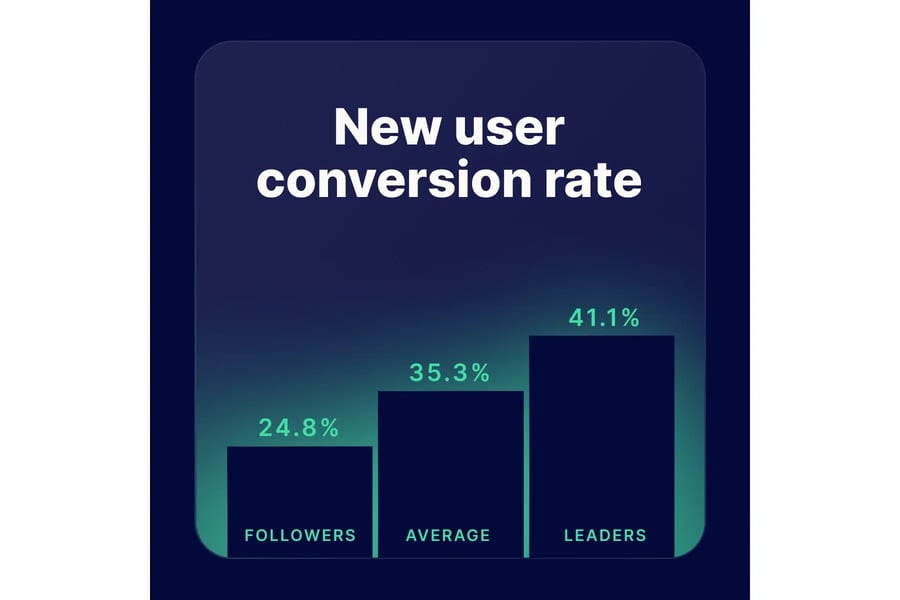
Definition**:** The percentage of newly activated accounts that subscribe to an offer, whether free or paid. It is one of the most fundamental D2C subscruption metrics for measuring product-market fit.
Benchmarks**:**
- Leaders**:** 41.1%
- **Average:** 35.3%
- **Followers:** 24.8%
Leaders convert new users at a rate 65% higher than followers. They treat the first interaction as a moment of commitment, not exploration. They align product, pricing, and messaging so users immediately understand *why subscribing now* makes sense, reducing hesitation before it starts.
### How to improve the new subscriber conversion rate:
- Communicate your value proposition clearly, highlighting exclusive benefits. This means that instead of listing features,you shold communicate outcomes. Ensure your landing page immediately highlights how you solve specific problems, making decision to subscribe feel obvious rather than risky.
- Design intuitive sign-up flows that minimize friction. Remove non-essential fields in your registration form and use progressive profiling to minimize data entry, as every extra click acts as a barrier in the subscription acquisition funnel.
- Use personalized onboarding journeys. If a user lingers on a specific content genre or feature page, trigger a data-driven nudge that highlights that specific value proposition to push them over the line.
| #### *Subscription Conversion Benchmarks FAQs* What’s a healthy new user conversion rate for D2C subscription brands? Top-performing brands convert over 40% of new users, significantly above the 25% follower benchmark. |
| --- |
## **Benchmark 2: Sub-5-minute conversion rate**
Definition**:** Percentage of users who complete subscription sign-up within the first five minutes of arriving on your platform. Speed reflects user intent, trust, and clarity of the offering.
**Benchmarks:**
- **Leaders:** 82.6%
- **Average:** 68.0%
- **Followers:** 57.3%
Leaders convert 44% more users almost immediately than followers. They understand that in the digital economy, speed is a proxy for trust. If a page loads slowly or a payment form is confusing, users subconsciously question the quality of the subscription service itself. Leaders ensure technical performance never gets in the way of their subscriber acquisition strategy.
[](https://blog.cleeng.com/hs/cta/wi/redirect?encryptedPayload=AVxigLIbhfEFmNwWA4%2FwGUH82S72EsPC0%2FXFDx6jDRMiWuS8ekrkeVCbH3tfQ6au%2B1uDji5e6y6BolHWRCKpjuBWmi8bBpVNWS6v1EC%2BaplSsKXDAPXSpcsauzPKXw8UpUpU808Cg5PsGk6vehRFphpTNdn2TBa%2BT0s6DoRQa2SQlz0Zp8is2qqG6XCdtiefqOzN392FePfPhBE0FP1L4J%2BShOHkrxlOjZOOys1NTb8LozXH&webInteractiveContentId=204823950259&portalId=5813983)
### How to improve sub-5-minute conversion rate**:**
- Optimize speed**:** prioritize technical performance. Ensure your landing pages and checkout flows load instantly on all devices, particularly mobile, where patience is lowest.
- Be direct**:** simplify your copy and design. Use a single, high-intent Call to Action that guides users along a clear path without distracting links or secondary offers.
- Re-engage instantly**:** don't wait for an email campaign to save a lost lead. Use subtle engagement nudges (like a popup offering help or clarifying a benefit) triggered by inactivity or exit intent to keep the user moving toward conversion while they are still on the site.
| #### *Subscription Conversion Benchmarks FAQs* How fast should users convert in D2C subscriptions? Top brands convert over 80% of users within five minutes, showing the power of a smooth, high-intent experience. |
| --- |
## **Benchmark 3: Trial conversion rate**
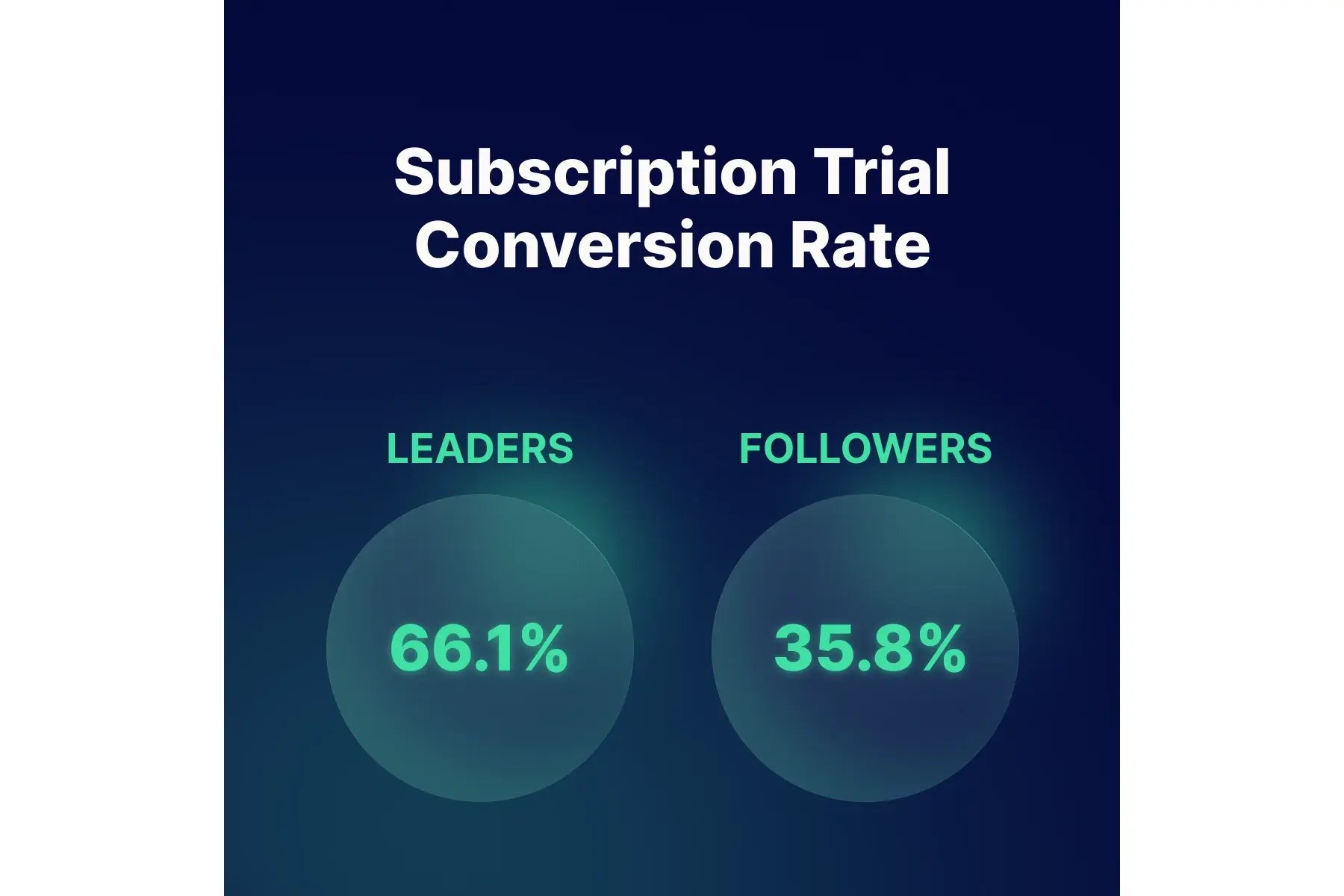
Definition**:** For brands with [free trials](https://blog.cleeng.com/boost-subscriber-conversion-rates-with-free-trials), the percentage of trial users who become paying subscribers. High rates indicate effective demonstration of value before payment.
**Benchmarks:**
- **Leaders:** 66.1%
- **Average:** 52.0%
- **Followers:** 35.8%
Top performers successfully convert two-thirds of their trial users into paying customers because they view the trial as an active sales cycle, not a passive "waiting period." They know that if a user doesn't experience the "Aha!" moment within the first few days, their trial to paid conversion rate will suffer. Leaders use the trial window to aggressively habituate the user to the platform.
### How to improve trial to paid conversion rate**:**
- Engage early**:** Don't wait until the trial is ending to talk to the user. Send tailored communications immediately after signup that encourage content consumption and platform exploration.
- Showcase value**:** proactively guide users toward your most "sticky" features. Ensure they experience the full breadth of the platform, such as creating a playlist or watching a premiere, before the payment gate activates.
- Personalize messaging**:** move beyond generic [welcome emails](https://www.warmy.io/blog/email-marketing-terms-you-need-to-learn/). Use behavioral segmentation to send messages based on what the user has watched or clicked, making recommendations that feel curated and personal.
| #### *Subscription Conversion Benchmarks FAQs* What's a good trial conversion rate for digital subscriptions? Leaders convert two-thirds of trial users into paying subscribers, while the follower average is just 36%. |
| --- |
## **Benchmark 4: Campaign conversion rate**
Definition**:** Percentage of subscriptions that renew at full price after a discount or promotion. This is a critical indicator for long-term subscription business benchmarks.
**Benchmarks:**
- **Leaders:** 60.1%
- **Average:** 41.6%
- **Followers:** 23.6%
Leaders outperform followers by **over 150%**, converting 2.5x more from discount campaigns. The difference is that Leaders sell the *product*, while Followers sell the *discount*. Leaders use promotions merely as a hook to get users in the door, but they spend the promotional period reinforcing the full-price value so that when renewal comes, the cost feels justified.
### **How to improve subscription campaign conversion rate:**
- Align messaging**:** ensure your marketing narrative is cohesive. The promise made in the ad must match the experience in the app, reinforcing value beyond just the price cut so the user builds an attachment to the content, not the coupon.
- Target deeply**: a**void "spray and pray" discounting. Use deep audience targeting to ensure offers reach users whose interests align with your content library, ensuring you acquire users with long-term potential rather than just bargain hunters.
- Be transparent**:** build trust through honesty. Ensure the user experience meets campaign promises with clear terms and transparent pricing upon renewal, eliminating the "bill shock" that causes immediate churn.
| #### *Subscription Conversion Benchmarks FAQs* How can I improve campaign conversion rates for subscriptions? Top-performing brands focus on messaging, targeting, and UX, resulting in much higher conversion post-promotion. |
| --- |
## **Benchmark 5: Average Revenue Per Trial (ARPT)**
Definition**:** Average revenue generated per new free trial, helping assess whether trials drive genuine revenue.
**Benchmarks:**
- **Leaders:** $15.40
- **Average:** $10.90
- **Followers:** $8.50
Leaders generate 81% more revenue per trial than followers because they optimize for unit economics, not just vanity metrics. They recognize that not all trials are created equal; some cohorts are destined to be high-value subscribers, while others are low-quality leads. Leaders focus their resources and upsell strategies on the users who demonstrate high intent.
### **How to improve Average Revenue Per Trial**
- Monetize smartly**:** bake monetization into the trial experience and test different trial lengths.
- Upsell timing**:** don't leave money on the table. Identify high-value trial cohorts and use strategic upsell prompts (such as offering an annual plan discount) at moments of high engagement.
- Analyze cohorts**:** Stop guessing what works. Use data to correlate specific trial behaviors (e.g., watching on a Smart TV vs. mobile) with long-term revenue patterns to refine your subscriber acquisition strategy.
| #### *Subscription Conversion Benchmarks FAQs* How much revenue should a free subscription trial generate? Leaders generate over $15 per trial on average, almost double follower performance. |
| --- |
## **Strategies for a high-converting funnel**
Benchmarking is just the first step in refining your subscriber acquisition strategy. To close gaps:
- Streamline sign-ups across web, mobile, and [CTV](https://blog.cleeng.com/connected-tv-billing-how-to-reduce-churn-stay-ahead-in-the-ctv-market).
- Ensure instant access upon payment confirmation.
- Offer [localized payment methods](https://blog.cleeng.com/local-payment-methods-for-global-subscription-growth) and frictionless checkout.
- Leverage analytics to segment trial users, track coupon performance, and identify patterns leading to higher retention and lifetime value.
All these strategies can be implemented seamlessly using **Cleeng’s suite of tools**, designed to optimize every stage of the acquisition and conversion journey, and the broader subscriber lifecycle.
## **Conclusion**
Mastering acquisition and conversion isn’t just about traffic — it’s about building a smooth, trustworthy, and valuable journey for every new user. By focusing on **key subscription conversion benchmarks** like conversion rates, campaign performance, and ARPT, you can diagnose funnel weaknesses and implement strategies that turn more visitors into paying subscribers. However, conversion is just the very first step of long-term success. [Download our Retention Playbook 2026](https://cleeng.com/resources/d2c-retention-benchmarks-2026) to discover D2C subscription metrics for the other subscriber lifecycle phases: revenue optimization, retention and loyalty, and customer experience.
Turning these insights into action requires the right infrastructure. Cleeng is designed specifically to help D2C subscription brands master every stage of the subscriber journey, from that critical first click to long-term loyalty. **Create your free account now** to explore our suite of tools and see how easily you can implement a high-converting, friction-free experience for your users.
[](https://blog.cleeng.com/hs/cta/wi/redirect?encryptedPayload=AVxigLJcXtU7UoFRCd3TepOEkxE9dC02KD3U10uMN6vibsmZnVqB3%2F3rw9gEfscCwQ4ZiRn67LKlFLAqtzQz38h%2FCKYeh4JVNFFvX5jnYlMlEq%2FvLt1%2FC%2BPsftHjSeVyhkLxxAuMrciL3RnYqI%2BipTUvDlx%2FG14WC4ZIJss5zSDhhctObVwLbbgpTM6cmunXtp1zm7rcxomq&webInteractiveContentId=204823950382&portalId=5813983)
### Popular posts
#### [How to Make Money on YouTube Without Ads – And Keep 100% of It Read more →](https://blog.cleeng.com/how-to-make-money-on-youtube-without-ads)
#### [Creator Monetization Strategies: Sustainable Growth Beyond Ad Revenue Read more →](https://blog.cleeng.com/content-creator-monetization-strategies)
#### [How to Recover Subscription Revenue: 3 Gaps Subscription Brands Ignore Read more →](https://blog.cleeng.com/how-to-recover-subscription-revenue)
#### [What Can You Do with a Free Cleeng Plan? A Complete Guide to Freemium Read more →](https://blog.cleeng.com/free-cleeng-plan)
#### [Subscription Revenue Optimization: 4 Key Benchmarks for 2026 Growth Read more →](https://blog.cleeng.com/d2c-subscription-revenue-optimization-4-key-benchmarks-for-growth)
### Get started free
Create a free account to see what your subscription data could tell you – no credit card required.
[Start free](https://srm.cleeng.com/auth/register)
### Related posts
#### [ Growth How to Make Money on YouTube Without Ads – And Keep 100% of It **Kamila Palka** · May 15, 2026, 10:36:26 AM](https://blog.cleeng.com/how-to-make-money-on-youtube-without-ads)
#### [ Growth Creator Monetization Strategies: Sustainable Growth Beyond Ad Revenue **Kamila Palka** · Apr 30, 2026, 11:34:19 AM](https://blog.cleeng.com/content-creator-monetization-strategies)
#### [ Churn & Retention How to Recover Subscription Revenue: 3 Gaps Subscription Brands Ignore **Sebastian Boruch** · Apr 23, 2026, 12:26:36 PM](https://blog.cleeng.com/how-to-recover-subscription-revenue)
Your Subscriber Retention Management® solution
[Contact us](https://cleeng.com/contact)
#### Ask AI for info
- [ChatGPT](https://chatgpt.com/?q=...)
- [Gemini](https://gemini.google.com/app?q=...)
- [Claude](https://claude.ai/new?q=...)
- [Perplexity AI](https://www.perplexity.ai/?q=...)
#### Products
- [Subscriber management and billing](https://cleeng.com/subscriber-management-system)
- [Merchant of Record](https://www.cleeng.com/products/merchant-of-record)
- [Churn Analytics](https://cleeng.com/churniq-churn-intelligence)
- [AI-Enhanced Customer Care](https://cleeng.com/pro)
#### Solutions
- [Streaming and OTT](https://www.cleeng.com/solutions/streaming)
- [Sports](https://cleeng.com/subscription-management-for-sports)
- [Wellness](https://cleeng.com/wellness)
- [Creators](https://www.cleeng.com/solutions/youtube-creators)
- [Enterprise](https://cleeng.com/solutions/enterprise)
- [Small and Medium Businesses](https://cleeng.com/pro)
#### Developer
- [API Reference](https://developers.cleeng.com/reference/apireference-overview)
- [Sandbox](https://srm-sandbox.cleeng.com/register)
- [Tutorials](https://developers.cleeng.com/docs/getting-started-with-cleeng)
- [Integrations](https://cleeng.com/integrations-connectors)
- [Migration](https://cleeng.com/integrations-connectors)
#### About
- [Company](https://cleeng.com/about-us)
- [Blog](https://blog.cleeng.com/)
- [Sustainability](https://cleeng.com/sustainability)
- [Careers](https://cleeng.com/careers)
#### Explore
- [Pricing](https://cleeng.com/pricingpro)
- [My Dashboard](https://srm.cleeng.com/login)
- [FAQ & support](https://publisher.support.cleeng.com/hc/en-us)
#### Customers
- [Who are Cleeng](https://cleeng.com/who-are-cleeng)
- [Get Support](https://cleeng.zendesk.com/hc/en-us/)
Copyright © 2026 Cleeng | All Rights Reserved | [Terms & Conditions](https://cleeng.com/master-service-agreement)
```json
{
"@context" : "https://schema.org",
"@type" : "BlogPosting",
"author" : {
"@type" : "Person",
"name" : "Kamila Palka"
},
"dateModified" : "2026-08-13T08:49:06Z",
"datePublished" : "2026-01-14T09:25:26Z",
"description" : "Discover 5 key subscription conversion benchmarks for 2026. Compare your D2C brand's trial-to-paid rates and ARPT against market leaders to boost growth.",
"headline" : "5 Benchmarks for Better Subscription Conversion",
"image" : "https://5813983.fs1.hubspotusercontent-na1.net/hubfs/5813983/2026%20key%20subscription%20benchmarks%20acquisition%20and%20subscription%20conversion%20%20benchmarks.webp",
"mainEntityOfPage" : {
"@id" : "https://blog.cleeng.com",
"@type" : "WebPage"
},
"publisher" : {
"@type" : "Organization",
"logo" : {
"@type" : "ImageObject",
"url" : "https://cdn.prod.website-files.com/624eb5c51026869311f0668a/66b09c7ffb2cada498b8a184_Cleeng%20logo%20-%20tagline%20bottom%20-%20transparent.svg"
},
"name" : "Cleeng"
}
}
```
```json
{
"@context" : "https://schema.org",
"@id" : "https://blog.cleeng.com/subscription-conversion-benchmarks#article",
"@type" : "BlogPosting",
"author" : {
"@type" : "Person",
"jobTitle" : "Content Marketing Strategist",
"name" : "Kamila Palka",
"url" : "https://www.linkedin.com/in/kamilapalka/"
},
"dateModified" : "2026-01-12",
"datePublished" : "2026-01-12",
"description" : "Discover 5 key subscription conversion benchmarks for D2C brands in 2026. Compare trial-to-paid rates, ARPT, and campaign conversions against market leaders.",
"headline" : "Subscription Conversion Benchmarks: 5 Key Stats for Better Acquisition",
"image" : {
"@type" : "ImageObject",
"height" : 630,
"url" : "https://blog.cleeng.com/hubfs/placeholder-image-url.jpg",
"width" : 1200
},
"keywords" : [ "Subscription conversion benchmarks", "D2C subscription metrics", "Trial to paid conversion rate", "Subscriber acquisition strategy", "ARPT" ],
"mainEntityOfPage" : {
"@id" : "https://blog.cleeng.com/subscription-conversion-benchmarks",
"@type" : "WebPage"
},
"name" : "Subscription Conversion Benchmarks: 5 Key Stats for Better Acquisition",
"publisher" : {
"@type" : "Organization",
"logo" : {
"@type" : "ImageObject",
"url" : "https://cdn.prod.website-files.com/624eb5c51026869311f0668a/6904971d9943fdc1bd658a45_logo%20gradient.png"
},
"name" : "Cleeng"
},
"url" : "https://blog.cleeng.com/subscription-conversion-benchmarks"
}
```
```json
{
"@context" : "https://schema.org",
"@type" : "FAQPage",
"mainEntity" : [ {
"@type" : "Question",
"acceptedAnswer" : {
"@type" : "Answer",
"text" : "Top-performing brands convert over 40% of new users, significantly above the 25% follower benchmark."
},
"name" : "What’s a healthy new user conversion rate for D2C subscription brands?"
}, {
"@type" : "Question",
"acceptedAnswer" : {
"@type" : "Answer",
"text" : "Top brands convert over 80% of users within five minutes, showing the power of a smooth, high-intent experience."
},
"name" : "How fast should users convert in D2C subscriptions?"
}, {
"@type" : "Question",
"acceptedAnswer" : {
"@type" : "Answer",
"text" : "Leaders convert two-thirds of trial users into paying subscribers, while the follower average is just 36%."
},
"name" : "What's a good trial conversion rate for digital subscriptions?"
}, {
"@type" : "Question",
"acceptedAnswer" : {
"@type" : "Answer",
"text" : "Top-performing brands focus on messaging, targeting, and UX, resulting in much higher conversion post-promotion."
},
"name" : "How can I improve campaign conversion rates for subscriptions?"
}, {
"@type" : "Question",
"acceptedAnswer" : {
"@type" : "Answer",
"text" : "Leaders generate over $15 per trial on average, almost double follower performance."
},
"name" : "How much revenue should a free subscription trial generate?"
} ]
}
```
```json
{
"@context" : "https://schema.org",
"@type" : "Blog",
"description" : "Insights and strategies on subscriber retention and D2C subscriptions from Cleeng.",
"name" : "Cleeng Blog",
"publisher" : {
"@type" : "Organization",
"logo" : {
"@type" : "ImageObject",
"url" : "https://cdn.prod.website-files.com/624eb5c51026869311f0668a/66b09c7ffb2cada498b8a184_Cleeng%20logo%20-%20tagline%20bottom%20-%20transparent.svg"
},
"name" : "Cleeng"
},
"url" : "https://blog.cleeng.com"
}
```