In the high-stakes world of subscription management, fraud is a shape-shifter. A security protocol that effectively blocks a credit card thief in New York might inadvertently block a legitimate, high-value subscriber in Dubai. Contrarily, a loose filter designed to encourage growth in emerging markets might open the floodgates to friendly fraud in mature economies.
For D2C subscription brands, digital publishers, and broadcasters, the cost of getting this wrong is high. If your fraud prevention strategy is static, you are likely bleeding revenue through two distinct wounds: chargebacks from actual fraud and lost revenue from false declines.
At Cleeng, we understand that true revenue protection requires a regional approach. Our AI Fraud Detection tool is engineered for global application, adapting its strategy to specific regional behaviors.
To illustrate its effectiveness, we analyzed data from three key markets: the United States (US), Europe (EU), and the Middle East & North Africa (MENA). The results demonstrate that effective fraud prevention is not just about blocking malicious actors – it's about optimizing revenue through regional intelligence.
Here is the data-driven breakdown of how AI adaptation can save a single merchant thousands per month in chargebacks, while solving completely different problems in each region.
See AI fraud detection tool results per region:
- United States
- Europe
- Middle East and Africa
How AI adaptation saves subscription revenue
In today's digital world, online payment fraud is a constantly evolving threat that subscription businesses must stay ahead of in order to protect themselves and their customers. By implementing robust security measures and staying informed about the latest fraud tactics, businesses can minimize risks and build trust with their users.
However, each region faces different fraud threats. This means that the all-in-one approach will not effectively address the unique challenges and vulnerabilities of each area. Tailored solutions are essential to combat fraud in a way that considers specific regional risks and requirements. Let's take a look at the key three markets we analyzed.
1. The US subscription market: Combating high-volume "friendly fraud"
The United States market is often characterized by high transaction volumes and robust consumer protection mechanisms. While this is great for buyer confidence, it creates a fertile environment for "friendly fraud". This occurs when a customer makes a legitimate purchase but later disputes the charge with their bank, claiming they never authorized it or that the service wasn't delivered.
The challenge
For US merchants, the primary revenue bleed isn't just the chargeback fees themselves, but the sheer volume of lost revenue from refunds and unnecessary disputes. Before AI was enabled, merchants were losing thousands of dollars each month to refunds alone.
In just one month, US clients on average were losing:
-
Over $28,000 from chargebacks (costs and lost revenue)
-
$38,000 from refunds (costs and lost revenue)
That's a total of $66,000 dollars lost in one month! This translates to almost $800,000 of lost revenue in a year.
The AI fraud prevention solution: 60% reduction in fraud cost
By implementing a regionally tuned AI model, Cleeng was able to distinguish between genuine customer dissatisfaction and systemic abuse.
Cleeng's AI fraud prevention tool leverages historical data from thousands of other merchants, thereby capturing the online footprint of 97% of shoppers and their behavioral patterns.
The AI fraud prevention results in the US (on average per month):
-
Chargebacks: from $28,000 to $8000 = $20,000 savings per month
-
Refunds: from $38,000 to $21,000 = $17,000 savings per month
-
Total savings: over $37,000 saved per month (56%)
-
Chargeback rate: reduced from 0.47% to 0.15% with the implementation of AI
-
Refund rate: reduced from 1% to 0.40% thanks to AI fraud prevention
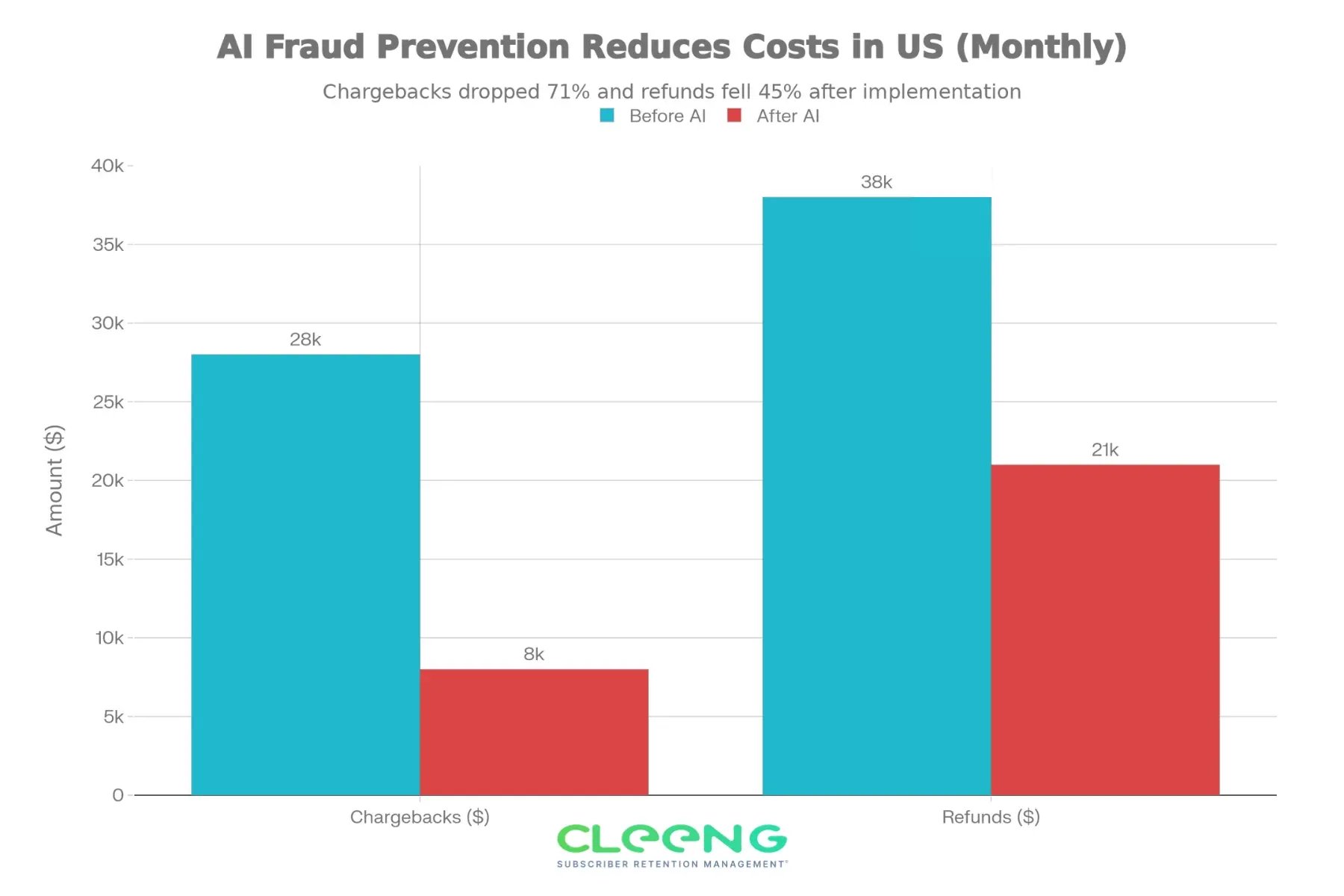
In the US, AI acted as a shield against abuse. By reducing the average monthly number of chargebacks by 66%, the tool preserved over $30,000 a month that was previously walking out the door.
This proves that in high-volume, mature markets, the goal of AI is to tighten the net without catching legitimate users.

2. The EU market: Precision efficiency in a regulated landscape
Europe presents a completely different landscape. Generally, the EU has lower fraud rates than the US, largely due to stricter regulations like PSD2 (Payment Services Directive 2) and Strong Customer Authentication, such as 3DS authentication being mandatory for online payments.
Many subscription service providers operate under the misconception that AI isn't necessary in such a "safe" market. However, the data proves otherwise. Even in a secure environment, there is significant room for optimization.
The challenge
The challenge in the EU isn't necessarily stopping a flood of fraud; it's about efficiency and reducing the cost of the fraud that does exist, all while navigating complex authentication layers.
When not using the AI fraud detection tool, our European merchants, on average, see the following:
- Chargeback rate of 0.24%
- Refund rate of 0.41%
The AI solution cuts chargeback and refund by more than 50%
Cleeng's AI model adapted to the regulatory environment, focusing on precision. It worked in tandem with 3D Secure protocols to authenticate low-risk transactions faster while flagging high-risk anomalies.
The AI fraud prevention results in the EU:
-
Total savings per month: European merchants, on average, save $13,000 thanks to the AI fraud prevention tool
-
Average chargeback rate went down from 0.24% to 0.07% (71% improvement)
-
Average refund rate dropped from 0.41% to 0.09% (78% improvement)
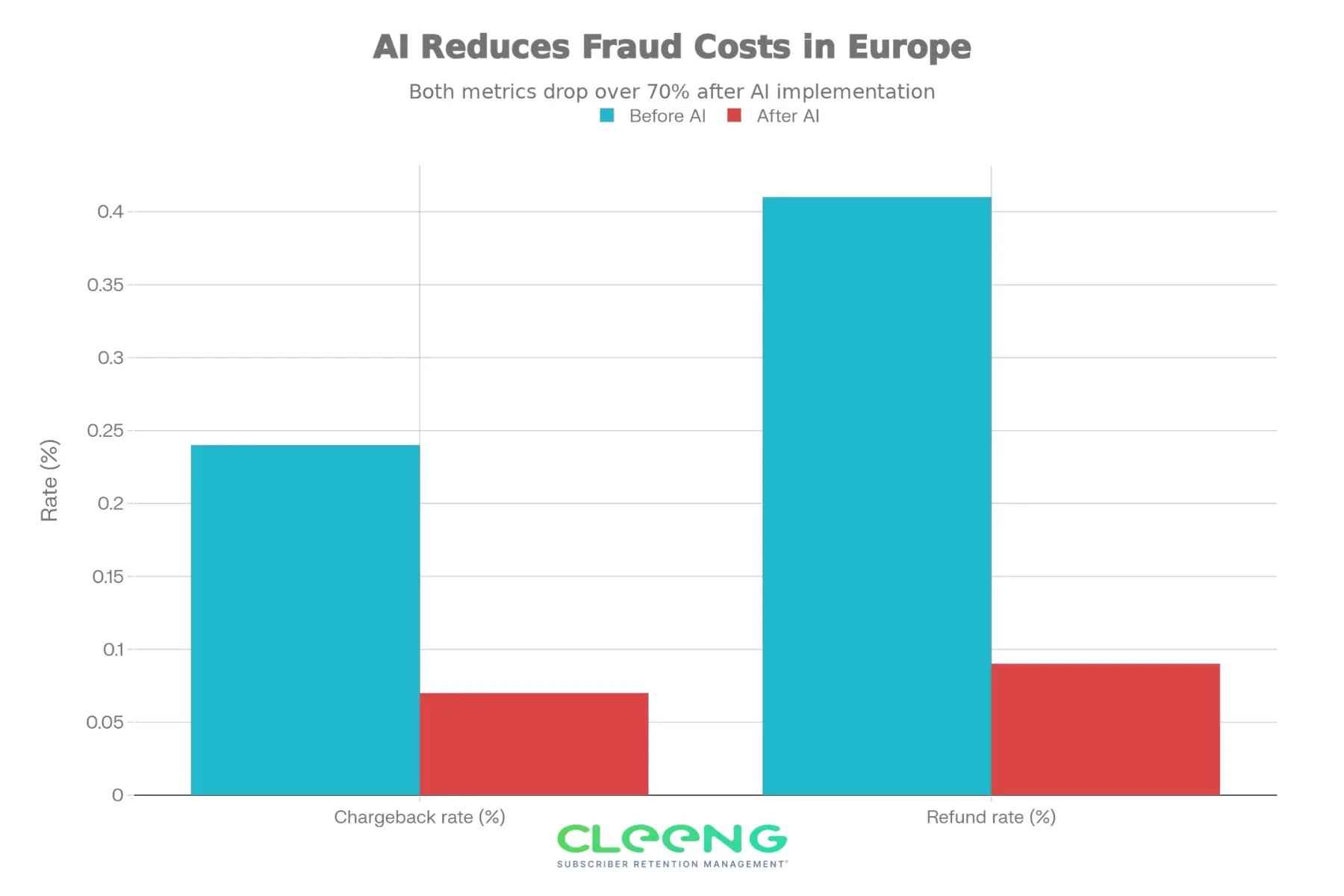
While the raw euro savings per month (13,000) might seem lower than in the US, the percentage improvement in the EU was the highest among all regions. The AI reduced the total monthly refund rate by a staggering 78%.
Crucially, this protection did not come at the cost of the user experience. The Initial Success Rate actually improved by +3%. This demonstrates that in regulated markets, AI does more than block fraud; it significantly reduces false positives, helping legitimate transactions navigate complex authentication layers more smoothly.
3. The MENA region: the revenue rescue and authorization uplift
The Middle East and North Africa (MENA) region often presents a high-friction payment environment for international merchants. Legacy fraud filters, trained on Western data sets, often flag legitimate transactions in MENA as risky due to different banking infrastructures or consumer behaviors.
The challenge: false declines in MENA
In MENA, the primary enemy is not the fraudster – it's the false decline. Aggressive, "one-size-fits-all" security settings often reject valid customers, leading to abysmal authorization rates.
The AI solution reduces the chargeback rate by 73%
In MENA, Cleeng’s AI fraud prevention tool delivers the most impressive results – not just by saving money, but by making money. The model learned the specific nuances of MENA payment data, recognizing that what looks "risky" to a US-centric model is actually normal behavior in Cairo or Dubai.
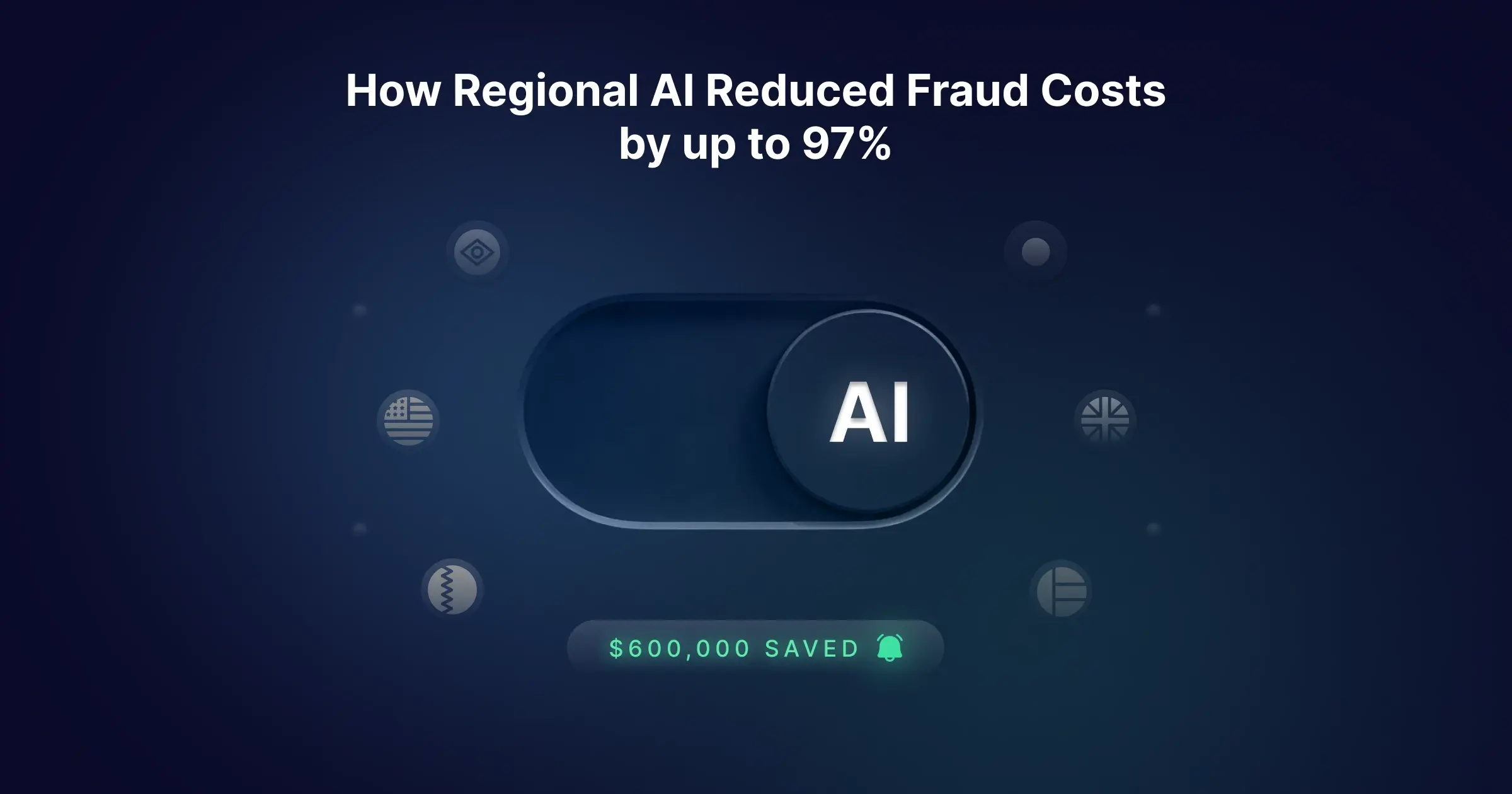
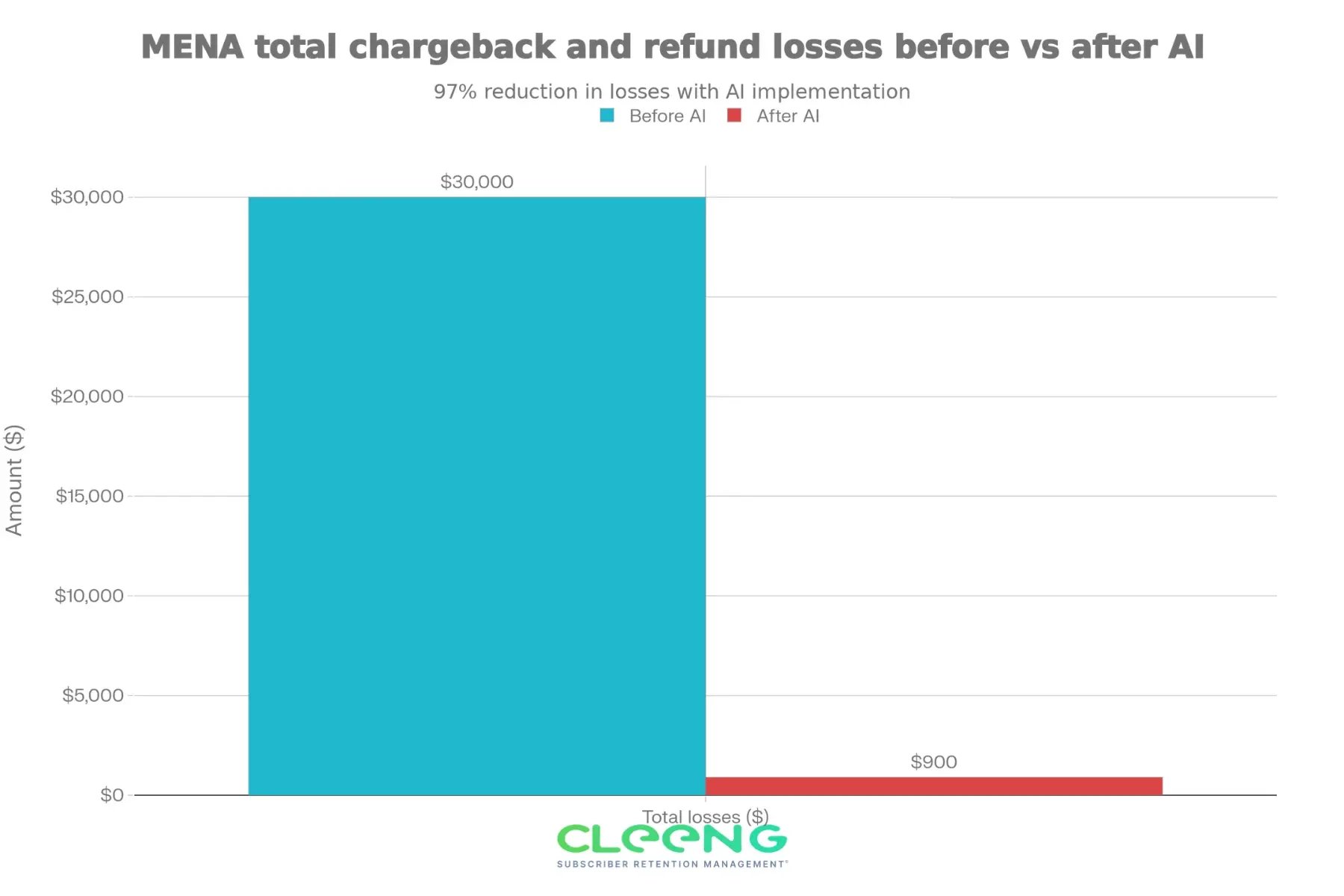
A certain MENA client successfully reduced losses from chargebacks and refunds, dropping from $30,000 to just $900!
The AI fraud prevention results in MENA:
-
Total monthly savings: 97% reduction in revenue lost to chargebacks and refunds
-
Average chargeback rate decreased by 73%
-
Average refund rate decreased by 50%
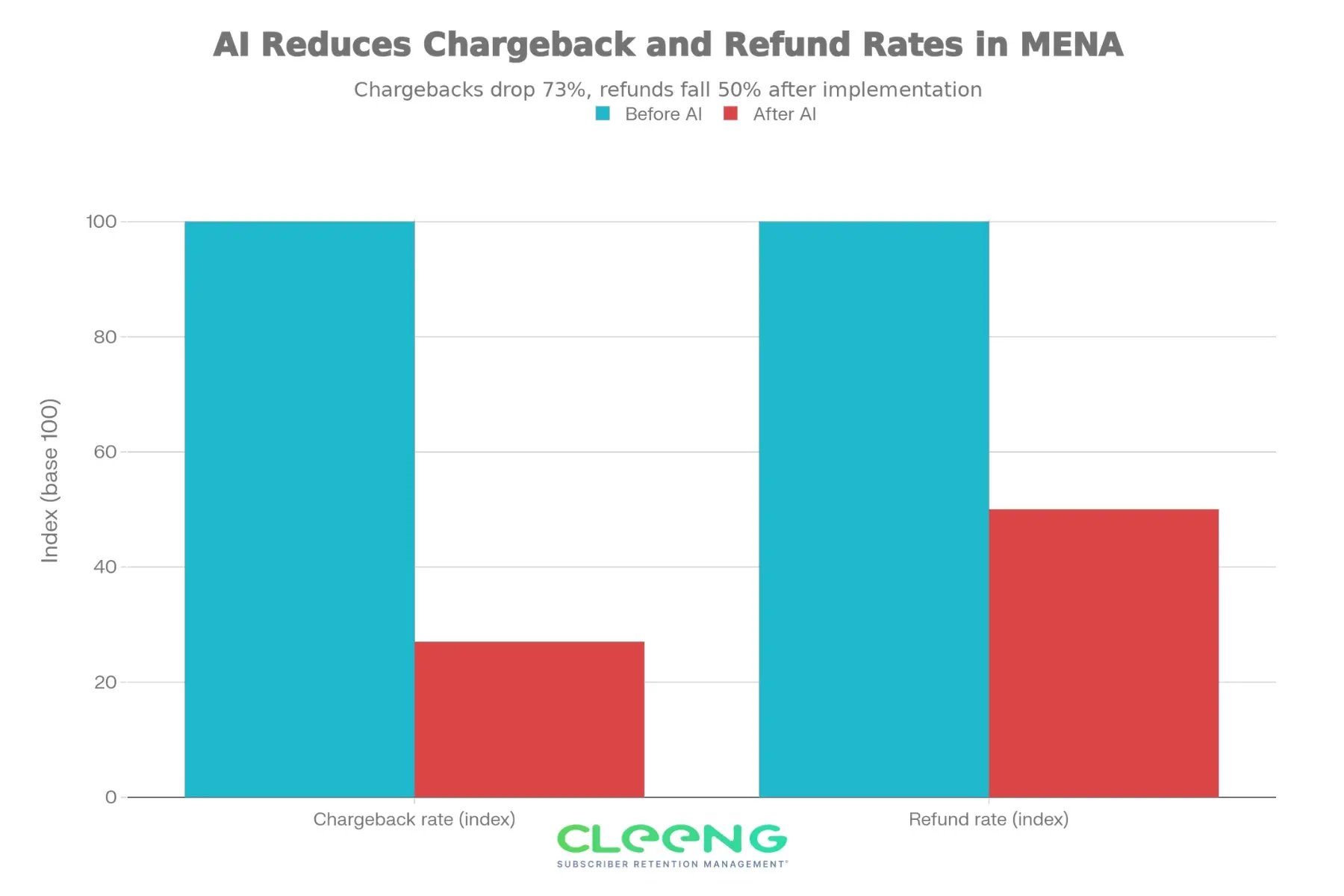
In MENA, the "fraud" tool effectively acted as a "revenue optimization" tool. It correctly identified that many transactions previously flagged as suspicious were actually valid. By reducing false positives, the merchant didn't just save on chargebacks – they unlocked a massive chunk of revenue that was previously being blocked by over-aggressive legacy filters.
The aggregate impact of adaptive AI
When we look at these three regions side-by-side, the value of adaptive AI becomes undeniable. It adjusts its behavior to the specific threat landscape of the region:
-
US (Cost reduction): Saved $30k/month by curbing abuse and friendly fraud.
-
EU (Efficiency): Achieved an 64% reduction in refund rates.
-
MENA (Revenue growth): Delivered a 97% improvement in revenue lost to chargebacks and refunds
Why this matters for your digital subscription business
Fraud isn't a static number – it's a regional behavior. If you treat your MENA customers like US customers, you will block good payments and stunt your growth in emerging markets. If you treat US customers like EU customers, you will bleed money on chargebacks and refund abuse.
Cleeng’s AI Fraud Detection doesn't just "block bad guys." It understands the context of the transaction, protecting your bottom line in the West while opening doors for revenue in the East.
To maximize your recurring revenue, you need a system that learns as it protects. For example, when a new fraud type sparks at similar merchants, the AI fraud prevention tools is able react immediately.
Are you ready to stop guessing which half of your transactions are hurting you? It is time to implement a strategy that protects your business without turning away legitimate subscribers.
Sign up for a free Cleeng account and discover how to safeguard your revenue against fraud effectively.