A seasonal subscription is a billing model built around a sport's actual calendar: fans sign up when the season starts, get billed on a schedule that matches the season, and auto-renew when the next one kicks off – instead of buying a season pass that expires and forces a full re-acquisition campaign every year. For sports streaming platforms, this single change is one of the most effective levers against off-season churn.
Key takeaways
- Sports streaming subscriptions churn at a structurally higher rate than general entertainment.
- Traditional season passes create a built-in 100% churn event: every subscriber has to be re-sold from scratch next season, and platforms typically win back only about half of them.
- Seasonal subscriptions fix this by auto-renewing at season start, so retention becomes the default instead of an annual re-acquisition project.
- Dynamic pricing layered on top lets platforms discount early, then step prices back up as the season progresses, without running manual promo campaigns.
- Platforms already using this model no longer require fans to re-register each season.
What is a seasonal subscription model?
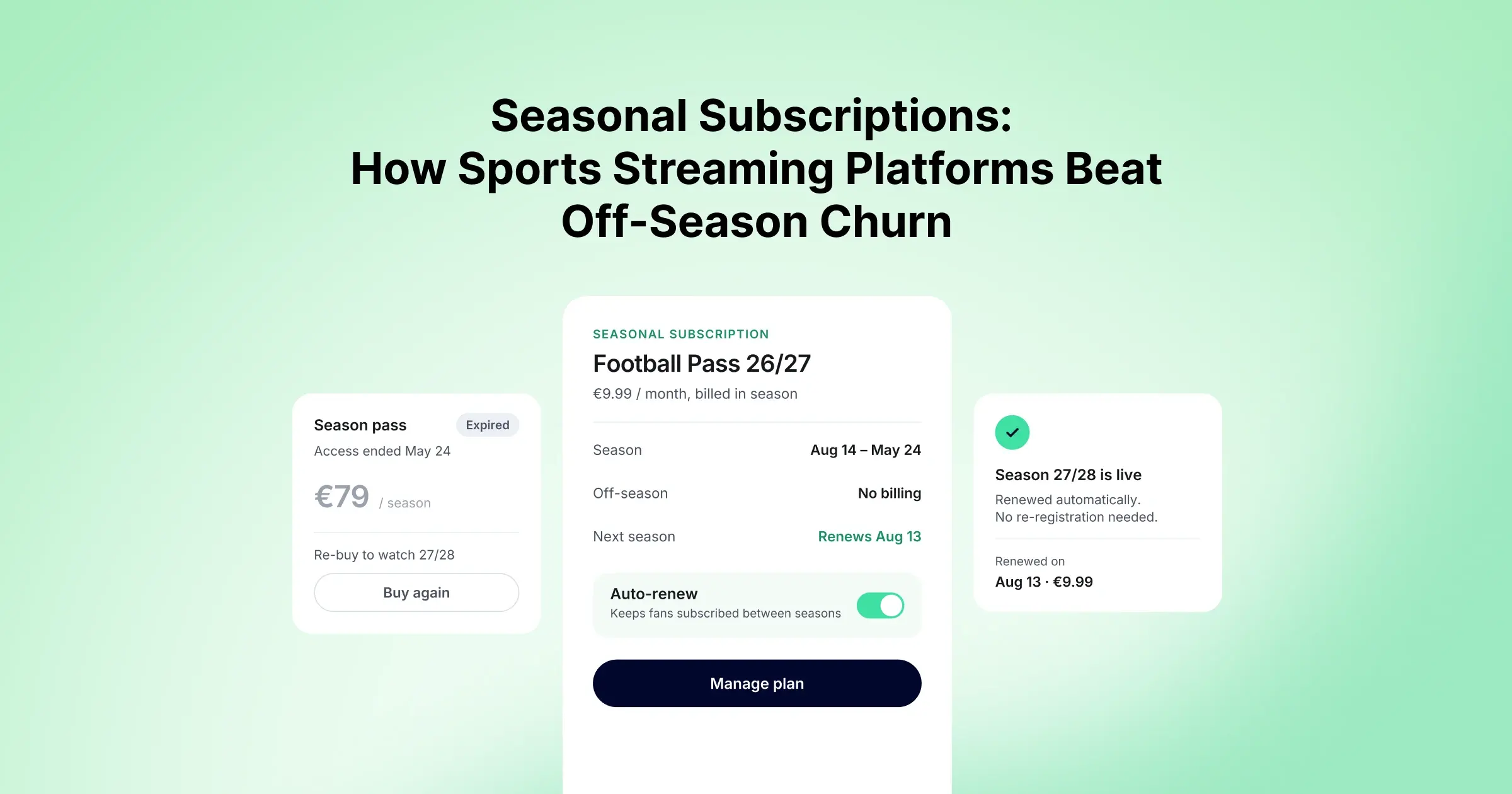
A seasonal subscription model bills and renews customers on a cycle tied to the actual season of the sport, rather than a generic monthly or annual cycle. The platform defines the season's start and end dates, aligns billing to that window, and automatically renews the subscription – at the same or an adjusted price – when the next season begins. The subscriber never has to actively re-buy access; they simply keep paying unless they choose to cancel.
This matters because sports content isn't consumed evenly across the year. Demand spikes when a league is in play and drops sharply in the off-season, and a subscription model that ignores that rhythm will bleed subscribers every time the content does.
Why sports streaming has a harder churn problem than other content
Off-season cancellation is a major retention issue in sports streaming. CivicScience’s 2026 research shows that a majority of Gen Z sports streaming subscribers typically cancel their sports-specific subscription once their preferred season ends.
This behavior sits within a broader streaming-retention problem. Antenna estimates that approximately 29.5 million premium-SVOD subscribers – 23% of subscribers in that category – were serial churners, defined as people who cancelled three or more premium-SVOD services within two years. Sports content is one of the clearest examples of this behavior: the content itself has an on/off switch, so the subscription follows it.
The problem with traditional season passes
Most sports broadcasters have historically monetized seasonal content with one of three models: season passes that expire at the end of the season, standard annual subscriptions, or short-term event passes. Each has a structural weakness for content this seasonal:
- Season passes give access for the season and then expire. This creates a 100% churn event every single year, since every subscriber has to be re-acquired from zero for the next season.
- Annual subscriptions ask fans to pay for months of dead air when there's no live content to watch, which suppresses sign-ups from price-sensitive fans in the first place.
- Event passes capture one-off demand but do nothing to build recurring revenue or retention across a season.
The re-acquisition cost compounds the problem. Platforms relying on season passes typically only win back around half of the previous season's subscribers, even after running dedicated marketing campaigns to bring them back. This means that half of every season's revenue base has to be rebuilt, every year, from marketing spend rather than retention.
How seasonal subscriptions work for sports streaming
A seasonal subscription model removes the expiration-and-repurchase cycle entirely. In practice, this means:
- Defining season timelines. The broadcaster sets the actual start and end dates of the season the subscription covers, rather than a generic 12-month term.
- Aligning billing and renewal to those dates. Subscribers are charged in a rhythm that matches the season, not an arbitrary calendar month.
- Auto-renewing into the next season. When the new season starts, the subscription renews automatically at full price, with no re-registration step for the fan.
- Applying dynamic pricing across the season. Prices can start lower to drive acquisition and rise as the season progresses, without requiring a new promo campaign each time.
The result is that retention becomes the default outcome instead of something the platform has to actively re-win every year.
Seasonal subscriptions vs. season passes vs. annual plans for sports streaming
|
Season pass |
Annual subscription |
Seasonal subscription |
|
|
Billing aligned to season |
Yes, but expires at season end |
No |
Yes, and auto-renews |
|
Requires re-acquisition each season |
Yes, 100% churn event |
No, but risks cancellation during dead months |
No, renews automatically |
|
Fan pays for off-season dead time |
No |
Yes |
No |
|
Supports mid-season discounting |
Rarely |
Rarely |
Yes, via dynamic pricing |
|
Typical off-season retention |
~0% (pass expires) |
Erodes steadily |
Retained by default unless canceled |
Dynamic pricing: acquiring fans all season long
Dynamic pricing works by decoupling price from a single fixed launch point: instead of setting one price for the whole season, the platform can change the price at any moment – lower to open the season, higher once demand peaks – and every subscriber still renews automatically into the next season at whatever the standard price is by then. Seasonal subscriptions also change how platforms can price and promote access throughout a season, not just at launch. Instead of a single price point and a one-time acquisition push, platforms can:
- Launch a live promotional price in minutes, without a development cycle
- Progressively lower prices as the season goes on to capture fans who join late
- Auto-renew late joiners at the full price once the following season begins
- Run as many concurrent offers as needed without choosing between a low-priced entry point and high lifetime value
Cleeng: the seasonal subscription model built for sports streaming
The scale of demand around major tournaments makes the retention problem obvious. beIN SPORTS reported that its coverage of the 2026 FIFA World Cup drew a cumulative audience of more than 2.1 billion viewers across matches involving Arab teams alone, with Egypt's Round of 16 match against Argentina alone reaching 192.6 million viewers – a scale of demand spike that beIN's premium OTT service, TOD, is built to convert into subscribers. Capturing that kind of tournament-driven surge is one thing; keeping those subscribers once the tournament ends is the harder, and more valuable, problem.
That's the exact gap Cleeng's Seasonal Subscriptions feature was built to close.
Cleeng lets sports platforms define season timelines, align billing and renewal to those dates, and auto-renew subscribers into the next season without a re-registration step – the mechanics described above, available as a native feature rather than something a platform has to engineer itself.
Cleeng pairs this with dynamic pricing, live promo creation, and churn analytics, so platforms can see season-to-season retention specifically – not just monthly churn – and adjust pricing or timing before the next season starts. For platforms weighing whether to build this logic in-house or adopt it, the build cost of season-aware billing, auto-renewal, and dynamic pricing is the same reason multi-sport platforms already show stronger off-season retention: the infrastructure exists before the off-season starts, not after subscribers have already churned.
How to implement a seasonal subscription model
- Map your content calendar to real season dates: not calendar quarters, the actual start and end of play.
- Align billing cycles to those dates so subscribers are charged in a rhythm that matches when they're actually getting value.
- Turn on auto-renewal by default so the subscriber's path of least resistance is staying subscribed, not re-buying.
- Layer in dynamic pricing to capture late-season sign-ups without running a new campaign for every price change.
- Track season-to-season retention specifically since that's the metric a seasonal model is designed to move.
Build a seasonal subscription model without starting from scratch
Cleeng's Seasonal Subscriptions feature handles the season-date logic, auto-renewal, and dynamic pricing described above natively, so sports platforms don't have to build this billing logic themselves. See how it works in a live demo or talk to our team about mapping it to your season calendar. You can also create a free account to see how easy it is to set up offers and view churn analytics in the Cleeng dashboard.

FAQ
What is the difference between a season pass and a seasonal subscription? A season pass grants access for one season and then expires, requiring the subscriber to re-purchase for the next season. A seasonal subscription bills on the same seasonal cycle but auto-renews when the next season begins, so the subscriber doesn't have to take any action to stay.
Why do sports streaming subscribers churn more than other streaming subscribers? Sports content is tied to a fixed season, so demand — and willingness to pay — naturally drops to near zero once the season ends. Over half of sports-only subscribers report canceling once their season is over, compared to more gradual, content-driven churn in general entertainment.
Does a seasonal subscription model mean lower revenue during the off-season? Not necessarily. Because the subscription auto-renews at the start of the next season rather than expiring, platforms avoid the marketing spend needed to re-acquire the same subscribers, which typically offsets any off-season pause in billing.
Can dynamic pricing be used with seasonal subscriptions? Yes. Platforms can launch promotional pricing at any point in the season, progressively adjust prices as the season goes on, and still auto-renew subscribers at full price once the next season starts.
Which sports platforms already use a seasonal subscription model? Multi-sport platforms like ESPN+ and Tennis TV report stronger off-season retention than single-sport services. At least one major NFL streaming partner has adopted a seasonal subscription model to align billing with the football season and eliminate season-to-season re-registration.