AI customer support is quickly becoming the default answer to customer support challenges. For many companies operating digital subscriptions — including streaming services, digital publishers, membership sites, and content creators — the promise of AI is undeniably attractive: instant resolutions, 24/7 availability, and the ability to scale global operations without an exponential increase in headcount.
But one reality is often overlooked: AI alone cannot fix a broken customer support strategy. Automation delivers real value only when it operates within a structured ecosystem that connects subscriber data, workflows, and human expertise. For digital subscription businesses, customer support is a primary driver of retention, subscriber satisfaction, and long-term revenue.
Leading subscription brands maintain a support contact rate as low as 0.24%, compared to the industry average of 0.8%, proving that well-designed support systems reduce both operational cost and churn risk.

In this context, AI is a powerful force multiplier – but only when it functions as part of a structured subscriber experience system.
Why AI customer support matters for digital subscriptions
Across the digital subscription economy — from streaming platforms to membership communities — support requests tend to follow predictable patterns. Subscribers frequently contact support for high-volume, low-complexity issues such as:
-
Security: Password resets and locked accounts
-
Access: Login failures across multiple devices.
-
Account changes: Plan upgrades, downgrades, and cancellations
-
Billing: Payment method updates and invoice queries.
Because these requests are repetitive, they are ideal candidates for AI automation, but only if the system behind the bot knows how to navigate the user’s specific subscription lifecycle. Without structure, AI customer support simply scales confusion faster.
AI customer support is only as good as the system behind it: the importance of subscriber infrastructure
AI systems are only as intelligent as the information they can access.
Most AI customer support tools pull responses from help center articles, knowledge bases, and historical support interactions. If those sources are outdated, incomplete, or inconsistent, the AI will produce unreliable answers.
This is where a simple principle applies: Garbage in, garbage out.
But in the subscription world, the “garbage” is often siloed data. If an AI agent isn’t connected to your billing engine or entitlement server, it is essentially flying blind. AI can deliver answers faster than any human team, but it might explain your refund policy perfectly while failing to see that the customer has been double-charged.
This is why successful digital subscription companies combine AI customer support with operational governance and human oversight. Automation handles repetitive tasks at scale, while humans ensure accuracy, empathy, and continuous improvement.
The AI customer support safety net: AI and human collaboration
The most effective implementations of AI customer support follow what can be described as a “Safety Net” model.
AI acts as the first layer of support, collecting information, guiding users through basic troubleshooting, and resolving simple requests. When the issue requires deeper understanding, empathy, or policy decisions, the conversation is seamlessly escalated to a human agent. For example, imagine a subscriber contacting support with the following message: "I'm being charged twice. This is the third time this has happened and I want a refund."
A well-designed AI customer support system can instantly analyze the request using sentiment detection and intent classification.
The AI identifies two key signals:
- Frustration detected through sentiment analysis
- Billing dispute complexity
Instead of attempting to resolve the issue automatically, the system routes the conversation directly to a human agent.
When the agent receives the conversation, they already have:
- The full chat transcript
- The user's subscription history
- Payment and billing records
- Device and access information
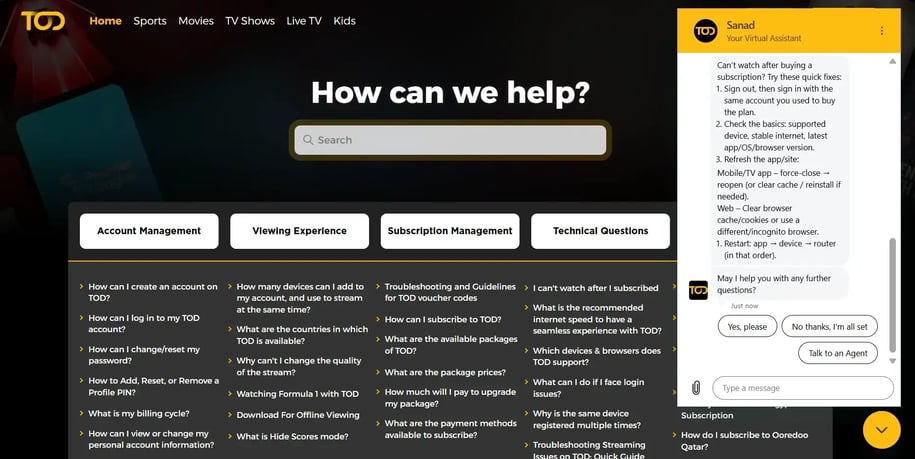
Screenshot of a branded help center and an AI-powered chatbot with the option of connecting to a live agent.
This context allows the human agent to focus on rebuilding trust rather than asking, “What seems to be the problem?”
Why Cleeng’s approach to AI customer support is different
Cleeng’s Hi5 solution is designed as a complete customer support environment specifically for the subscription lifecycle. Unlike generic bots, Hi5 operates within the Subscriber Retention Management (SRM®) suite.
Because many support requests are closely tied to account status, subscription plans, payment attempts, or access rights, having visibility into the broader SRM® environment is a game-changer. Support teams can see the exact reason for a payment failure or an access block in real-time, which allows them to resolve issues with fewer back-and-forth interactions.
This connection helps support teams respond more efficiently while also giving businesses clearer insight into recurring support issues that may affect the subscriber experience.
Within this structure, AI customer support acts as one layer of the overall support system, helping resolve simple questions quickly while guiding more complex cases to human agents.
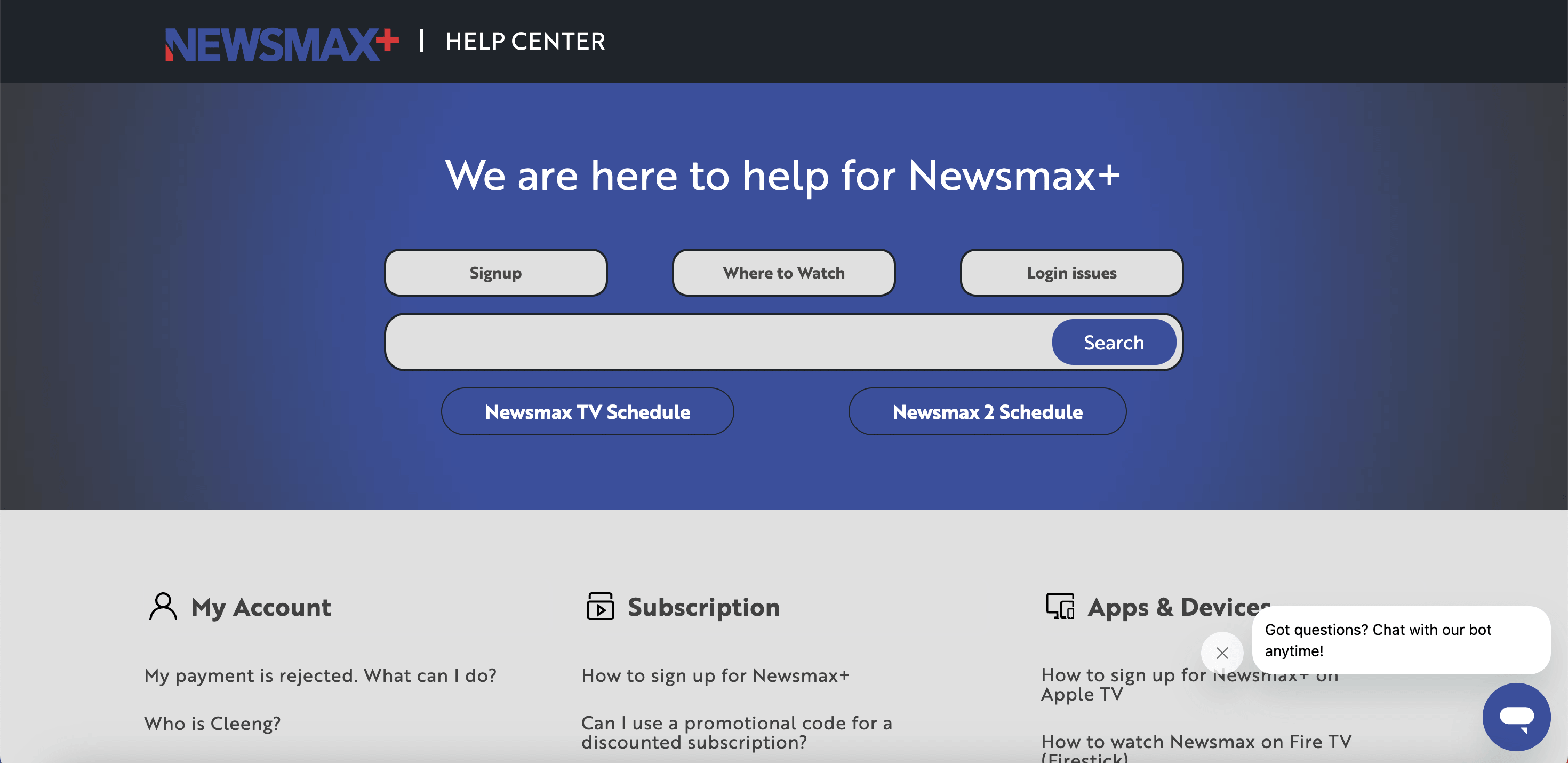
Preview of a help center powered by Cleeng, with an AI-chatbot option
Conclusion
The future of AI customer support is not about replacing support teams, but rather about building structured systems where automation and human expertise work together.
For digital subscription businesses, the real advantage comes from combining AI automation, structured workflows, and human expertise. When these elements operate together, support becomes more than a reactive service. It becomes a strategic driver of retention, satisfaction, and sustainable growth.
Are you ready to streamline your customer support operations with AI? Create your free account right now!

.png)
.png)