A subscriber clicks Cancel. In the next few seconds, they'll tell you something no dashboard ever will: their subscription cancellation reason.
Many D2C subscription brands waste that moment. Their cancellation survey offers a handful of generic options, and most people click "Other". The responses land in a report nobody acts on. If the options don't reflect your content, your pricing, or your audience, the data can't tell you what to fix.
Drawing on recent research from Deloitte, Parks Associates, CTAM, Hub Entertainment Research and Loop, we've compiled the subscription cancellation reasons and benchmarks every streaming and D2C subscription brand should know. We'll also show how custom cancellation reasons in Cleeng's Hosted Customer Flows let you ask the question in your own words, in every language your subscribers speak.
Key takeaways
- Price is the top subscription cancellation reason. 30% of US consumers name cutting household expenses as their main reason to cancel a streaming service (Parks Associates).
- Content drives churn in waves. Nearly 1 in 4 subscribers cancel as soon as they finish the show they signed up for (Parks Associates).
- User experience alone causes cancellations. 36% of viewers have cancelled a streaming service for UX reasons only (CTAM and Hub Entertainment Research, 2026).
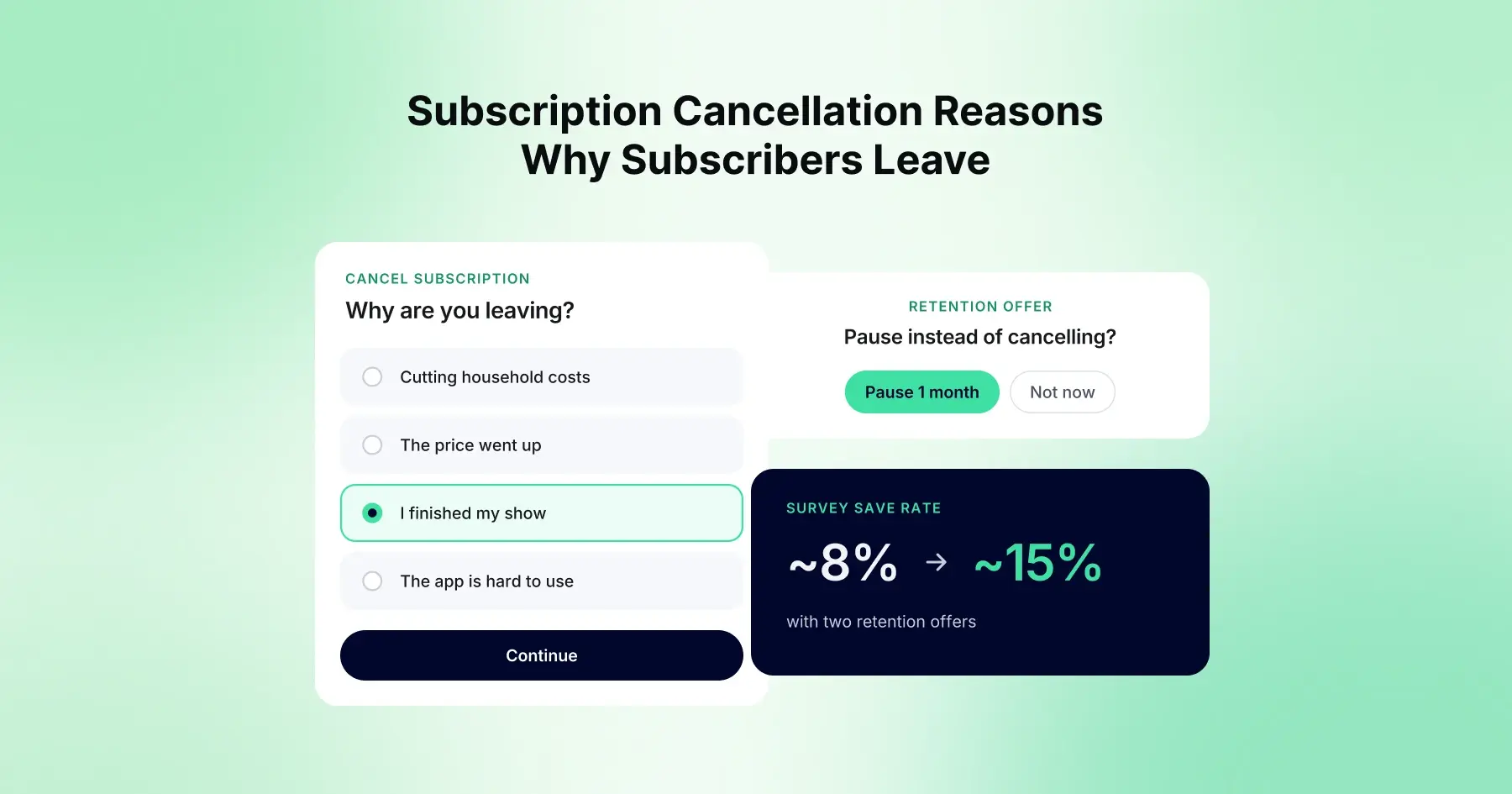
- The reason step saves subscribers. A well-designed cancellation survey saves about 8% of cancellations at the reason step (Loop, 2026).
- Generic reasons lists produce "Other". Custom, translated reasons produce data you can act on.
Why most cancellation surveys don't explain churn
Most cancellation surveys fail because their reasons are too generic to act on. Nearly every subscription brand runs some form of exit survey, but only a few get answers they can use. Four problems quietly undermine the data:
- Generic reasons. A default list can't reflect your catalog, your sports season, or your pricing model, so subscribers pick the closest match or skip to "Other".
- Reasons that don't lead to action. If "Too expensive" can't be separated from "I'm paying for too many services", you can't tell whether to test a cheaper plan, a pause option, or a bundle.
- One language for every market. A reasons list in English shown to a Spanish- or Portuguese-speaking audience lowers both completion and accuracy.
- Data that stays in the flow. Subscription cancellation reasons that never reach your analytics can't be segmented, compared over time, or used to trigger win-back campaigns.
Fixing this starts with knowing what subscribers are most likely to tell you. Here's what the research says.
1. Price: Is it still the top reason subscribers cancel in 2026?
Yes, price is the most common subscription cancellation reason in streaming. According to Parks Associates (2026), 30% of US consumers now name cutting household expenses as their top reason for cancelling a streaming service, up from 26% in 2020. Affordability has overtaken content availability as the leading driver of churn.
Price sensitivity is just as sharp at the margin. Deloitte's Digital Media Monitor (2026) finds that 61% of consumers would likely cancel their favorite streaming service if the monthly price rose by $5, and almost 75% are frustrated that their services keep raising prices.
How to capture price-related cancellation reasons
- Split "too expensive" into specific reasons. "The price went up", "I'm cutting back on subscriptions" and "I don't use it enough for the cost" each call for a different response.
- Match each reason with the right offer. A lower-cost or ad-supported plan, a pause, or an annual discount will land with one group and miss another.
- Track reasons after every price change. A spike in price-related cancellations right after an increase is the clearest signal you'll get.
2. Content: how many subscribers cancel after finishing a show?
Nearly one in four subscribers cancels after finishing a show. Parks Associates' quarterly surveys of 8,000 US internet households show that close to a quarter of subscribers cancel a service as soon as they finish the specific show they signed up for.
Many of them come back. Deloitte's 2025 Digital Media Trends research found that 24% of consumers cancelled and then resubscribed to the same service within six months. These subscribers aren't unhappy. They're done for now, and they need a different response than someone who's leaving for good.
How to capture content-related subscription cancellation reasons
- Name your content. "I finished the series I subscribed for", "The season is over" or "The content I want is missing" tell you far more than "Not enough content".
- Use the reason to time your win-back. Subscribers who left after a series finale are the audience for your next season launch.
- Share the data with your content team. Missing-content reasons are a direct signal of what your audience wants next.
3. User experience: how often does it cause cancellations?
Poor user experience causes cancellations more often than most brands assume. A July 2026 study by CTAM and Hub Entertainment Research found that 36% of viewers have cancelled a streaming subscription with user experience as the sole reason. Among viewers under 25, that rises to 43%.
The friction is widespread: 80% of viewers experience at least one problem "all the time". Yet many default reasons lists fold all of it into a single "Technical issues" option.
How to capture experience-related cancellation reasons in digital subscriptions
- Separate the types of friction. Playback quality, app navigation, login and payment problems each belong to a different team.
- Route reasons to the people who can fix them. Experience-related cancellations are product feedback, not just churn data.
- Compare reasons by device. A cluster on one platform often points to a specific app issue.
4. Other cancellation reasons to include in your survey
Price, content, and experience cover most voluntary churn, but a complete cancellation survey also accounts for these reasons:
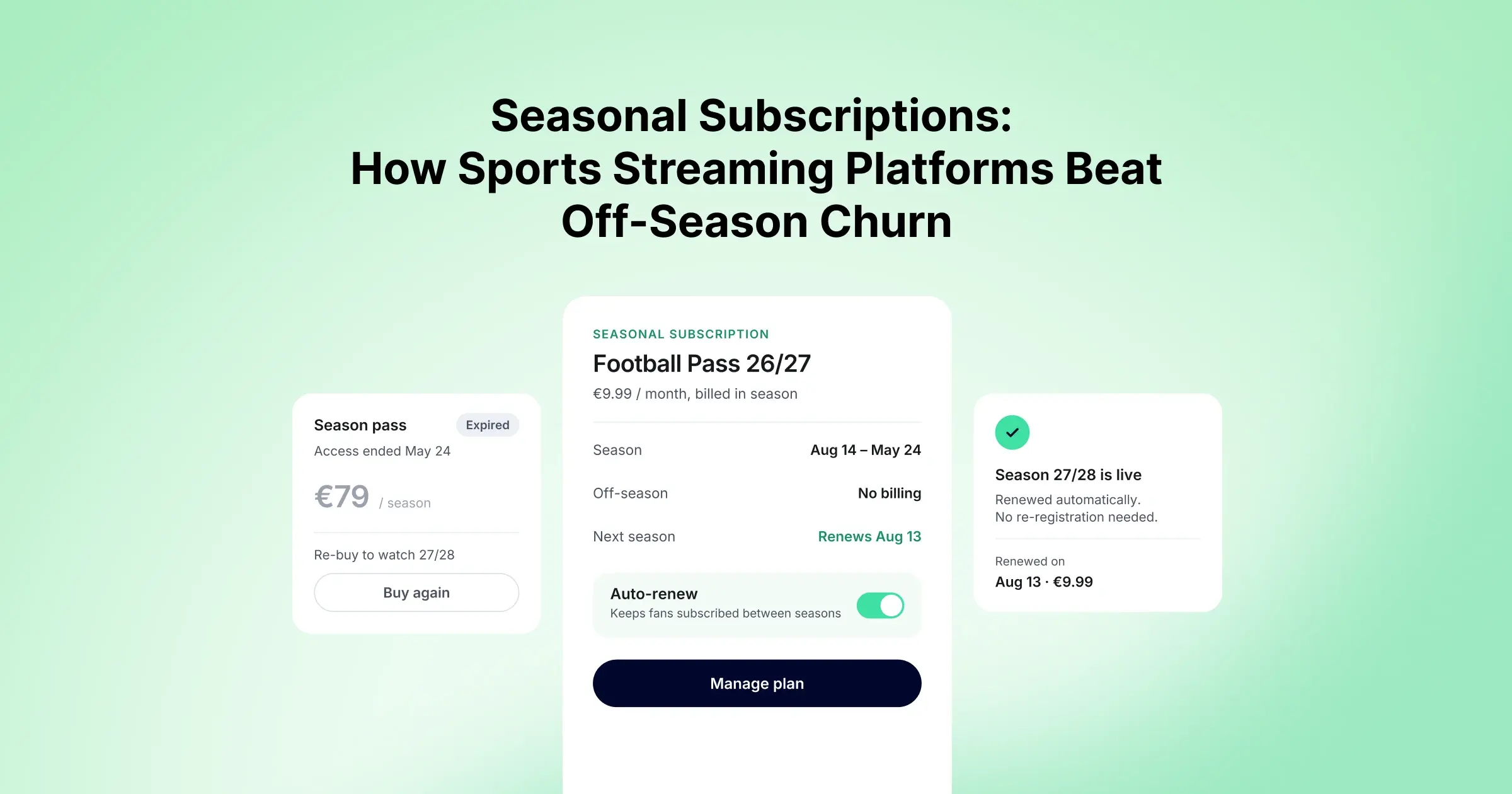
- Seasonal viewing. Sports fans often cancel when the season or tournament ends. "The season is over" separates them from subscribers who are unhappy with the service. Learn more about seasonal subscriptions.
- Temporary need. Some subscribers sign up for one event, trip, or free trial and always planned to leave. They are prime candidates for a pause offer.
- Switching to a competitor. "I prefer watching on another app" tells you where subscribers go, and which features or titles you are losing them over.
- Too many subscriptions. Subscription fatigue is different from price sensitivity. These subscribers may stay for a bundle or a lower tier.
- Failed payments. Involuntary churn never shows up in a cancellation survey, because the subscriber never clicks Cancel. Track it separately and recover it with payment retries and dunning, so it doesn't distort your voluntary churn data.
5. Save rate: how many cancellations can a reason survey save?
A well-designed reason survey saves about 8% of cancellations on its own. In its 2026 analysis of subscription cancellation flows, Loop reports an average save rate of about 8% at the reason survey stage alone. Flows offering two retention offers reached about 14.7%, and one brand running 11 tailored reasons hit a 22% overall save rate.
Loop's data comes from Shopify product subscriptions rather than streaming, but the principle carries over: specific reasons, each matched with a relevant response, save more subscribers than a generic list.
How to turn subscription cancellation reasons into saves
- Keep the list short. A focused set of reasons is faster to answer and easier to act on.
- Order reasons by frequency. Put the reasons your subscribers choose most at the top.
- Give every reason a next step. Each answer should map to an offer, a fix or a follow-up, never a dead end.
How does your churn compare? See save rates, churn and win-back benchmarks across the full subscriber lifecycle in our 2027 Subscription Benchmarks eBook.
Subscription cancellation benchmarks at a glance
The table summarizes each cancellation driver, its benchmark, and a custom reason that captures it.
|
Cancellation driver |
Benchmark |
Source |
Example custom reason |
|---|---|---|---|
|
Cost-cutting |
30% name it their top reason to cancel |
Parks Associates |
"I'm cutting back on subscriptions" |
|
Price increases |
61% would cancel over a $5 increase |
Deloitte |
"The price went up" |
|
Finished content |
Nearly 1 in 4 cancel after finishing a show |
Parks Associates |
"I finished the series I subscribed for" |
|
Resubscribers |
24% cancel and return within six months |
Deloitte, 2025 |
"I'll be back for the next season" |
|
User experience |
36% cancelled due to UX alone (43% under 25) |
CTAM and Hub, 2026 |
"The app is hard to use on my TV" |
|
Reason survey saves |
≈8% average save rate at the reason step |
Loop, 2026 |
One matched offer per reason |
How to write custom cancellation reasons in Cleeng Hosted Customer Flows
The reasons you ask about shape the data you get back. That's why Cleeng Hosted Customer Flows now let you replace the default cancellation reasons with your own, without writing a line of code.
- Turn it on in minutes. In the Cleeng dashboard, go to Hosted Customer Flows and switch on "Show cancellation survey" and "Enable custom cancellation reasons". Your reasons replace the default list in production within a few minutes.
- Write reasons in your own words. Add between 2 and 10 reasons that reflect your content, pricing and audience, from "The season is over" to "I prefer watching on another app".
- Put the most common reasons first. Reorder the list so the answers subscribers choose most often sit at the top.
- Speak every subscriber's language. Add translations for each language your flows support. Any reason without a translation falls back to English, so no subscriber sees an empty list.
- Compare reasons across markets. Whatever language a subscriber sees, the selected reason is recorded in English, keeping your churn analytics consistent across every market. Combine it with ChurnIQ to see which reasons drive churn in each segment.
Ask better questions, get better answers
A cancellation isn't just a lost subscriber. It's the most honest feedback your business will ever receive. Price, content, experience and timing each drive churn differently, and a generic reasons list blurs them into noise.
When you ask the right questions in your own words, you can see exactly why subscribers leave, respond with the right offer, and win back the ones who were only gone for now.
Cleeng helps D2C subscription brands master every stage of the subscriber journey, from acquisition to long-term loyalty. Create your free account to set up Hosted Customer Flows and start writing cancellation reasons that work for your business.

Frequently asked questions
What are the most common subscription cancellation reasons?
For streaming services, the most common subscription cancellation reasons are cost-cutting, price increases, finishing the content a subscriber signed up for, and poor user experience. Seasonal viewing, temporary need and switching to a competitor follow. Failed payments cause involuntary churn on top of these.
Why do people cancel streaming services?
Most people cancel streaming services to cut household costs or because they have finished what they wanted to watch. Parks Associates finds 30% cancel mainly to save money, and nearly 1 in 4 cancel after finishing a show. Many of them return: 24% resubscribe within six months (Deloitte, 2025).
What should a cancellation survey ask?
A cancellation survey should ask one question, "Why are you leaving?", with 2 to 10 specific reasons that reflect your content, pricing and audience. Each reason should map to a next step: an offer, a fix or a follow-up.
What is a good save rate for a cancellation flow?
Loop reports an average save rate of about 8% at the reason survey stage, rising to around 14.7% when flows show two retention offers. Brands with tailored reasons for every scenario have reached 22%.
How do streaming platforms reduce subscriber churn?
Streaming platforms reduce churn by capturing specific cancellation reasons, matching each reason with a relevant offer such as a pause, a cheaper plan or an annual discount, and timing win-back campaigns to new content releases.