It is easy to talk about SaaS scalability – every platform claims to handle millions of users. But live OTT events do not behave like normal SaaS traffic, and even the largest, most well-resourced platforms in the world have struggled when audiences arrive all at once.
Netflix certainly isn't new to streaming. When they did their first major live sporting event – the Jake Paul vs. Mike Tyson fight in November 2024 – the platform that serves 301.6 million subscribers globally hit a wall. Despite their infrastructure and experience, approximately 90,000 viewers reported outages in the hour before the fight, with widespread buffering, freezing, and login failures during the livestream. Netflix had never done live sports at that scale before, and the cracks showed immediately.
ESPN+ has done dozens of UFC events, but the technical failures have persisted. The Alex Pereira vs. Magomed Ankalaev PPV in March 2025 was the latest example — widespread buffering, connection dropouts, and severe lag frustrated viewers so badly that UFC fighters themselves publicly criticized the broadcast.
These are not small platforms. They have billions in revenue, smart engineering teams, and global infrastructure. Yet both failed during high-profile live events because live streaming at the PPV scale is fundamentally different from on-demand delivery. The load pattern is compressed, unpredictable, and unforgiving.
What's the best way to prepare a streaming platform for a live event spike?
The answer starts with understanding that live OTT platform scalability is a different problem than general streaming capacity.
In sports and pay-per-view, demand does not rise gently over time. It compresses into a short, steep window right before the event begins.
That moment shapes how we think about performance at Cleeng. Over years of support for live PPV and sports broadcasters, we have learned that readiness is not just about handing more traffic, but rather handling a very specific kind of pressure: the moment when payments, fraud controls, entitlement checks, and third-party systems are all stressed at once.
That is the difference between a generic scale and a live-event performance.
The critical 60 minutes that define live OTT platform scalability
Most SaaS platforms are designed around relatively predictable patterns. Traffic may rise over time, spike around campaigns, or vary by region and time zone, but in many cases, the load spreads out naturally.
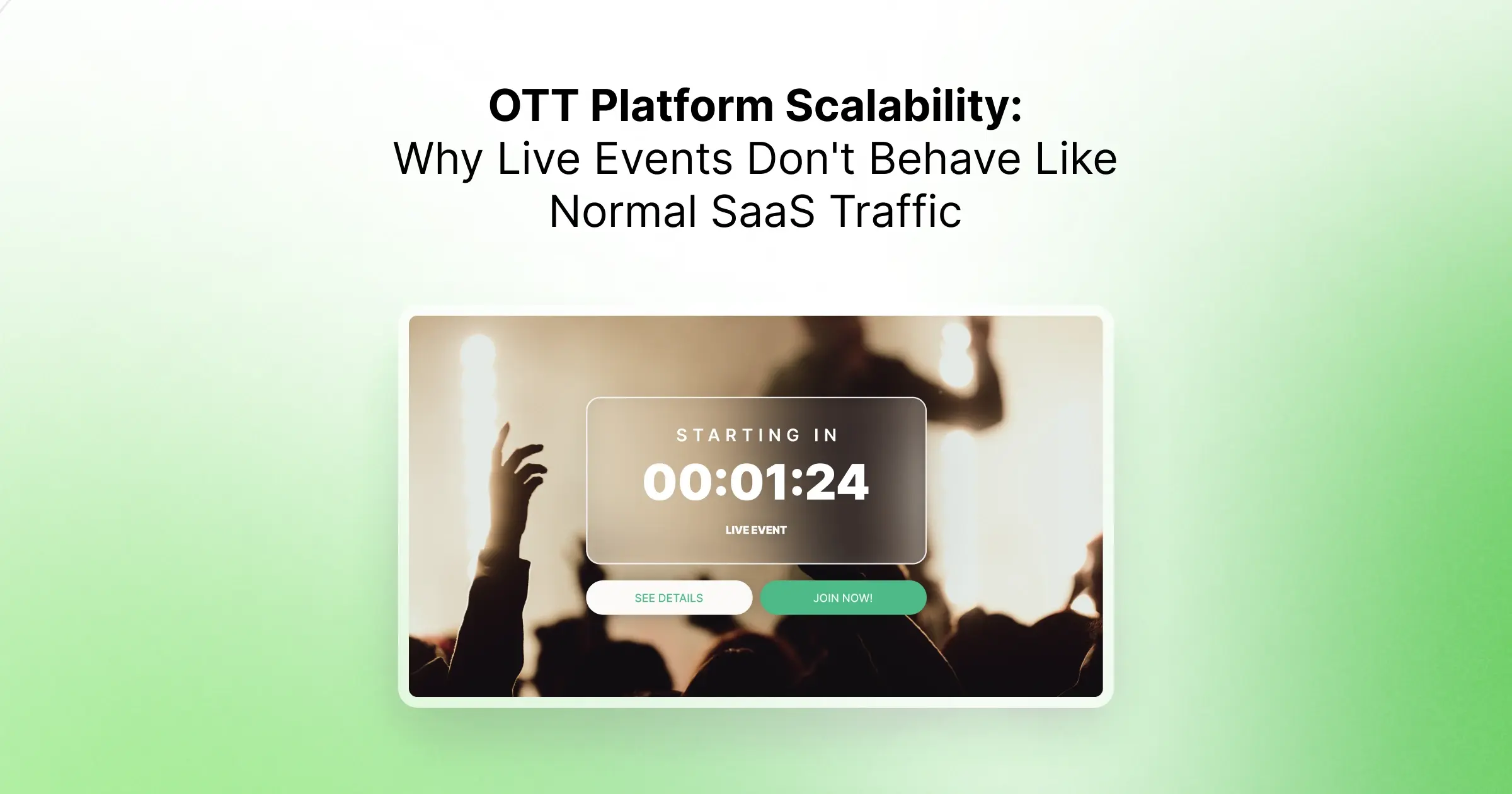
Live OTT is different. In sports and PPV especially, audiences tend to cluster around a fixed moment. Fans do not just browse casually throughout the day. They show up with urgency. They log in, recover passwords, update payment methods, complete purchases, and request access in a concentrated burst before kickoff, first bell, or event start.
That is why one of the most important patterns we optimize for is the 60-minute pre-event window. We have seen versions of this pattern across the PPV industry, especially in sports. It is the point where commercial intent and operational pressure peak at the same time.

This matters because live-event performance is not only a technical concern. It is a business-critical moment. If a viewer cannot complete a purchase or gain access quickly during that window, they are not just experiencing friction. They may miss the event entirely.
In live OTT, performance affects conversion just as directly as it affects user experience.
Live event payment performance is often the hardest part
When people think about live streaming performance, they often focus on video delivery. That makes sense - nobody wants buffering or playback issues during a major event. But from a commerce perspective, one of the hardest moments often comes before the stream even starts.
If the purchase flow fails, the viewer never gets to the content.
How should an OTT platform handle payment failures during a live event surge?
The short answer: treat live event payment performance as a first-class part of the broadcast, not a back-office concern.
That is why we treat payments as part of the live-event experience, not as a separate back-office system. In practice, payment performance during a PPV rush is shaped by multiple moving parts:
-
payment service providers,
-
processors,
-
fraud controls,
-
authentication layers,
-
regional payment methods, and
-
other external systems that are essential to the transaction but not fully under your control.
The complexity of live-event commerce is not just about high volume but about coordinating multiple systems under pressure, including systems you do not own. A purchase flow can be well designed internally and still face friction if an external dependency slows down, behaves differently under surge conditions, or becomes more conservative at exactly the wrong time.
Fraud control adds another layer. Large live events naturally create patterns that can look unusual: many viewers arriving in a short period, buying the same offer, often close to the same deadline. Those are legitimate behaviors, but they can resemble suspicious patterns if systems are not calibrated carefully. At scale, performance and fraud prevention are not separate concerns. They have to be considered together.
Architecting for live events means designing systems you do not control
This is one of the realities that makes live OTT different from many other SaaS categories. It is not enough to optimize your own APIs and infrastructure in isolation. You also have to architect for variability in many critical systems around you.
That means thinking beyond raw speed. It means designing for resilience when third-party services respond more slowly than expected, when external risk controls behave differently under event pressure, or when one part of the transaction path becomes less predictable than it looked in a steady-state environment.
What's the best way for a streaming platform to reduce third-party dependency risk during a live PPV event?
The answer is visibility and pre-event stress testing across the entire purchase journey — not just your own stack.
In that context, performance is as much about preparedness as it is about architecture. Teams need visibility into where friction appears across the purchase and access journey. They need to understand how registration, payment, fraud checks, and entitlement requests interact during a surge. And they need an operating model that lets them identify weak points before a real audience finds them first.
We have found that this mindset matters more than any generic claim about scale.
Live-event readiness comes from understanding how systems behave together under pressure, not just how they behave on their own.
Our performance work is cyclical by design
Performance work in live OTT is cyclical by necessity. We identify the part of the purchase or access flow most likely to become a bottleneck, optimize it, load test it, and then reassess the system as a whole. Once one constraint is removed, another usually becomes visible, whether that is a payment dependency, a fraud rule, an entitlement check, or a newer workflow introduced by the product.
That is why we load test throughout the year, not just before major events. Repeated testing helps us catch regressions as the platform evolves, and it lets us validate how new payment methods, integrations, and event scenarios behave under live-event traffic patterns. In this environment, readiness is not something you prove once. It has to be re-earned as the system changes.

What years of PPV have taught us about live event performance
Experience matters here because live-event traffic has a way of exposing assumptions. Cleeng has been working in this space since the early days of PPV in digital streaming. Over the years, that has meant supporting a range of major live-event and sports use cases from early PPV launches to high-profile events (the Super Bowl, tennis Grand Slams, F1 races, and the original Fight of the Century), and broadcaster ecosystems.
What those years have reinforced is not a single formula, but a set of patterns.
The pre-event rush is real.
Purchase demand becomes highly time-sensitive.
Payment friction becomes far more visible when viewers feel urgency.
Different event types surface different weaknesses.
And no matter how much experience a team has, the system still needs to be tested against the reality of the next event, not the memory of the last one.
Experience should not be framed as certainty. Its real value is that it helps teams know where to look first, what questions to ask earlier, and which parts of the journey deserve the most attention when preparing for a live event.
What actually matters
If there is one lesson behind how we architect for live OTT events, it is this: generic scale is not the same thing as live-event readiness.
What matters is whether the full journey - payments, fraud controls, entitlements, and access - continues to work as one coherent system during the narrow window when demand peaks. That is the standard we optimize for.
Trust Cleeng’s expertise to optimize every moment of your live OTT event. Create your free account now and ensure your system is ready for peak demand or book a meeting with our team at the NAB Show.