
You've built a digital subscription business that's growing across borders. Your product is solid, your marketing is working, and subscribers are signing up from markets in São Paulo to Stockholm. But behind the scenes, a silent killer is draining your resources, delaying launches, and putting your entire operation at risk.
Subscription compliance.
TLDR; How companies maintain compliance while scaling subscriptions
To maintain momentum during global expansion, subscription service providers automate three critical pillars: tax, data privacy, and payment security. The growth trade-off is simple: every regulatory change forces emergency pivots that delay product launches. Most high-growth businesses now use specialized compliance infrastructure or a Merchant of Record (MoR) solution to absorb these risks rather than building in-house.
Why compliance is crippling subscription growth
The complexity of global subscriptions isn't just about different languages. Fragmented legal landscapes change weekly, and your subscription business must stay on top of them.
The subscription tax compliance nightmare: 176 countries and counting
If you think sales tax means tracking a few percentage rates, you're in for a shock. The global tax landscape is a minefield of complexity. Here's what you're actually dealing with when selling across broders:
-
Global registration: Over 170 countries require foreign digital providers to register, charge, and remit tax. Miss one, and you're liable for all the tax you should have collected, retroactively.
-
The U.S. complexity: You're navigating approximately 13,000 tax jurisdictions across states, counties, and municipalities. Each has its own rules about whether SaaS is taxable, at what rate, and from what date.
-
Recurring payments: VAT/GST must be applied correctly on every renewal, upgrade, subscription downgrade, and currency change, not just the initial charge.
-
Place of supply determination: You must figure out where your customer is located using evidence like billing addresses or IP addresses. Getting this wrong means either overcharging customers or underpaying authorities.
Managing these complexities in-house demands significant teams and resources that could be better used elsewhere. This is why growing companies opt for tax compliance software for subscription businesses.
Data privacy and how to stay compliant across the globe
When GDPR launched in 2018, many businesses viewed it as a European problem. Today, similar frameworks have proliferated globally. For subscription businesses, this means:
-
Transparency and a lawful basis for every piece of data you collect from subscribers. You can't just bury consent in your terms of service. You need explicit, informed consent for data processing, and subscribers must be able to withdraw it at any time.
-
Data minimization: you can only collect data that's necessary for your service.
-
Technical and organizational security measures to protect both personal and payment data. Encryption, access controls, and tokenization are mandatory requirements, and their absence can trigger massive fines in a data breach.
-
Cross-border data transfer rules: You need legal mechanisms like Standard Contractual Clauses (SCCs) to move subscriber data between regions. Without these, data transfers are illegal.
Non-compliance means penalties and these can be severe. GDPR fines can reach €20 million or 4% of global annual turnover, whichever is higher. And it's not just the EU anymore – Brazil's LGPD, California's CCPA, and dozens of other frameworks carry similar penalties, putting a strong emphasis on the importance of subscription compliance.
Subscription payment compliance: the three-layer gauntlet
Payment processing for subscriptions isn't just about moving money from A to B. You must navigate a complex regulatory landscape designed to protect consumers and combat fraud.
Layer 1: Card network & authentication: PSD2 and Strong Customer Authentication (SCA) in Europe require two-factor authentication. For subscriptions, subsequent recurring charges only qualify for exemptions if the merchant is properly identified and uses correct transaction flags.
Layer 2: PCI-DSS compliance: This is non-negotiable. It requires 12 core requirements covering network security, regular penetration testing, and annual audits. The "smart play" is to use specialized providers so you never touch card data directly.
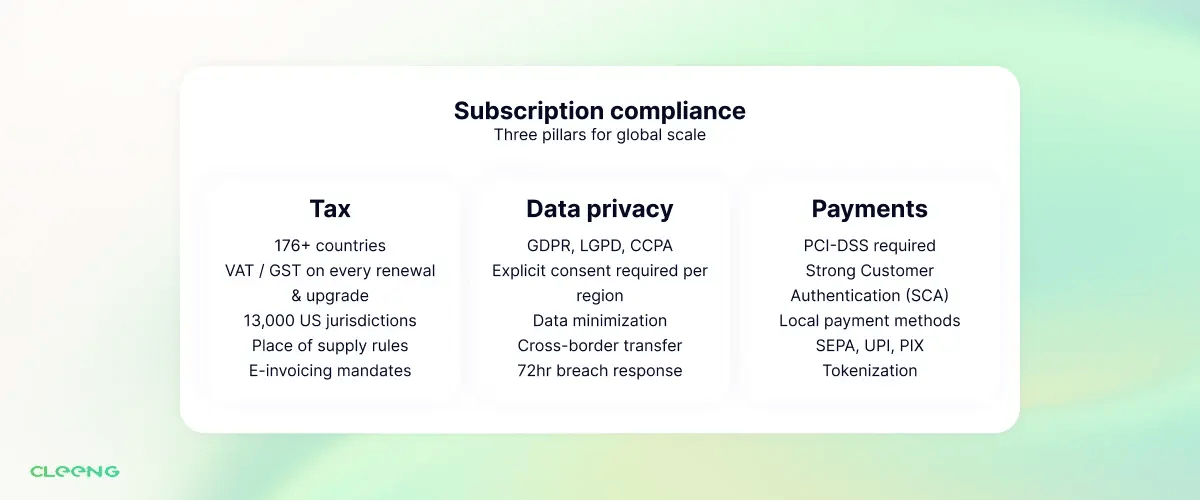
Layer 3: Regional payment methods: Global expansion means adapting to local rules. SEPA Direct Debit in Europe requires pre-notification; markets like India and Brazil have their own mandate rules and real-time payment expectations.

Technical subscription compliance implementation: what you actually need
When you move from strategy to implementation, these are the specific operational requirements your digital subscription system must handle:
Invoicing and subscription service tax compliance
1. Registration thresholds
Obligations trigger differently everywhere. In the EU, digital services often trigger VAT at the first euro. Some countries offer thresholds (e.g., €10,000 in Germany), while the U.S. uses economic nexus thresholds (typically $100,000 in sales or 200 transactions).
2. E-invoicing mandates
Real-time structured data (not just a PDF) is mandatory, for example, in Brazil, Mexico, India, Italy, and France. These government clearance systems can reject invoices for formatting errors, requiring immediate correction.
3. Filing and record-keeping
Periodic returns (monthly or quarterly) must be filed accurately. Transaction records must be maintained for 5-10 years, including the evidence used to determine the place of supply.

Data security and sovereignty in digital subscriptions
1. Technical measures
You must implement encryption at rest and in transit for all personal data. For financial information, high-growth businesses rely on payment tokenization – a process that replaces sensitive Primary Account Numbers (PANs) with a unique, random string of characters called a token. Because tokens have no mathematical relationship to the original card data and no inherent value outside your specific payment system, they significantly reduce your PCI-DSS scope and ensure that even if your system is compromised, the data remains useless to attackers.
2. Cross-border transfers
You need legal mechanisms like Standard Contractual Clauses or adequacy decisions to move subscriber data between regions legally.
3. Breach response
You must have the capacity to detect and report breaches within required timeframes (typically 72 hours).
The secret to growth: Automated billing compliance
Here's what happens when you automate subscription compliance:
-
Launch products faster: Enter new markets months ahead of schedule. Your legal and finance teams will have all the requirements, tax registrations, and payment methods ready to go from day one.
-
Free up your engineers: Let your developers focus on building features, not retrofitting your billing system. Automated compliance handles changes in tax rates, privacy laws, and payment regulations without consuming weeks of engineering time.
-
Expand globally with ease: Turn market expansion from a major project into a simple configuration change. Leadership can confidently enter promising new regions without being slowed down by compliance overhead.
-
Stay audit-ready: Stop panicking and manually reconstructing data. With automated systems, you'll have a clear audit trail ready whenever a tax authority or payment processor asks for it.
-
Protect your revenue: Avoid payment failures and blocked subscriptions. Automation ensures you meet all authentication requirements and are correctly registered for tax in every jurisdiction you sell in.
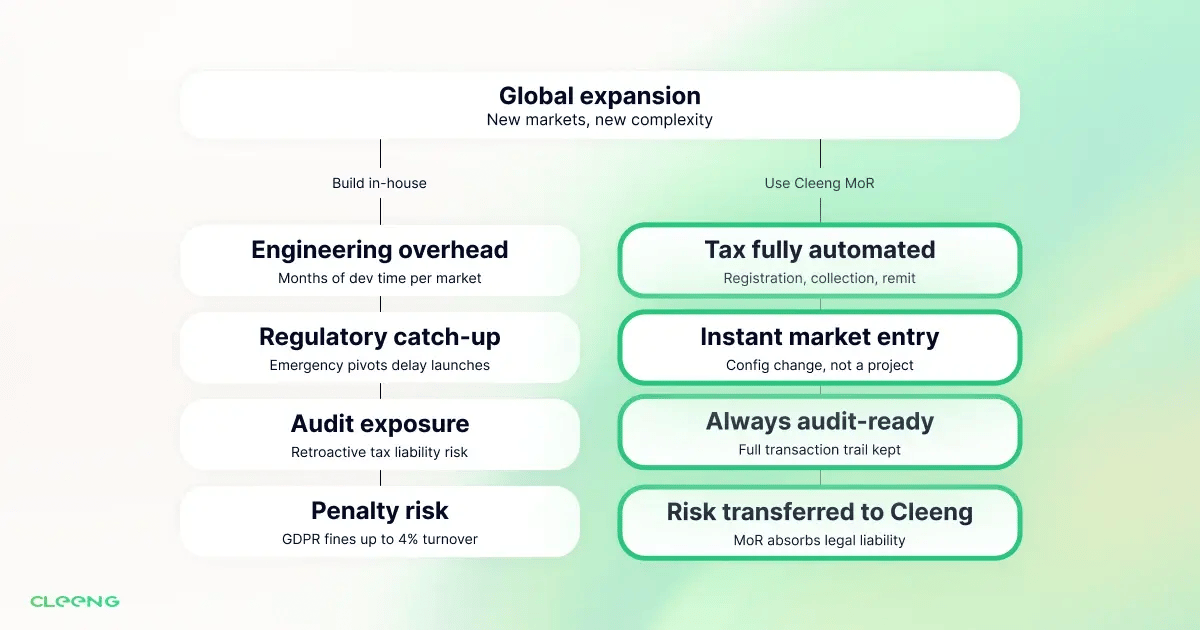
This is exactly why Cleeng was built. As a Merchant of Record (MoR), Cleeng takes on the legal and financial responsibility for your subscription transactions – handling tax registration, collection, and remittance across markets, ensuring PCI-DSS and SCA compliance, and managing data privacy obligations so your team doesn't have to. Rather than building this infrastructure in-house, subscription businesses use Cleeng to offload compliance risk entirely and enter new markets with confidence.
Conclusion: invest in subscription compliance infrastructure
Compliance isn't going away. If anything, it's getting more complex as governments worldwide increase scrutiny of digital businesses, strengthen consumer protection, and close tax loopholes.
The question isn't whether to handle compliance – it's how. Building and maintaining subscription compliance infrastructure in-house means diverting engineering resources from product development, hiring specialized legal and tax expertise, and constantly playing catch-up with regulatory changes.
Ready to stop letting compliance hold back your growth? You already know how companies maintain compliance while scaling subscriptions across borders. Now it's time for you to focus on what you do best and let specialized infrastructure handle the rest.