---
title: Hosted Customer Flows and Their Benefits for Subscription Apps
description: Discover the benefits of using Cleeng's Hosted Customer Flows for subscription apps, from rapid deployment to global scalability and seamless user experiences.
image: https://blog.cleeng.com/hubfs/benefits%20of%20using%20hosted%20customer%20flows%20for%20subscription%20apps.webp
---
Products
What it does
[Core Subscriber Management and Billing](https://cleeng.com/subscriber-management-system) [Merchant of Record Payments, Tax and Compliance](https://cleeng.com/merchant-checkout-optimization) [ChurnIQ Smart and Predictive Churn Analytics](https://cleeng.com/products/subscription-churn-analytics) [Hi5 AI-Enhanced Customer Care](https://cleeng.com/customer-care-digital-subscriptions)
AI Products
[Cleeng AI Ask questions in plain language](https://cleeng.com/ai) [Cleeng MCP Server Connect Cleeng to your own AI tools](https://cleeng.com/ai/mcp) [Data Intelligence Enriched context for every subscriber](https://cleeng.com/ai/subscriber-data) [Trust & Governance Complete control and auditability](https://cleeng.com/ai/legal)
Solutions
By industry
[Streaming and OTT](https://cleeng.com/solutions/streaming) [Sports](https://cleeng.com/solutions/subscription-management-for-sports) [Wellness](https://cleeng.com/solutions/wellness) [Creators](https://cleeng.com/solutions/youtube-creators) [Gaming](https://cleeng.com/solutions/gaming) [Memberships](https://cleeng.com/solutions/memberships)
By scale
[Enterprise](https://cleeng.com/solutions/enterprise) [Small and Medium Businesses](https://cleeng.com/pro)
For partners
[Agencies & Integrators](https://cleeng.com/solutions/agencies) [B2B2C Platforms](https://cleeng.com/solutions/b2b2c-platforms)
Developers
[Launch Subscriptions](https://developers.cleeng.com/docs/launch-subscriptions) [Build with LLMs](https://developers.cleeng.com/docs/build-with-llms) [Integrate apps](https://developers.cleeng.com/docs/payments_on_mobile_tv_apps_intro) [System status](http://status.cleeng.com/) [Integrations Hub](https://cleeng.com/integrations-connectors) [Migration guide](https://cleeng.com/migrate-to-cleeng) [Certified Partner Program](https://publisher.support.cleeng.com/hc/en-us/articles/22272169788188-Cleeng-Certified-Partner-Program)
Resources
[Publisher Help Center](https://publisher.support.cleeng.com/hc/en-us) [Blog](https://blog.cleeng.com/) [Customer stories](https://cleeng.com/clients) [Events](https://cleeng.com/events) [Research & reports](https://cleeng.com/resources) [Demo Hub](https://cleeng.com/demohub)
[Pricing](https://cleeng.com/pricing)
[Login](https://srm.cleeng.com/auth) [Get started free](https://srm.cleeng.com/auth/register)
[Blog](https://cleeng.com/blog)
# 8 Benefits of Hosted Customer Flows for Subscription Apps
Platform Infrastructure | Anna Sobiak | Jul 2, 2026
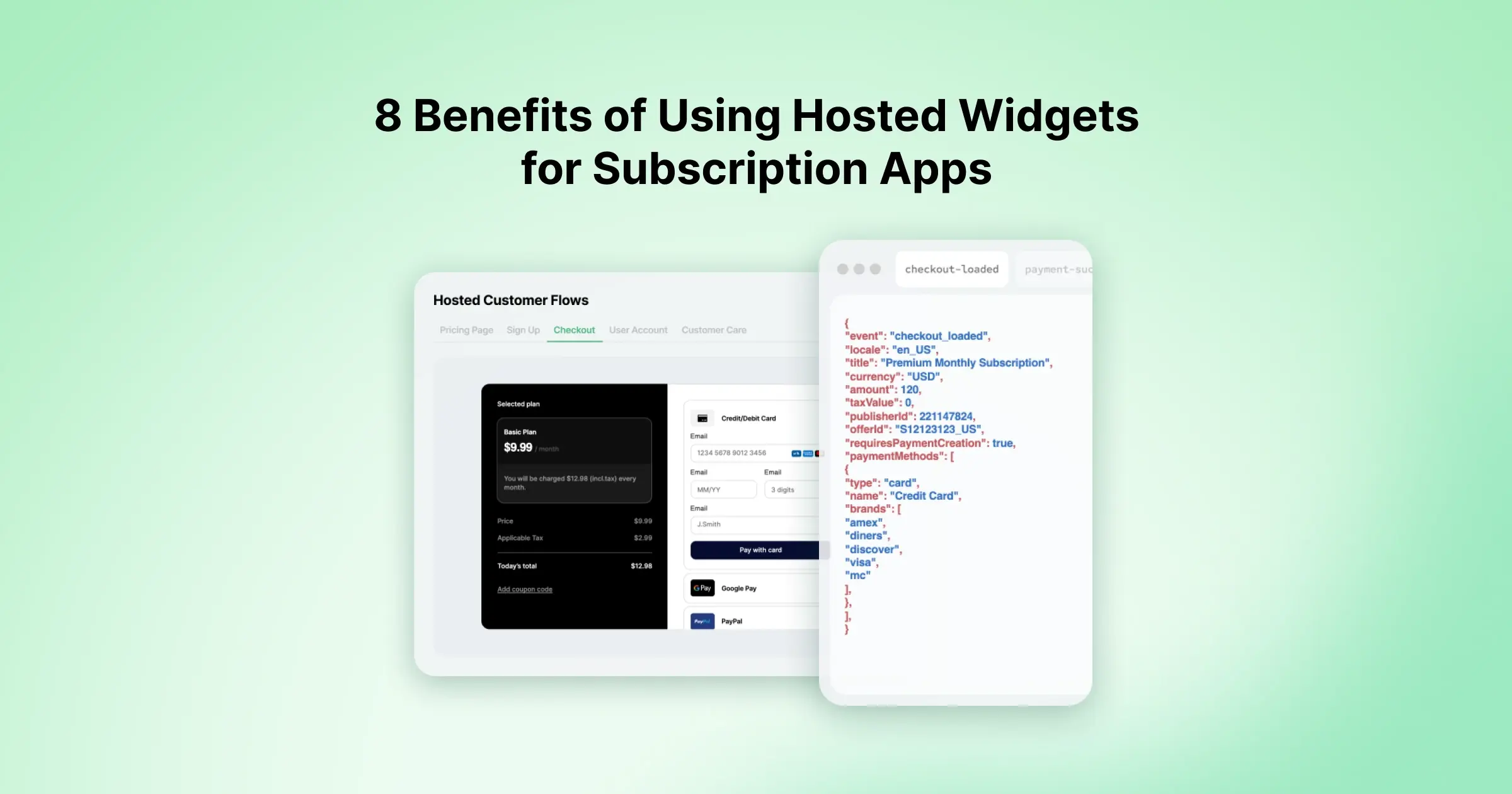
Most OTT and [D2C subscription apps](https://blog.cleeng.com/d2c-subscription-model-how-to-build-a-future-proof-subscription-platform) face the same hidden problem: their subscription product is strong, but the infrastructure around it (the login flow, the checkout, the account management screens, the support layer) is held together with custom code, point solutions, and engineering time that could be spent elsewhere.
The result is a fragile subscriber journey that's slow to iterate on, expensive to maintain, and difficult to scale internationally. Every time compliance rules change, a payment method needs to be added, or you want to test a new checkout layout, someone has to file an engineering ticket and wait.
Hosted Customer Flows (or widgets) are a different operating model. Instead of stitching together APIs and building UX from scratch, teams embed pre-built, production-ready components that handle the entire subscriber flow in a single integration.
[Cleeng's Hosted Customer Flows](https://publisher.support.cleeng.com/hc/en-us/articles/21714585736732-MediaStore-Hosted-Customer-Flows) are part of its [Subscriber Relationship Management (SRM®)](https://cleeng.com/srm-solutions) platform, built specifically for OTT, sports streaming, and D2C subscription apps. The four Hosted Customer Flows cover every touchpoint in the [subscriber lifecycle](https://blog.cleeng.com/benefits-of-integrated-retention-management-system):
- Sign Up Widget. Login, registration, and password reset.
- Checkout Widget. Full payment processing, including recurring billing.
- User Account Widget. Subscriber self-service and account management.
- Customer Care Widget. Embedded FAQs and support ticketing via [Hi5](https://cleeng.com/customer-care-digital-subscriptions).
Here's why leading digital subscription businesses choose Hosted Customer Flows over building subscriber flows in-house.
## 1. With Hosted Customer Flows you launch in minutes, not months
Every week a subscription flow sits in the engineering backlog is a week without subscriber revenue. Custom subscription flows built on top of APIs like [Stripe](https://cleeng.com/stripe-fees-calculator) or [Recurly](https://cleeng.com/compare/recurly-alternative) typically take four to eight weeks to reach production – and that timeline doesn't include QA, compliance review, or the scope changes that inevitably occur when billing logic touches payment infrastructure.
Cleeng's Hosted Customer Flows deploy in approximately 20 minutes using a few lines of embed code. There is no backend configuration, no payment infrastructure to wire up, and no UI to build from scratch.
For subscription teams launching a new service, entering a new market, or running a proof of concept ahead of a broader rollout, that difference is significant. Eight weeks of blocked engineering has a measurable cost in delayed revenue and missed market windows. Twenty minutes doesn't.
The bottom line. Hosted Customer Flows eliminate the engineering bottleneck between your subscription strategy and your first paying subscriber, reducing time-to-revenue from weeks to a single afternoon.
## 2. Hosted Customer Flows work with whatever you've already built
[Streaming](https://cleeng.com/solutions/streaming), media platforms, and digital apps (for example, connected devices) are rarely greenfield. They run on a mix of legacy systems, modern front-end frameworks, and video infrastructure that predates any subscription layer. Adopting third-party UI components that demand re-platforming is not a realistic option.
Cleeng's Hosted Customer Flows are fully framework-agnostic. They integrate with React, Vue, Angular, or plain HTML — whichever front-end technology your team already uses. There is no requirement to standardize your architecture around a specific framework, and no risk of disrupting your existing product delivery or content management infrastructure.
The integration pattern is the same regardless of stack: embed the code, configure the options, and the widget operates within your existing environment.
The bottom line: For teams worried about integration risk, the answer is that there isn't any. Cleeng's Hosted Customer Flows fit into your stack rather than requiring your stack to change.
[](https://blog.cleeng.com/hs/cta/wi/redirect?encryptedPayload=AVxigLIHV2oZyQMaQYVCde7PwLhfYrBIHa1Ew5H2s40ugCEYukRAPKHduZuBTSjXUGZkF7bxDGn0CYhChglIjKI4biZTTh0bb19DTUp%2FsmYvfjM0X%2B0LRg3j0jG2rTfwqBLZQcbK5VtnagYas54saZyl4cxYQyOye2d0HfRa%2Btzy%2BLp8QQo5ZhaO7XKMj%2BwHm8c%2FXe%2BlUIY%3D&webInteractiveContentId=216341073314&portalId=5813983)
## 3. Zero maintenance – and compliance risk stays with Cleeng
Custom-built subscription flows carry an ongoing maintenance cost that rarely appears in the initial build estimate. Security patches, SCA enforcement updates, GDPR changes, new payment method requirements; each one requires engineering time, indefinitely. For businesses operating across multiple regulatory environments, that burden scales with market expansion.
Hosted Customer Flows change the risk model. Because the flows are hosted by Cleeng, all updates (new features, security patches, and regulatory compliance changes) are deployed automatically to every customer simultaneously, without any action required on your end.
Cleeng's platform is fully compliant with PCI-DSS and GDPR standards. As a [Merchant of Record](https://cleeng.com/merchant-of-record), Cleeng also assumes the liability for payment processing, tax remittance across 13,000+ jurisdictions, and regulatory compliance, transferring that operational and legal burden away from your team entirely.
Cleeng communicates all upcoming changes to clients in advance via detailed [Release Notes](https://publisher.support.cleeng.com/hc/en-us/sections/4620091486108-Release-Notes), so product and marketing teams are never surprised by a UI or behavior change in a live widget.
The bottom line. You get enterprise-grade security, payment compliance, and regulatory coverage without dedicating developers to maintain it. Every week your team isn't managing compliance is a week spent on growth.
## 4. Hosted Customer Flows: built-in subscriber support that reduces churn
Unresolved billing issues and support friction are among the most common drivers of voluntary churn in subscription businesses. A subscriber who can't reset their password, update a payment method, or understand why they were charged is a subscriber who cancels.
Cleeng's Customer Care Widget, powered by [Hi5](https://cleeng.com/customer-care-digital-subscriptions), addresses this at the point of friction rather than routing subscribers through a separate support channel. The embedded FAQ layer resolves the most common user questions (billing inquiries, cancellation requests, payment failures) directly within the subscriber interface, without requiring a human agent.
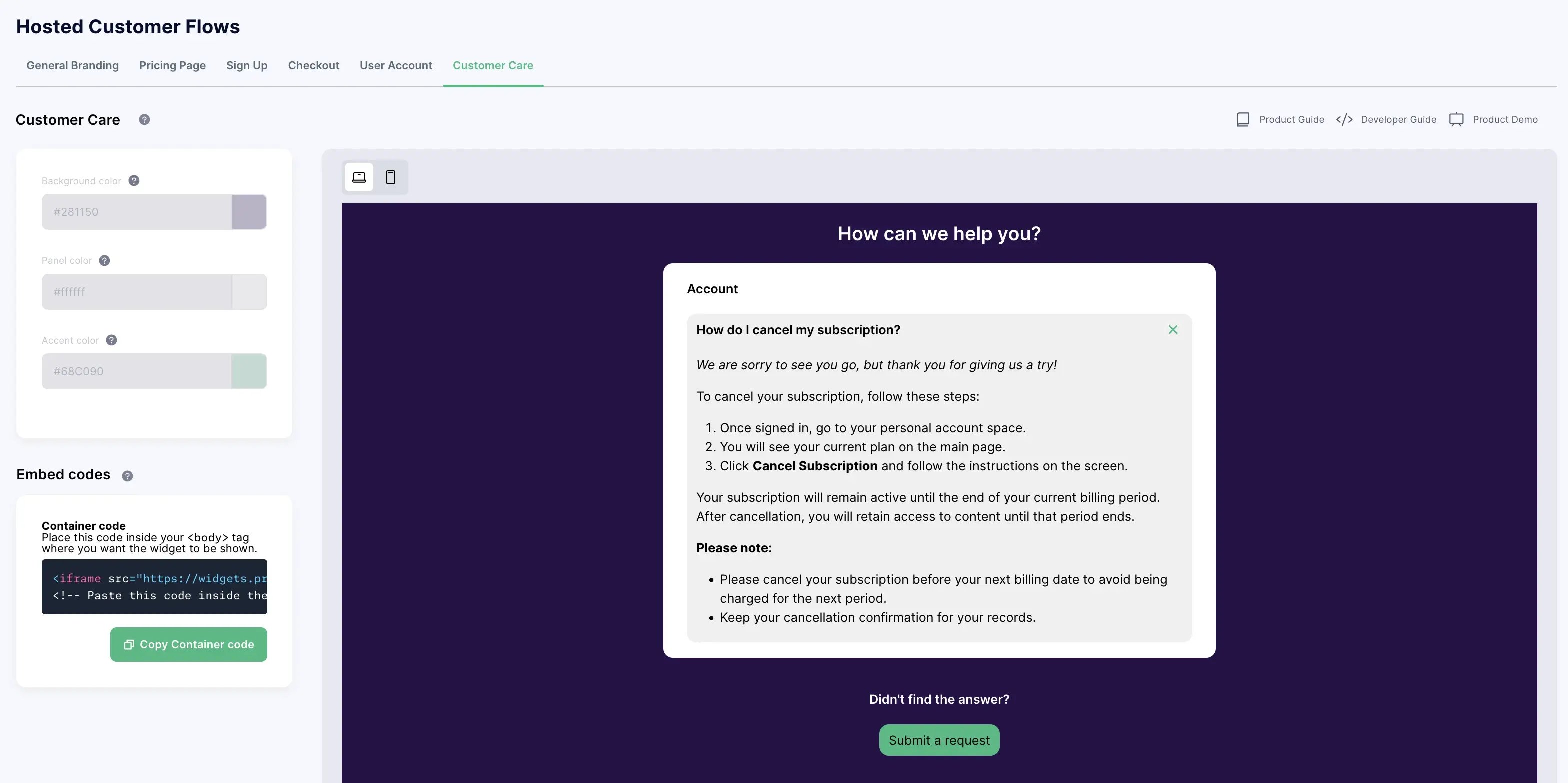
[Hi5 delivers a 72%+ self-service resolution rate](https://cleeng.com/resources/d2c-retention-benchmarks-2026), which means the large majority of subscriber support issues are handled automatically, at any hour, without staffing cost. For issues that do require human judgment, subscribers can submit a ticket directly within the widget, and Cleeng's specialized support team responds on behalf of your company.
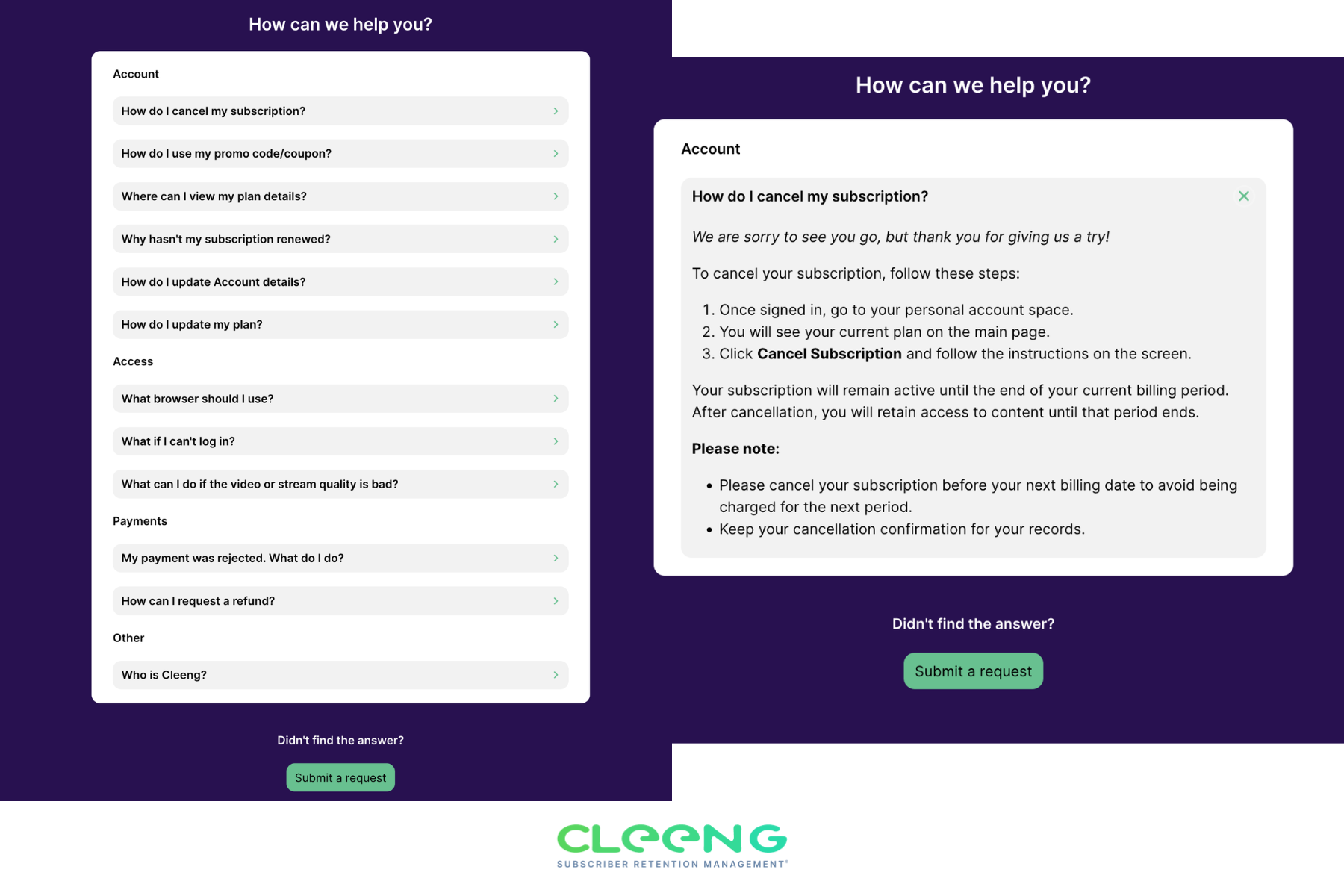
This is not just a cost efficiency; it is a retention mechanism. A subscriber who gets an immediate, accurate answer to a billing question is far less likely to churn than one who waits 48 hours for an email response.
The bottom line. Hi5 turns your subscriber support interface into a churn prevention layer, resolving 72%+ of issues automatically while keeping subscribers in your product rather than in their email.
## 5. Hosted Customer Flows are on-brand and fully editable – without an engineering ticket
Subscription UX is not a one-time decision. Checkout layouts change during promotions. Branding updates when your visual identity evolves. Customer care options shift as your product grows. In a custom-built environment, each of these changes requires an engineering ticket, a deployment, and a review cycle.
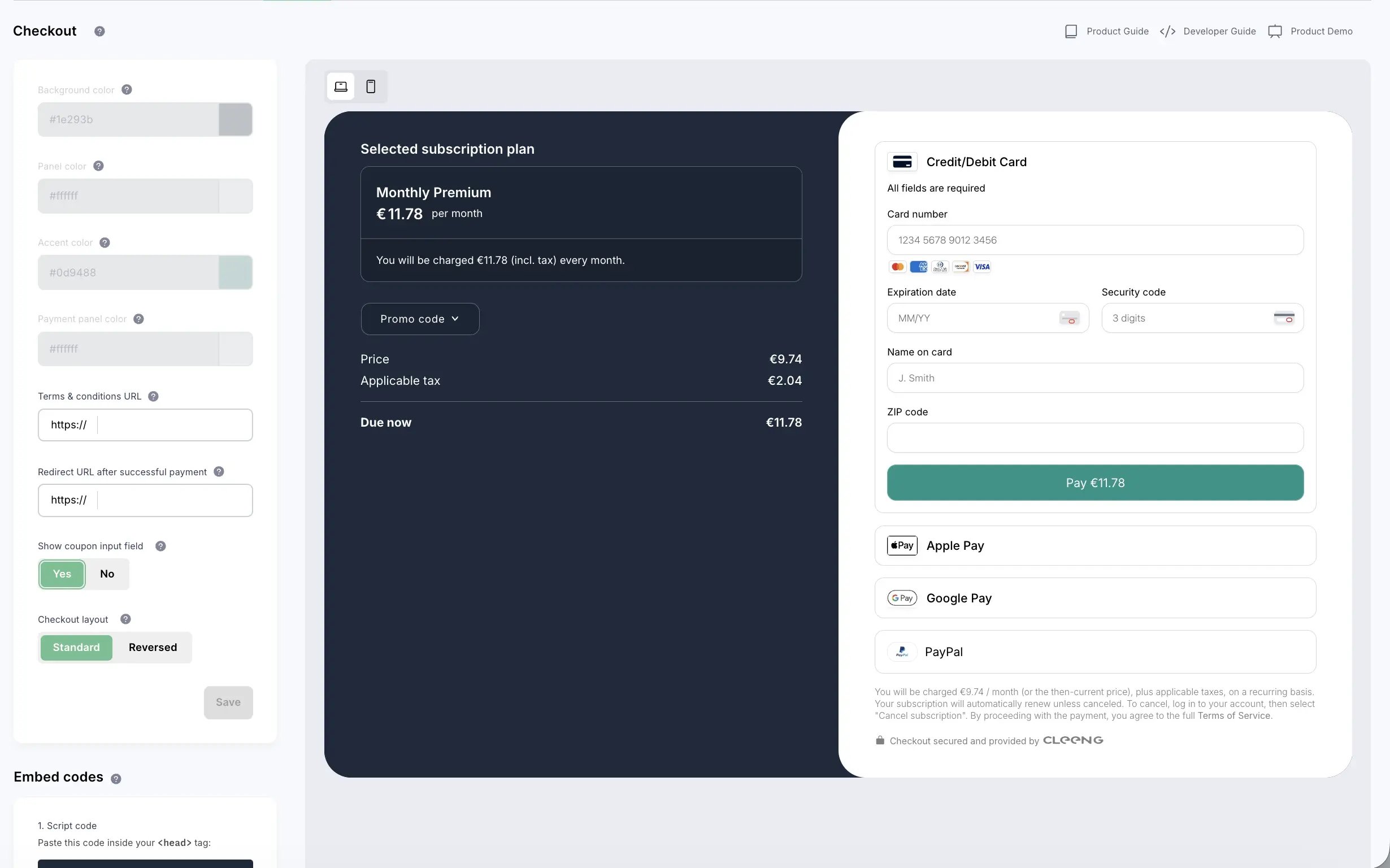
With Cleeng's Hosted Customer Flows, all of this is managed through the [Cleeng Dashboard](https://srm.cleeng.com/register) and applied immediately to your live widgets — no code deployment required after the initial setup.
Branding, layout, checkout behavior and payment option visibility are all controlled from a single interface. Marketers and product managers can iterate on the subscriber experience without waiting for engineering capacity.
One concrete example: if your product doesn't offer discount codes, you can remove the discount field from the checkout entirely using a dashboard toggle. If you add a new payment partner or want to test a different checkout order, that change goes live in seconds – not in the next sprint.
The bottom line. The teams who own the subscriber experience should be able to control it without filing engineering tickets. Hosted widgets make that possible from day one.
## 6. A complete subscriber journey – not just one step
Most subscription tools solve one part of the subscriber lifecycle well. The fragile part is the space between tools: the handoffs where subscriber identity doesn't carry over, where the checkout and account management UX don't match, where a cancelled subscriber falls into a gap between systems.
Cleeng's Hosted Customer Flows are designed to eliminate those gaps by covering the entire flow in a single integration:
- The Sign Up Widget handles login, registration, and password reset
- The Checkout Widget manages the complete purchase process, including payment authorization and recurring billing setup
- The User Account Widget gives subscribers self-service control over their subscription: plan changes, payment method updates, cancellation, and reactivation
- The Customer Care Widget surfaces FAQs and support access within the same subscriber interface
Supported payment methods include credit card, Google Pay, Apple Pay, and PayPal, for both initial purchases and recurring payments. This matters particularly for global subscription audiences, where payment method availability directly affects conversion rates.
This is what platform consolidation looks like in practice: one integration, one identity layer, one support interface, one dashboard to manage all of it, rather than three or four point solutions with separate contracts, separate UX, and separate maintenance overhead.
The bottom line. One integration delivers the entire signup-to-self-service experience, with consistent UX at every step and no gap between systems where subscriber relationships break down.
## 7. Hosted Customer Flows are built for a global subscriber base
A subscription flow that converts in one market will underperform in another if it isn't adapted for local expectations. The layout direction, language, currency, and payment method are crucial to be adapted. Sports, streaming, and subscription apps expanding internationally can't afford to treat localization as an afterthought.
Cleeng's Hosted Customer Flows are built for global deployment:
- Fully responsive across desktop, tablet and mobile- with no additional configuration required
- Flexible layout order. The arrangement of UI elements can be reordered for different market conventions. Right-to-left layouts are supported for Arabic-speaking markets, for example
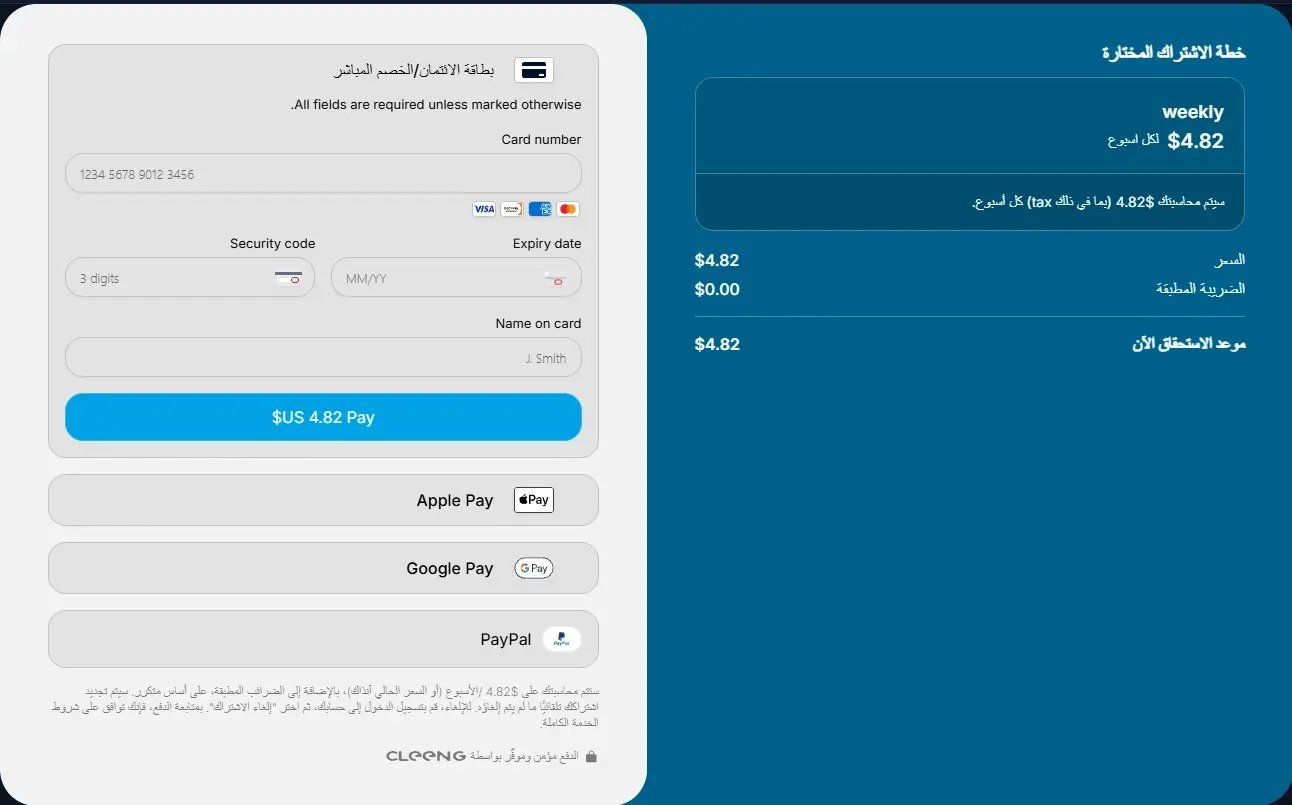
- Multi-language and multi-currency support. Subscribers see the interface in their language and transact in their local currency, reducing friction at the moment of purchase
- [Local payment methods.](https://blog.cleeng.com/local-payment-methods-for-global-subscription-growth) Beyond the major global options, the widgets support regional payment preferences to maximize conversion in specific markets, including LatAm, APAC, and MENA
- Optimized load performance. Fast widget loading reduces drop-off at the critical moment when a subscriber decides whether to complete a purchase
For live sports streaming in particular (where subscribers enter checkout in a high-intent moment) load performance and frictionless UX are not nice-to-haves. They are revenue.
The bottom line. Global subscriber acquisition requires local subscriber experience. Cleeng's hosted widgets handle the language, currency, layout, and payment method complexity. This means that your team doesn't have to rebuild that infrastructure for every new market.
## 8. Purpose-built for subscriptions — deployable for teams of every size
Cleeng's Hosted Customer Flows are not a generic subscription tool repurposed for media. They are built specifically for the complexity of subscription apps like sports streaming, D2C broadcasting, and fitness and wellness streaming. On top of that, they come with the payment method breadth, multi-device support, and compliance infrastructure those businesses require.
At the same time, they are designed to scale with the team using them.
- For startups and early-stage streaming products. Hosted widgets make it possible to launch a compliant, fully branded subscription flow without a dedicated front-end build. The 20-minute deployment means you can begin validating a subscription model with real paying subscribers before your engineering team has finished the backlog for the custom version.
- For teams running proofs of concept. The low integration overhead means you can stand up a working subscriber flow for an internal demo, a pilot program, or a limited market test without committing to a full infrastructure build.
- For broadcasters and enterprise OTT platforms. The compliance infrastructure (PCI-DSS, GDPR, SCA, 13,000+ tax jurisdictions), the Merchant of Record model, the multi-language and multi-currency support, and the centralized dashboard make hosted widgets viable at scale — with the governance, audit trail, and liability coverage that regulated media businesses require.
The same widget infrastructure that a startup uses to launch their first subscription product is what a major sports broadcaster uses to manage millions of concurrent subscribers across multiple markets.
The bottom line: Cleeng's Hosted Customer Flows are purpose-built for subscription complexity and deployable at any stage – from your first subscriber to your ten-millionth.
## Summary
For OTT, sports streaming, and D2C media businesses, hosted subscription widgets are not just a faster way to build a checkout screen. They are a different approach to subscriber infrastructure – one that consolidates the subscriber journey into a single integration, transfers compliance and payment liability to a specialist, and gives marketing and product teams direct control over the subscriber experience without ongoing engineering dependency.
Evaluating how to build or improve the subscriber flow for your OTT or subscription product? Create a free account to explore [Cleeng's](https://claude.ai/epitaxy/local_f9c4f5a8-a640-4424-9b81-8dd4196b9847#)Hosted Customer Flows.
[](https://blog.cleeng.com/hs/cta/wi/redirect?encryptedPayload=AVxigLKzxiwpnuURsy4%2FVFCevGbSraMaZkqTioHbaQ4%2FV%2F3peNNh9J6Gqv856kWIykVSloBwQxznFv1i9UOBcemx2247REukhuvJiv0dEAkM0lTsoJXsZbDhfwVA7FheTXoor1UXjEArxJpKjImHUIjpEUqVSDN9ufVdlzMt2PZ20YOdukhFsRaALJfrKtbjxcLDNuPY%2ByvP&webInteractiveContentId=216341073311&portalId=5813983)
### Popular posts
#### [How to Migrate Subscribers to a New Platform Without Losing Renewals Read more →](https://blog.cleeng.com/how-to-migrate-subscribers-to-a-new-platform)
#### [Meet Cleeng's AI Agent Team: How Launch, Run, and Grow Work Together Read more →](https://blog.cleeng.com/cleengs-ai-agent-team)
#### [Why MCP Servers Will Transform Subscriber Management (+ Why Cleeng Built One) Read more →](https://blog.cleeng.com/mcp-server-for-subscriber-retention)
#### [Google Play Billing, Done Right: 2026 Guide for Subscription Brands Read more →](https://blog.cleeng.com/google-play-billing-subscriptions)
#### [Agentic AI for Subscriber Retention Is Here: What It Means for D2C & OTT Brands Read more →](https://blog.cleeng.com/agentic-ai-for-subscriber-retention-d2c-ott)
### See your whole business clearly.
Connect your data and watch your live dashboard fill in — no credit card required.
[Start free](https://srm.cleeng.com/register)
### Related posts
#### [ Platform Infrastructure How to Migrate Subscribers to a New Platform Without Losing Renewals **Kübra Güven** · Sep 18, 2026, 1:05:16 PM](https://blog.cleeng.com/how-to-migrate-subscribers-to-a-new-platform)
#### [ Platform Infrastructure Meet Cleeng's AI Agent Team: How Launch, Run, and Grow Work Together **Kamila Palka** · Sep 9, 2026, 4:47:15 PM](https://blog.cleeng.com/cleengs-ai-agent-team)
#### [.webp) Platform Infrastructure Why MCP Servers Will Transform Subscriber Management (+ Why Cleeng Built One) **Kamila Palka** · Sep 2, 2026, 3:10:01 PM](https://blog.cleeng.com/mcp-server-for-subscriber-retention)
Your Subscriber Retention Management® solution
[Contact us](https://cleeng.com/contact)
#### Ask AI for info
- [ChatGPT](https://chatgpt.com/?q=...)
- [Gemini](https://gemini.google.com/app?q=...)
- [Claude](https://claude.ai/new?q=...)
- [Perplexity AI](https://www.perplexity.ai/?q=...)
#### Products
- [Subscriber management and billing](https://cleeng.com/subscriber-management-system)
- [Merchant of Record](https://www.cleeng.com/products/merchant-of-record)
- [Churn Analytics](https://cleeng.com/churniq-churn-intelligence)
- [AI-Enhanced Customer Care](https://cleeng.com/pro)
#### Solutions
- [Streaming and OTT](https://www.cleeng.com/solutions/streaming)
- [Sports](https://cleeng.com/subscription-management-for-sports)
- [Wellness](https://cleeng.com/wellness)
- [Creators](https://www.cleeng.com/solutions/youtube-creators)
- [Enterprise](https://cleeng.com/solutions/enterprise)
- [Small and Medium Businesses](https://cleeng.com/pro)
#### Developer
- [API Reference](https://developers.cleeng.com/reference/apireference-overview)
- [Sandbox](https://srm-sandbox.cleeng.com/register)
- [Tutorials](https://developers.cleeng.com/docs/getting-started-with-cleeng)
- [Integrations](https://cleeng.com/integrations-connectors)
- [Migration](https://cleeng.com/integrations-connectors)
#### About
- [Company](https://cleeng.com/about-us)
- [Blog](https://blog.cleeng.com/)
- [Sustainability](https://cleeng.com/sustainability)
- [Careers](https://cleeng.com/careers)
#### Explore
- [Pricing](https://cleeng.com/pricingpro)
- [My Dashboard](https://srm.cleeng.com/login)
- [FAQ & support](https://publisher.support.cleeng.com/hc/en-us)
#### Customers
- [Who are Cleeng](https://cleeng.com/who-are-cleeng)
- [Get Support](https://cleeng.zendesk.com/hc/en-us/)
Copyright © 2026 Cleeng | All Rights Reserved | [Terms & Conditions](https://cleeng.com/master-service-agreement)
```json
{
"@context" : "https://schema.org",
"@type" : "BlogPosting",
"author" : {
"@type" : "Person",
"name" : "Anna Sobiak"
},
"dateModified" : "2026-08-13T08:46:16Z",
"datePublished" : "2026-07-02T11:16:33Z",
"description" : "Discover the benefits of using Cleeng's Hosted Customer Flows for subscription apps, from rapid deployment to global scalability and seamless user experiences.",
"headline" : "Hosted Customer Flows and Their Benefits for Subscription Apps",
"image" : "https://5813983.fs1.hubspotusercontent-na1.net/hubfs/5813983/benefits%20of%20using%20hosted%20customer%20flows%20for%20subscription%20apps.webp",
"mainEntityOfPage" : {
"@id" : "https://blog.cleeng.com",
"@type" : "WebPage"
},
"publisher" : {
"@type" : "Organization",
"logo" : {
"@type" : "ImageObject",
"url" : "https://cdn.prod.website-files.com/624eb5c51026869311f0668a/66b09c7ffb2cada498b8a184_Cleeng%20logo%20-%20tagline%20bottom%20-%20transparent.svg"
},
"name" : "Cleeng"
}
}
```
```json
{
"@context" : "https://schema.org",
"@type" : "Article",
"about" : [ {
"@type" : "Thing",
"name" : "Subscription Management"
}, {
"@type" : "Thing",
"name" : "OTT Streaming"
}, {
"@type" : "Thing",
"name" : "Subscriber Retention"
} ],
"articleSection" : "Product",
"author" : [ {
"@type" : "Person",
"jobTitle" : "Product Designer",
"name" : "Anna Sobiak",
"worksFor" : {
"@type" : "Organization",
"name" : "Cleeng",
"url" : "https://cleeng.com"
}
}, {
"@type" : "Person",
"jobTitle" : "Content Marketing Strategist",
"name" : "Kamila Palka",
"worksFor" : {
"@type" : "Organization",
"name" : "Cleeng",
"url" : "https://cleeng.com"
}
} ],
"dateModified" : "2026-07-02",
"datePublished" : "2026-07-02",
"description" : "Hosted subscription widgets cut launch time from months to 20 minutes, eliminate compliance risk, and reduce churn — without custom engineering. Here's why OTT and streaming teams choose them.",
"headline" : "8 Benefits of Using Hosted Widgets for Subscription Apps",
"keywords" : [ "hosted widgets for subscription apps", "OTT subscription widgets", "subscriber lifecycle management", "D2C media subscription flow", "hosted checkout for OTT", "subscription retention infrastructure", "SRM platform", "Cleeng" ],
"mainEntityOfPage" : {
"@id" : "https://blog.cleeng.com/benefits-of-using-hosted-customer-flows-for-subscription-apps",
"@type" : "WebPage"
},
"mentions" : [ {
"@type" : "SoftwareApplication",
"applicationCategory" : "Subscriber Relationship Management",
"name" : "Cleeng SRM®"
}, {
"@type" : "SoftwareApplication",
"applicationCategory" : "AI Customer Support",
"name" : "Hi5"
} ],
"publisher" : {
"@type" : "Organization",
"logo" : {
"@type" : "ImageObject",
"url" : "https://5813983.fs1.hubspotusercontent-na1.net/hubfs/5813983/assets/cleenglogo.svg"
},
"name" : "Cleeng",
"url" : "https://cleeng.com"
},
"url" : "https://blog.cleeng.com/benefits-of-using-hosted-customer-flows-for-subscription-apps"
}
```
```json
{
"@context" : "https://schema.org",
"@type" : "Blog",
"description" : "Insights and strategies on subscriber retention and D2C subscriptions from Cleeng.",
"name" : "Cleeng Blog",
"publisher" : {
"@type" : "Organization",
"logo" : {
"@type" : "ImageObject",
"url" : "https://cdn.prod.website-files.com/624eb5c51026869311f0668a/66b09c7ffb2cada498b8a184_Cleeng%20logo%20-%20tagline%20bottom%20-%20transparent.svg"
},
"name" : "Cleeng"
},
"url" : "https://blog.cleeng.com"
}
```