---
title: "Stripe vs. Cleeng: Which Subscription Billing Setup Fits Your Business?"
description: "Stripe vs. Cleeng: Stripe processes payments, but who owns your tax compliance? Compare both setups on fees, subscriber lifecycle, and Merchant of Record."
image: https://blog.cleeng.com/hubfs/stripe%20vs%20cleeng%20stripe%20vs%20cleeng%20merchant.webp
---
Products
What it does
[Core Subscriber Management and Billing](https://cleeng.com/subscriber-management-system) [Merchant of Record Payments, Tax and Compliance](https://cleeng.com/merchant-checkout-optimization) [ChurnIQ Smart and Predictive Churn Analytics](https://cleeng.com/products/subscription-churn-analytics) [Hi5 AI-Enhanced Customer Care](https://cleeng.com/customer-care-digital-subscriptions)
AI Products
[Cleeng AI Ask questions in plain language](https://cleeng.com/ai) [Cleeng MCP Server Connect Cleeng to your own AI tools](https://cleeng.com/ai/mcp) [Data Intelligence Enriched context for every subscriber](https://cleeng.com/ai/subscriber-data) [Trust & Governance Complete control and auditability](https://cleeng.com/ai/legal)
Solutions
By industry
[Streaming and OTT](https://cleeng.com/solutions/streaming) [Sports](https://cleeng.com/solutions/subscription-management-for-sports) [Wellness](https://cleeng.com/solutions/wellness) [Creators](https://cleeng.com/solutions/youtube-creators) [Gaming](https://cleeng.com/solutions/gaming) [Memberships](https://cleeng.com/solutions/memberships)
By scale
[Enterprise](https://cleeng.com/solutions/enterprise) [Small and Medium Businesses](https://cleeng.com/pro)
For partners
[Agencies & Integrators](https://cleeng.com/solutions/agencies) [B2B2C Platforms](https://cleeng.com/solutions/b2b2c-platforms)
Developers
[Launch Subscriptions](https://developers.cleeng.com/docs/launch-subscriptions) [Build with LLMs](https://developers.cleeng.com/docs/build-with-llms) [Integrate apps](https://developers.cleeng.com/docs/payments_on_mobile_tv_apps_intro) [System status](http://status.cleeng.com/) [Integrations Hub](https://cleeng.com/integrations-connectors) [Migration guide](https://cleeng.com/migrate-to-cleeng) [Certified Partner Program](https://publisher.support.cleeng.com/hc/en-us/articles/22272169788188-Cleeng-Certified-Partner-Program)
Resources
[Publisher Help Center](https://publisher.support.cleeng.com/hc/en-us) [Blog](https://blog.cleeng.com/) [Customer stories](https://cleeng.com/clients) [Events](https://cleeng.com/events) [Research & reports](https://cleeng.com/resources) [Demo Hub](https://cleeng.com/demohub)
[Pricing](https://cleeng.com/pricing)
[Login](https://srm.cleeng.com/auth) [Get started free](https://srm.cleeng.com/auth/register)
[Blog](https://cleeng.com/blog)
# Stripe vs. Cleeng: Which Subscription Billing Setup Fits Your Business?
Payments, Tax & Compliance | Enzo Bermond | Jul 29, 2026
When subscription businesses compare Stripe vs. Cleeng, the question isn’t “which platform is better” – it’s “which combination fits where we are today, and where we’re headed”. Stripe is one of the most widely adopted payment platforms in the world, and for good reason. Its developer experience is excellent, its documentation is thorough, and getting a first payment live is genuinely fast. For businesses testing product-market fit with simple subscription tiers, it covers the essentials well.
But subscription businesses aren't static. Plans multiply, add-ons appear, global markets open up, and the engineering effort required to hold everything together tends to grow quietly until it becomes a significant overhead.
This article compares three infrastructure setups side by side:
- Stripe alone: using Stripe Payments and Stripe Billing directly
- Cleeng [Core](https://cleeng.com/subscriber-management-system) + Stripe: Cleeng handles subscriber lifecycle, Stripe handles payments
- Cleeng Core and [Merchant](https://cleeng.com/products/merchant-of-recordhttps://cleeng.com/products/merchant-of-record): Cleeng handles both subscriber management and payments end-to-end
## **TL;DR – Stripe vs. Cleeng at a glance**
- Stripe is a payment processor; Cleeng is subscriber infrastructure. Stripe excels at accepting payments with best-in-class APIs. Cleeng adds the subscriber lifecycle layer (entitlements, plan logic, add-ons, promotions, and churn analytics) that Stripe wasn't built to own.
- **There are three setups, not two.** Run Stripe alone, add Cleeng Core on top of your existing Stripe account, or use Cleeng Merchant for payments and subscriber management end-to-end.
- The real decision is who owns tax compliance**.** With Stripe you remain the Seller of Record and are responsible for VAT, GST, and sales tax in every jurisdiction. As Merchant of Record, C[leeng takes on that liability across 13,000+ jurisdictions](https://cleeng.com/products/merchant-of-record).
- **Stripe now offers a Merchant of Record option – but as a feature, not its core model.** Stripe Managed Payments (launched April 2025) adds Merchant of Record for *eligible* transactions in 75+ countries at a [3.5% fee per successful transaction](https://support.stripe.com/questions/managed-payments-pricing), pushing the all-in rate to ~6.4% + $0.30 domestic. Cleeng offers MoR as a primary, native service across all supported transactions. The difference is add-on vs. operating model.
- Base fees understate the real cost**.** Stripe's headline 2.9% + $0.30 stacks with Billing, Tax, and cross-border fees, often reaching an effective 4–5% for international subscription businesses.
- **Bottom line:** Stripe is enough for domestic, low-complexity catalogs. Add Cleeng Core when subscriber logic or churn management outgrows custom code. Choose Cleeng Merchant when global tax compliance becomes a material cost or risk.
## **What Stripe is built for**
Stripe's payment infrastructure is among the best in class: clean APIs, a rich ecosystem, broad card network coverage, and almost no friction to get started. For teams prioritizing speed-to-market or running straightforward subscription models, Stripe Checkout and Stripe Billing cover a lot of ground with minimal setup.
Where the setup starts to stretch is in complex subscriber lifecycle scenarios: enforcing plan exclusivity, managing add-on eligibility, running multi-phase promotions, handling suspension vs. cancellation on failed payments, or localizing checkout copy by market. These are achievable in Stripe, but they require building and maintaining custom logic outside the billing layer. Over time, that custom layer can become a significant internal system on its own.
Stripe is, at its core, a payment service provider (PSP) – its primary business is processing transactions, not acting as the seller. Historically, that meant tax compliance sat with you: Stripe Tax could calculate what was owed, but responsibility for remitting VAT, GST, and sales tax in each jurisdiction stayed with the merchant.
That changed in April 2025, when Stripe launched Managed Payments, its first Merchant of Record offering. It's a feature layered onto Stripe's PSP stack, not a native operating model. Managed Payments applies only to eligible transactions, leaves configuration, disputes, and compliance in unsupported territories with you, and – per Stripe's own pricing documentation – adds a 3.5% fee on every successful transaction on top of standard processing. That surcharge is calculated on the full transaction amount *including* VAT or sales tax, pushing the all-in rate to roughly 6.4% + $0.30 domestically and past 8% internationally.
This is the core distinction from Cleeng: for Stripe, Merchant of Record is an add-on to a payments business. For Cleeng Merchant, being your Merchant of Record *is* the service.
## **Stripe vs. Cleeng Core vs. Cleeng Merchant: Capability comparison for subscriptions**
The distinction between Cleeng Core + Stripe and Cleeng Merchant is primarily about who owns payment processing and tax liability – the subscriber management capabilities are shared across both. The comparison below shows where each setup stands on the scenarios that matter most as subscription businesses grow.
| Capability | Stripe alone | Cleeng Core + Stripe | Cleeng Merchant |
| --- | --- | --- | --- |
| Mutually exclusive plans | Custom application logic required | ✓ Native – plan exclusivity rules built in | ✓ Native – plan exclusivity rules built in |
| Add-on management & billing alignment | Manual subscription item + proration logic | ✓ Native – add-on compatibility and cycle alignment handled | ✓ Native – add-on compatibility and cycle alignment handled |
| Multi-phase promotional pricing | Possible via Subscription Schedules – edge cases multiply | ✓ Native – free trial -\> discount -\> full price in one flow | ✓ Native – free trial -\> discount -\> full price in one flow |
| Suspend-on-failure (vs. cancel) | Custom webhook logic – default is retry-then-cancel | ✓ Native – configurable suspension vs. cancellation | ✓ Native – configurable suspension vs. cancellation |
| Checkout localization | Custom UI required – hosted checkout is not market-customizable | ✓ Native – fully localizable Hosted Customer Flows | ✓ Native – fully localizable Hosted Customer Flows |
| Payment processing | $0.30 / tx + 3-4.5% of amount depending on the payment method and user location | $0.30 / tx + 3-4.5% of amount depending on the payment method and user location | $0.29 / tx + 2.9% $0.19 / attempt + 2.9% |
| Tax compliance (VAT/GST/Sales tax) | Stripe Tax: 0.5% per transaction; you remain Seller of Record Stripe Managed Payments: MoR for eligible transactions in 75+ countries, +3.5% per transaction | Stripe Tax: 0.5% per transaction; you remain Seller of Record Stripe Managed Payments: MoR for eligible transactions in 75+ countries, +3.5% per transaction | Merchant of Record – Cleeng bears full tax liability in [13,000+ jurisdictions](https://cleeng.com/products/merchant-of-record) |
| Churn analytics and retention | Not included | ChurnIQ + 60+ campaign types | ChurnIQ + 60+ campaign types |
| Identity and entitlement management | Not included | Hi5 – specialized agents + self-service widgets | Hi5 – specialized agents + self-service widgets |
| User authentication | Not included | ✓ Native – user registration and login | ✓ Native – user registration and login |
| Subscriber support infrastructure | Not included | Hi5 – specialized agents + self-service widgets | Hi5 – specialized agents + self-service widgets |
| Pricing model | 2.9% + $0.30 + 0.5-0.8 % Billing With Managed Payments: +3.5% | $0.74/managed user/month + Stripe fees With Managed Payments: +3.5% | $0.74/managed user/month + $0.29 + 2.9% |
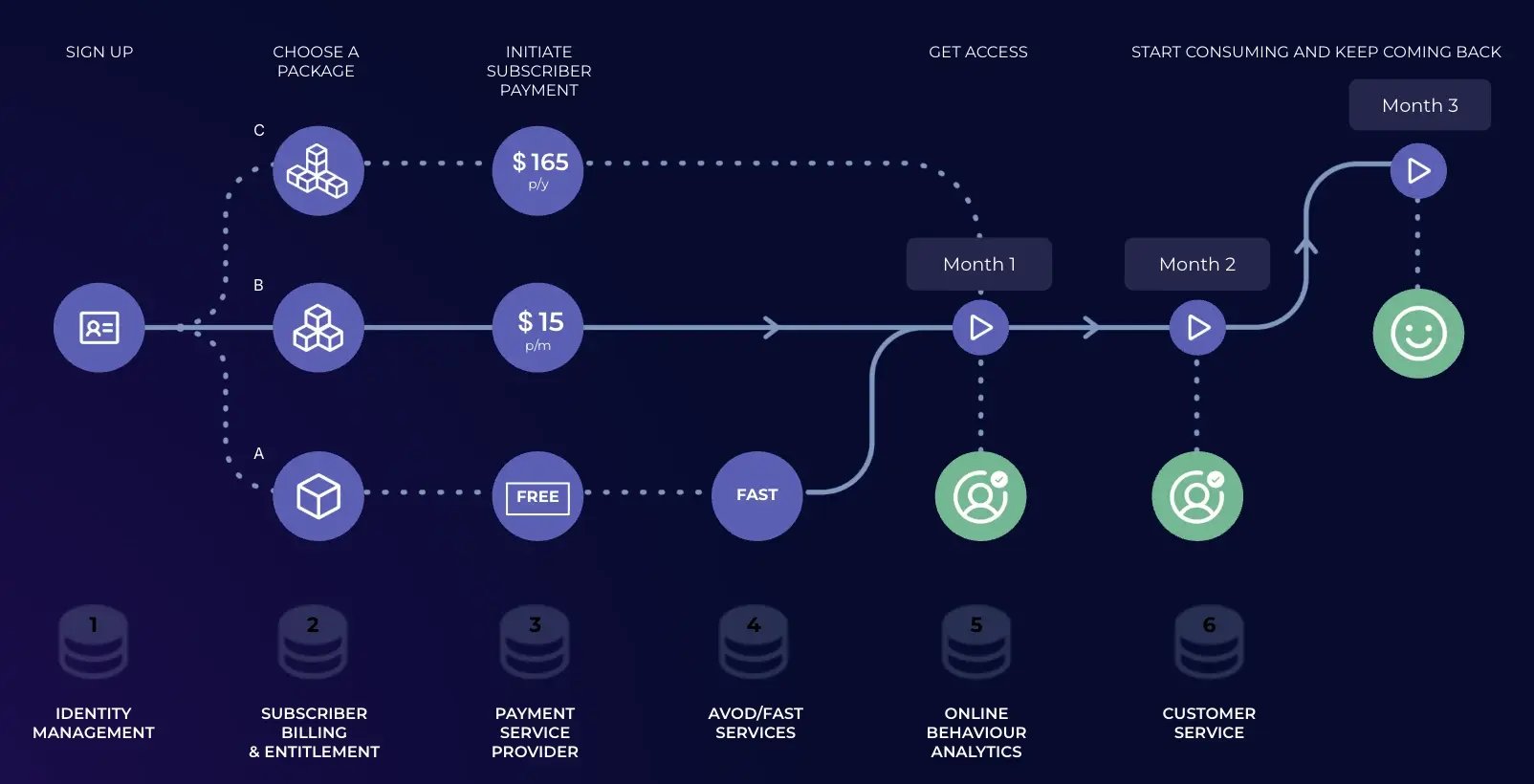
See below the full Cleeng subscriber flow:
## **Cleeng Core + Stripe: subscriber infrastructure with your payment layer**
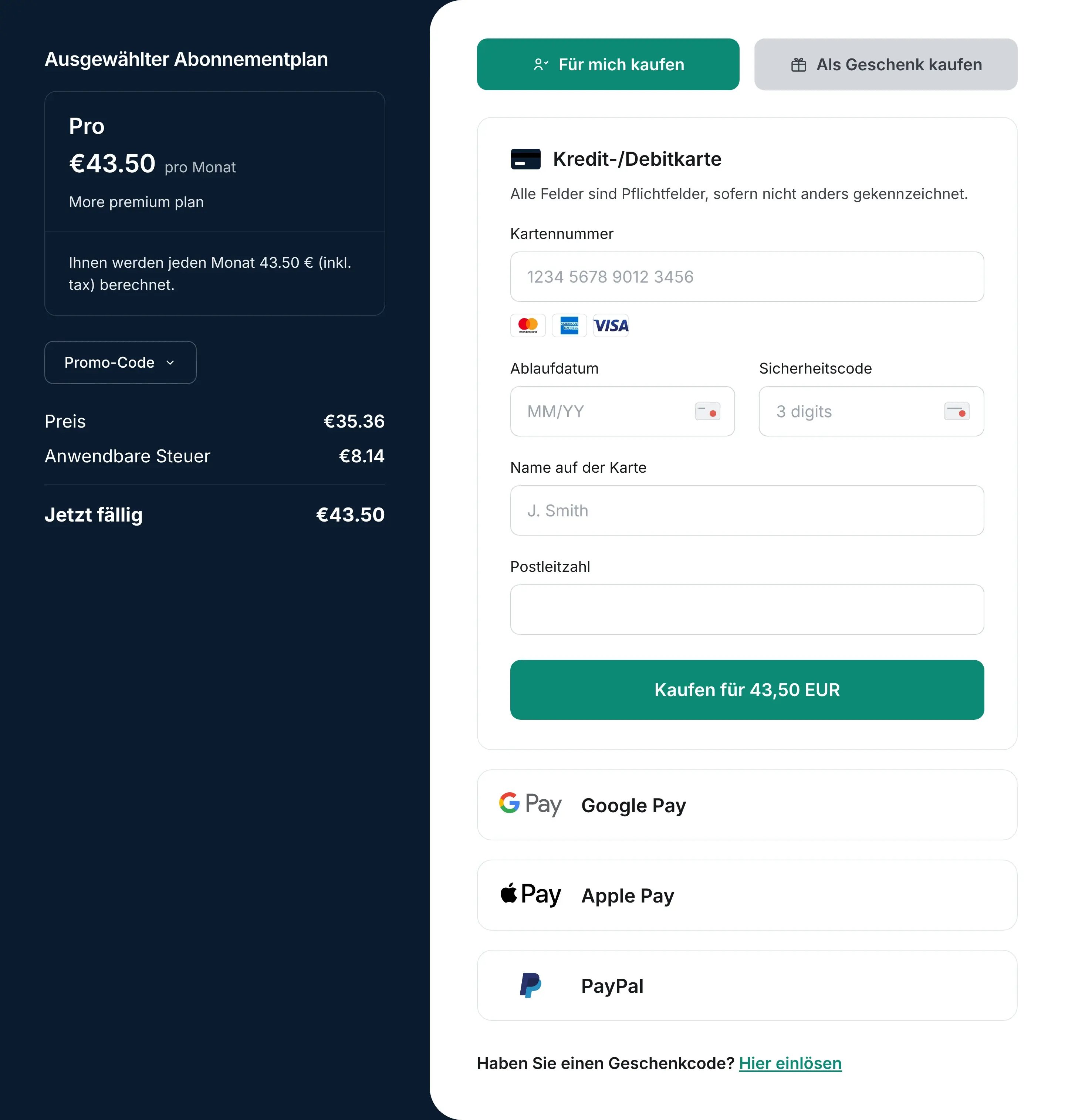
[Cleeng Core](https://cleeng.com/subscriber-management-system) is the subscriber lifecycle layer that sits on top of your existing Stripe account. It gives subscription businesses entitlements, access control, plan logic, add-on management, multi-phase promotions, churn analytics, and localized checkout flows – while payments continue to route through Stripe.
This is a practical choice for businesses that:
- Already have a Stripe integration and want to preserve it
- Operate in markets where Stripe's card network coverage is a priority
- Have negotiated custom Stripe rates they want to retain
- Need subscriber management capabilities that would otherwise require significant in-house engineering
In this setup, Stripe handles what it was designed for – payment processing – while Cleeng handles the subscriber lifecycle complexity that Stripe was not built to absorb. Tax compliance responsibility remains with the merchant, via Stripe Tax or an alternative solution.
Learn more about [Cleeng's integration with Stripe](https://cleeng.com/integrations-connectors/stripe).
## **Cleeng Merchant: full-stack subscriber and payment infrastructure**
[Cleeng Merchant](https://cleeng.com/products/merchant-of-record) extends Core by bringing payment processing and tax compliance in-house. Cleeng acts as the Merchant of Record, which means payment routing, VAT/GST/sales tax calculation and remittance across 13,000+ jurisdictions, and chargeback management are all handled by Cleeng rather than the merchant.
This model suits businesses that:
- Are expanding internationally and want to reduce tax compliance overhead
- Prefer a single commercial relationship for payments, billing, and subscriber management
- Want to consolidate fee visibility rather than managing multiple Stripe add-ons
- Are at a stage where operational simplicity outweighs the flexibility of a direct Stripe relationship
The trade-off is a degree of flexibility: merchants operate within Cleeng's PSP network rather than configuring their own Stripe account directly. For most D2C subscription brands, media, broadcasting, and OTT businesses, the operational gain is significant.
**Not sure which fits your tax exposure? [Talk to our team](https://cleeng.com/contact) about a Merchant of Record assessment.**
## **Stripe vs Cleeng Core vs Merchant: Which setup fits your business**
**There is no single right answer – it depends on where your business is today and where it's heading.**
**Stripe alone makes sense when:**
- Your subscription catalog is simple: one to three flat-rate plans, no add-ons
- You have strong in-house engineering and the capacity to own subscriber logic
- Speed to first transaction is the priority and complexity hasn't arrived yet
**Cleeng Core + Stripe makes sense when:**
- You need subscriber lifecycle capabilities that Stripe doesn't provide natively
- You want to keep Stripe as your payment processor for coverage, rate, or relationship reasons
- You're managing churn, running promotions, or expanding to new markets
**Cleeng Merchant makes sense when:**
- Global tax compliance is becoming a material operational cost or risk
- You want a single platform responsible for the full subscriber and payment stack
- You're scaling beyond the point where managing multiple Stripe add-ons is efficient
## **When migration becomes the right move**
The decision to move from Stripe alone to a Cleeng-based setup usually surfaces at one of three moments:
- The subscription catalog grows beyond two or three simple tiers and custom Stripe logic starts to accumulate
- International expansion creates a real reckoning with tax compliance obligations
- Engineering time spent maintaining subscriber plumbing begins competing meaningfully with product development
Cleeng's free tier, [covering up to 10,000 subscribers with no integration fees,](https://cleeng.com/pro) means there's no financial barrier to validating Core before committing. The platform is API-first, with over 35 pre-built connectors across video, CTV, marketing, support, and more. The architecture is designed to be open: Cleeng Core sits alongside your existing stack, and the step from Core to Merchant is a configuration decision rather than a rebuild.
## **Real fees: what you're actually paying**
Stripe's base rate is straightforward. But subscription businesses don't run on base Stripe — they combine Stripe Payments with Stripe Billing, and often add Stripe Tax and Stripe Radar on top. Fees compound across each layer.
This calculator shows the full fee picture with our [Stripe vs. Cleeng fees calculator](https://cleeng.com/stripe-fees-calculator).
**[](https://blog.cleeng.com/hs/cta/wi/redirect?encryptedPayload=AVxigLK2%2Bs8CcSDzifi9B60YdR6w%2F5Eauzhnn15z6PtDbMZhU%2FEKP8nHzxkVOdRBZg71K6cxbt0QTnz5Yaj5mECGnWTgrgkNUexmDMuQxZmGR1soUjoip%2F8r%2BVkM7guvsKg4kytDy%2FAXmIuDNcpeSUgWRhIMN%2Fq%2Fw15P5pm98B8rEE58i9Yd8ZnA5mOxXNnOFf69sS7Zfy4%3D&webInteractiveContentId=218250965393&portalId=5813983)**
What is a Merchant of Record?
A Merchant of Record (MoR) is the legal entity that processes a payment and takes on responsibility for tax collection, remittance, and compliance in the buyer's jurisdiction. When Cleeng acts as Merchant of Record, it – not you — carries that liability.
Does Stripe offer Merchant of Record services?
Yes, but with limits. Since April 2025, Stripe Managed Payments lets Stripe act as Merchant of Record for eligible transactions, covering tax compliance and remittance in 75+ countries. However, it's a feature within Stripe's payments stack rather than a standalone MoR model: it excludes several major markets, leaves some compliance and dispute responsibility with the merchant, and adds a 3.5% fee per successful transaction (calculated on the tax-inclusive amount). Cleeng, by contrast, offers Merchant of Record as a primary service — Cleeng becomes the legal seller across all supported transactions, not on a per-eligibility basis. Stripe Tax remains a separate, calculation-only tool where you stay the Seller of Record.
What's the difference between Cleeng Core and Cleeng Merchant?
Both give you the same subscriber lifecycle tools – entitlements, plan logic, churn analytics, localized checkout. Cleeng Core routes payments through your existing Stripe account; Cleeng Merchant replaces that with Cleeng acting as Merchant of Record, taking on payment processing and tax liability directly.
How much do Stripe fees actually cost for a subscription business?
Base Stripe Payments pricing is 2.9% + $0.30 per transaction, plus roughly 0.7% for Stripe Billing. Add-ons like Stripe Tax (+0.5%) and, where enabled, Stripe Managed Payments (+3.5%) stack on top — pushing the effective all-in rate toward 4–5% for international subscriptions, or ~6.4% + $0.30 domestic with Managed Payments. Use the fee calculator to model your actual cost based on volume.
### Popular posts
#### [How to Localize Pricing for Global Streaming in 2026 Read more →](https://blog.cleeng.com/how-to-localize-pricing-for-global-streaming)
#### [Google Play Billing, Done Right: 2026 Guide for Subscription Brands Read more →](https://blog.cleeng.com/google-play-billing-subscriptions)
#### [International VAT for US Streaming Subscriptions Read more →](https://blog.cleeng.com/international-vat-for-us-streaming-subscriptions)
#### [Payment Platforms for Subscriptions: Cleeng, Recurly, Chargebee & Paddle Read more →](https://blog.cleeng.com/cleeng-recurly-chargebee-paddle-which-platforms-wins-at-global-subscription-payments)
### Get started free
Create a free account to see what your subscription data could tell you – no credit card required.
[Start free](https://srm.cleeng.com/auth/register)
### Related posts
#### [ Payments, Tax & Compliance How to Localize Pricing for Global Streaming in 2026 **Kamila Palka** · Sep 7, 2026, 9:59:13 AM](https://blog.cleeng.com/how-to-localize-pricing-for-global-streaming)
#### [ Payments, Tax & Compliance Google Play Billing, Done Right: 2026 Guide for Subscription Brands **Kübra Güven** · Aug 31, 2026, 4:15:23 PM](https://blog.cleeng.com/google-play-billing-subscriptions)
#### [ Payments, Tax & Compliance International VAT for US Streaming Subscriptions **Kamila Palka** · Aug 27, 2026, 10:47:30 AM](https://blog.cleeng.com/international-vat-for-us-streaming-subscriptions)
Your Subscriber Retention Management® solution
[Contact us](https://cleeng.com/contact)
#### Ask AI for info
- [ChatGPT](https://chatgpt.com/?q=...)
- [Gemini](https://gemini.google.com/app?q=...)
- [Claude](https://claude.ai/new?q=...)
- [Perplexity AI](https://www.perplexity.ai/?q=...)
#### Products
- [Subscriber management and billing](https://cleeng.com/subscriber-management-system)
- [Merchant of Record](https://www.cleeng.com/products/merchant-of-record)
- [Churn Analytics](https://cleeng.com/churniq-churn-intelligence)
- [AI-Enhanced Customer Care](https://cleeng.com/pro)
#### Solutions
- [Streaming and OTT](https://www.cleeng.com/solutions/streaming)
- [Sports](https://cleeng.com/subscription-management-for-sports)
- [Wellness](https://cleeng.com/wellness)
- [Creators](https://www.cleeng.com/solutions/youtube-creators)
- [Enterprise](https://cleeng.com/solutions/enterprise)
- [Small and Medium Businesses](https://cleeng.com/pro)
#### Developer
- [API Reference](https://developers.cleeng.com/reference/apireference-overview)
- [Sandbox](https://srm-sandbox.cleeng.com/register)
- [Tutorials](https://developers.cleeng.com/docs/getting-started-with-cleeng)
- [Integrations](https://cleeng.com/integrations-connectors)
- [Migration](https://cleeng.com/integrations-connectors)
#### About
- [Company](https://cleeng.com/about-us)
- [Blog](https://blog.cleeng.com/)
- [Sustainability](https://cleeng.com/sustainability)
- [Careers](https://cleeng.com/careers)
#### Explore
- [Pricing](https://cleeng.com/pricingpro)
- [My Dashboard](https://srm.cleeng.com/login)
- [FAQ & support](https://publisher.support.cleeng.com/hc/en-us)
#### Customers
- [Who are Cleeng](https://cleeng.com/who-are-cleeng)
- [Get Support](https://cleeng.zendesk.com/hc/en-us/)
Copyright © 2026 Cleeng | All Rights Reserved | [Terms & Conditions](https://cleeng.com/master-service-agreement)
```json
{
"@context" : "https://schema.org",
"@type" : "BlogPosting",
"author" : {
"@type" : "Person",
"name" : "Enzo Bermond"
},
"dateModified" : "2026-08-14T13:49:24Z",
"datePublished" : "2026-07-29T09:24:43Z",
"description" : "Stripe vs. Cleeng: Stripe processes payments, but who owns your tax compliance? Compare both setups on fees, subscriber lifecycle, and Merchant of Record.",
"headline" : "Stripe vs. Cleeng: Which Subscription Billing Setup Fits Your Business?",
"image" : "https://5813983.fs1.hubspotusercontent-na1.net/hubfs/5813983/stripe%20vs%20cleeng%20stripe%20vs%20cleeng%20merchant.webp",
"mainEntityOfPage" : {
"@id" : "https://blog.cleeng.com",
"@type" : "WebPage"
},
"publisher" : {
"@type" : "Organization",
"logo" : {
"@type" : "ImageObject",
"url" : "https://cdn.prod.website-files.com/624eb5c51026869311f0668a/66b09c7ffb2cada498b8a184_Cleeng%20logo%20-%20tagline%20bottom%20-%20transparent.svg"
},
"name" : "Cleeng"
}
}
```
```json
{
"@context" : "https://schema.org",
"@id" : "https://blog.cleeng.com/stripe-vs-cleeng-subscription-billing",
"@type" : "FAQPage",
"mainEntity" : [ {
"@type" : "Question",
"acceptedAnswer" : {
"@type" : "Answer",
"text" : "A Merchant of Record (MoR) is the legal entity that processes a payment and takes on responsibility for tax collection, remittance, and compliance in the buyer's jurisdiction. When Cleeng acts as Merchant of Record, it — not you — carries that liability."
},
"name" : "What is a Merchant of Record?"
}, {
"@type" : "Question",
"acceptedAnswer" : {
"@type" : "Answer",
"text" : "Yes, but with limits. Since April 2025, Stripe Managed Payments lets Stripe act as Merchant of Record for eligible transactions, covering tax compliance and remittance in 75+ countries. However, it's a feature within Stripe's payments stack rather than a standalone MoR model: it excludes several major markets, leaves some compliance and dispute responsibility with the merchant, and adds a 3.5% fee per successful transaction (calculated on the tax-inclusive amount). Cleeng, by contrast, offers Merchant of Record as a primary service — Cleeng becomes the legal seller across all supported transactions, not on a per-eligibility basis. Stripe Tax remains a separate, calculation-only tool where you stay the Seller of Record."
},
"name" : "Does Stripe offer Merchant of Record services?"
}, {
"@type" : "Question",
"acceptedAnswer" : {
"@type" : "Answer",
"text" : "Both give you the same subscriber lifecycle tools — entitlements, plan logic, churn analytics, localized checkout. Cleeng Core routes payments through your existing Stripe account; Cleeng Merchant replaces that with Cleeng acting as Merchant of Record, taking on payment processing and tax liability directly."
},
"name" : "What's the difference between Cleeng Core and Cleeng Merchant?"
}, {
"@type" : "Question",
"acceptedAnswer" : {
"@type" : "Answer",
"text" : "Base Stripe Payments pricing is 2.9% + $0.30 per transaction, plus roughly 0.7% for Stripe Billing. Add-ons like Stripe Tax (+0.5%) and, where enabled, Stripe Managed Payments (+3.5%) stack on top — pushing the effective all-in rate toward 4–5% for international subscriptions, or ~6.4% + $0.30 domestic with Managed Payments. Use the fee calculator to model your actual cost based on volume."
},
"name" : "How much do Stripe fees actually cost for a subscription business?"
} ]
}
```
```json
{
"@context" : "https://schema.org",
"@id" : "https://blog.cleeng.com/stripe-vs-cleeng-subscription-billing#breadcrumb",
"@type" : "BreadcrumbList",
"itemListElement" : [ {
"@type" : "ListItem",
"item" : "https://cleeng.com",
"name" : "Home",
"position" : 1
}, {
"@type" : "ListItem",
"item" : "https://cleeng.com/blog",
"name" : "Blog",
"position" : 2
}, {
"@type" : "ListItem",
"item" : "https://blog.cleeng.com/stripe-vs-cleeng-subscription-billing",
"name" : "Stripe vs. Cleeng: Which Subscription Billing Setup Fits Your Business?",
"position" : 3
} ]
}
```
```json
{
"@context" : "https://schema.org",
"@type" : "Blog",
"description" : "Insights and strategies on subscriber retention and D2C subscriptions from Cleeng.",
"name" : "Cleeng Blog",
"publisher" : {
"@type" : "Organization",
"logo" : {
"@type" : "ImageObject",
"url" : "https://cdn.prod.website-files.com/624eb5c51026869311f0668a/66b09c7ffb2cada498b8a184_Cleeng%20logo%20-%20tagline%20bottom%20-%20transparent.svg"
},
"name" : "Cleeng"
},
"url" : "https://blog.cleeng.com"
}
```