---
title: Why MCP Servers Will Transform Subscriber Management (+ Why Cleeng Built One)
description: An MCP server connects AI assistants to your subscription platform. Here's what that means and why Cleeng built one for subscriber management and retention.
image: https://blog.cleeng.com/hubfs/Why%20MCP%20Servers%20Will%20Transform%20Subscriber%20Management%20(+%20Why%20Cleeng%20Built%20One).webp
---
Products
What it does
[Core Subscriber Management and Billing](https://cleeng.com/subscriber-management-system) [Merchant of Record Payments, Tax and Compliance](https://cleeng.com/merchant-checkout-optimization) [ChurnIQ Smart and Predictive Churn Analytics](https://cleeng.com/products/subscription-churn-analytics) [Hi5 AI-Enhanced Customer Care](https://cleeng.com/customer-care-digital-subscriptions)
AI Products
[Cleeng AI Ask questions in plain language](https://cleeng.com/ai) [Cleeng MCP Server Connect Cleeng to your own AI tools](https://cleeng.com/ai/mcp) [Data Intelligence Enriched context for every subscriber](https://cleeng.com/ai/subscriber-data) [Trust & Governance Complete control and auditability](https://cleeng.com/ai/legal)
Solutions
By industry
[Streaming and OTT](https://cleeng.com/solutions/streaming) [Sports](https://cleeng.com/solutions/subscription-management-for-sports) [Wellness](https://cleeng.com/solutions/wellness) [Creators](https://cleeng.com/solutions/youtube-creators) [Gaming](https://cleeng.com/solutions/gaming) [Memberships](https://cleeng.com/solutions/memberships)
By scale
[Enterprise](https://cleeng.com/solutions/enterprise) [Small and Medium Businesses](https://cleeng.com/pro)
For partners
[Agencies & Integrators](https://cleeng.com/solutions/agencies) [B2B2C Platforms](https://cleeng.com/solutions/b2b2c-platforms)
Developers
[Launch Subscriptions](https://developers.cleeng.com/docs/launch-subscriptions) [Build with LLMs](https://developers.cleeng.com/docs/build-with-llms) [Integrate apps](https://developers.cleeng.com/docs/payments_on_mobile_tv_apps_intro) [System status](http://status.cleeng.com/) [Integrations Hub](https://cleeng.com/integrations-connectors) [Migration guide](https://cleeng.com/migrate-to-cleeng) [Certified Partner Program](https://publisher.support.cleeng.com/hc/en-us/articles/22272169788188-Cleeng-Certified-Partner-Program)
Resources
[Publisher Help Center](https://publisher.support.cleeng.com/hc/en-us) [Blog](https://blog.cleeng.com/) [Customer stories](https://cleeng.com/clients) [Events](https://cleeng.com/events) [Research & reports](https://cleeng.com/resources) [Demo Hub](https://cleeng.com/demohub)
[Pricing](https://cleeng.com/pricing)
[Login](https://srm.cleeng.com/auth) [Get started free](https://srm.cleeng.com/auth/register)
[Blog](https://cleeng.com/blog)
# Why MCP Servers Will Transform Subscriber Management (+ Why Cleeng Built One)
Platform Infrastructure | Kamila Palka | Sep 2, 2026
.webp)
Traditional AI models could tell you which subscribers were likely to churn. Today’s AI agents can do something about it. An MCP server is what connects agents like Claude or OpenAI’s tools directly to your subscription platform, giving them access to subscriber data and the ability to take action. If you've been evaluating how agentic AI tools are supposed to plug into the stack you already run, an MCP server is the piece that makes that possible without a custom integration for every tool.
## TL;DR
Model Context Protocol (MCP) is an open standard that lets an AI tool connect to real software and act inside it. Several subscription tools – now including Cleeng – have shipped their own MCP servers in 2026. Most cover one slice of the stack (analytics, marketing, or feedback). The Cleeng MCP Server is built to cover the full subscriber lifecycle – retention, monetization, integrations, and support – through one connection.
## **What is an MCP server?**
Model Context Protocol (MCP) is an open standard for connecting an AI tool to a piece of software so it can understand that software's context and take real action inside it – not just answer questions about publicly available information. An "MCP server" is the specific connection a company builds to expose its own product to MCP-aware assistants like Claude or OpenAI's tools.
Before MCP, connecting an AI tool to a specific tool meant a custom, one-off integration – one build per assistant, one contract, one thing for a dev team to maintain. MCP replaces that with one connection any MCP-aware assistant can use.
## **Why subscription platforms are shipping their own MCP servers**
Cleeng isn't the only [subscription management platform](https://cleeng.com) doing this, and it's worth knowing the landscape before evaluating any one of them. Several subscription and retention-adjacent platforms have shipped their own MCP servers in 2026, each covering a different slice of the stack and each with real limits worth understanding before assuming any of them overlaps with what Cleeng's MCP Server does.
| | **Cleeng MCP Server** | **Stripe MCP** | **RevenueCat MCP** |
| --- | --- | --- | --- |
| **Primary focus** | Full subscriber lifecycle – retention, monetization, integrations, support, billing | Payment processing, customer and financial operations | In-app purchase and mobile subscriber entitlement lookups |
| **AI architecture** | Multi-agent: specialized agents share one connection and one data foundation | Single agent / tool API, direct endpoint access | Single agent / tool API, entitlement and purchase lookups |
| **Best for** | Digital subscriptions, media/OTT teams running full-stack retention operations | Developers building payment flows into AI agents | Mobile teams checking subscriber status and entitlements |
| **What it doesn't do** | | Doesn't understand churn or retention patterns, and doesn't manage entitlements beyond payments | Doesn't manage billing, support, or retention actions |
- **Stripe's MCP server** gives an AI agent access to payment processing, customer records, and financial operations. It's genuinely useful for a developer wiring payment actions into an agent, but it has no concept of churn, retention, or subscriber lifecycle beyond the transaction itself.
- **RevenueCat's MCP server** is built for mobile teams looking up a subscriber's entitlements or purchase history on iOS/Android. It answers "what does this subscriber have," not "why are subscribers leaving" or "what should we do about it."
None of these connects an assistant to the operational side of a subscription business the way Cleeng's does: managing entitlements, executing billing actions, resolving a subscriber's support case, or launching a new offer, all from the same connection.
## **What the Cleeng MCP server actually does for subscriber retention**
The Cleeng MCP Server is one connection to the *entire* subscriber lifecycle, not one slice of it. Use it with Claude, OpenAI's tools, or another assistant your team already works in, and a team of specialized agents gets access to the full range of subscriber retention operations – in natural language, not a dashboard.
Connecting takes three steps:
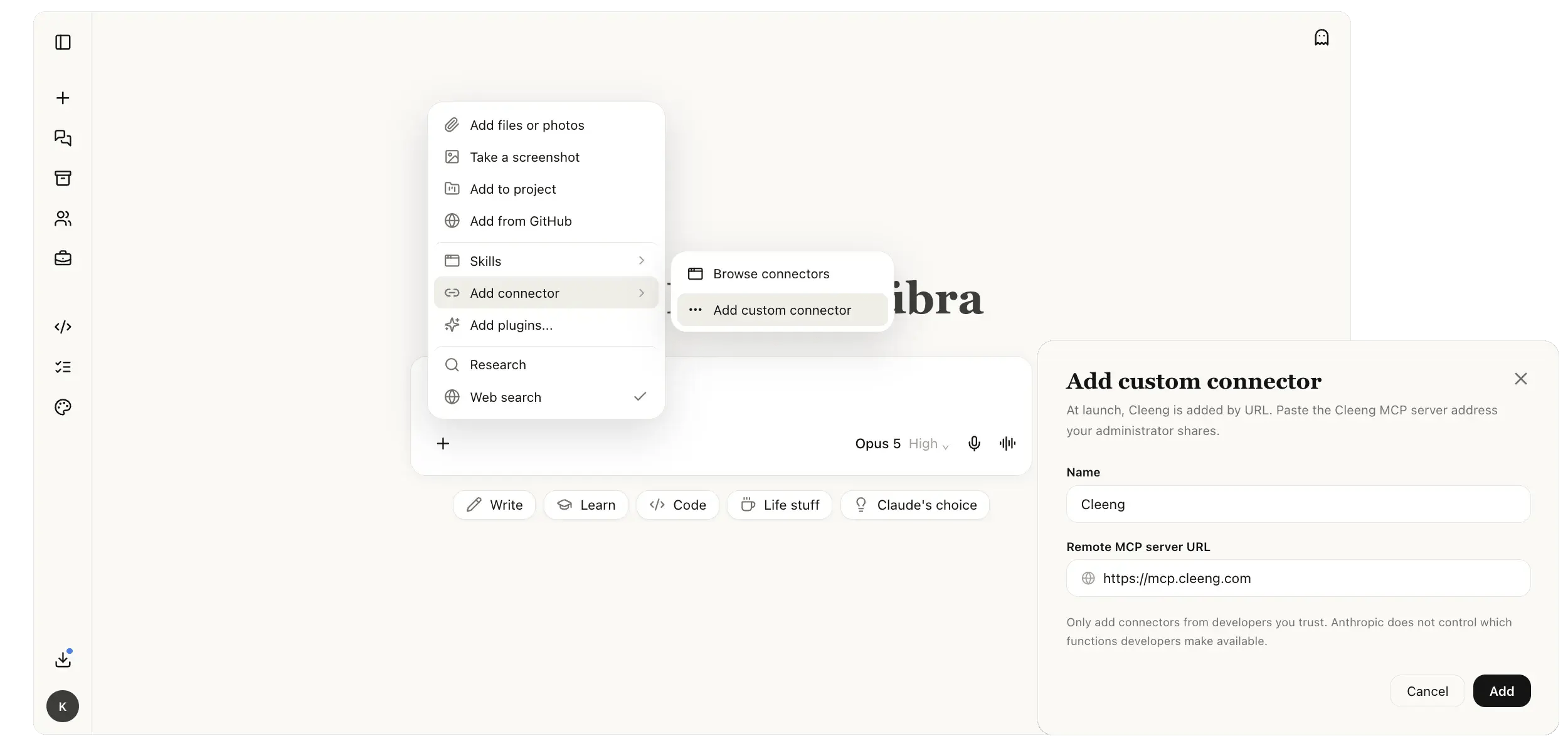
**1. Connect to Cleeng** – add Cleeng as a custom connector to your favorite AI tool, for examle, Claude, as shown below.
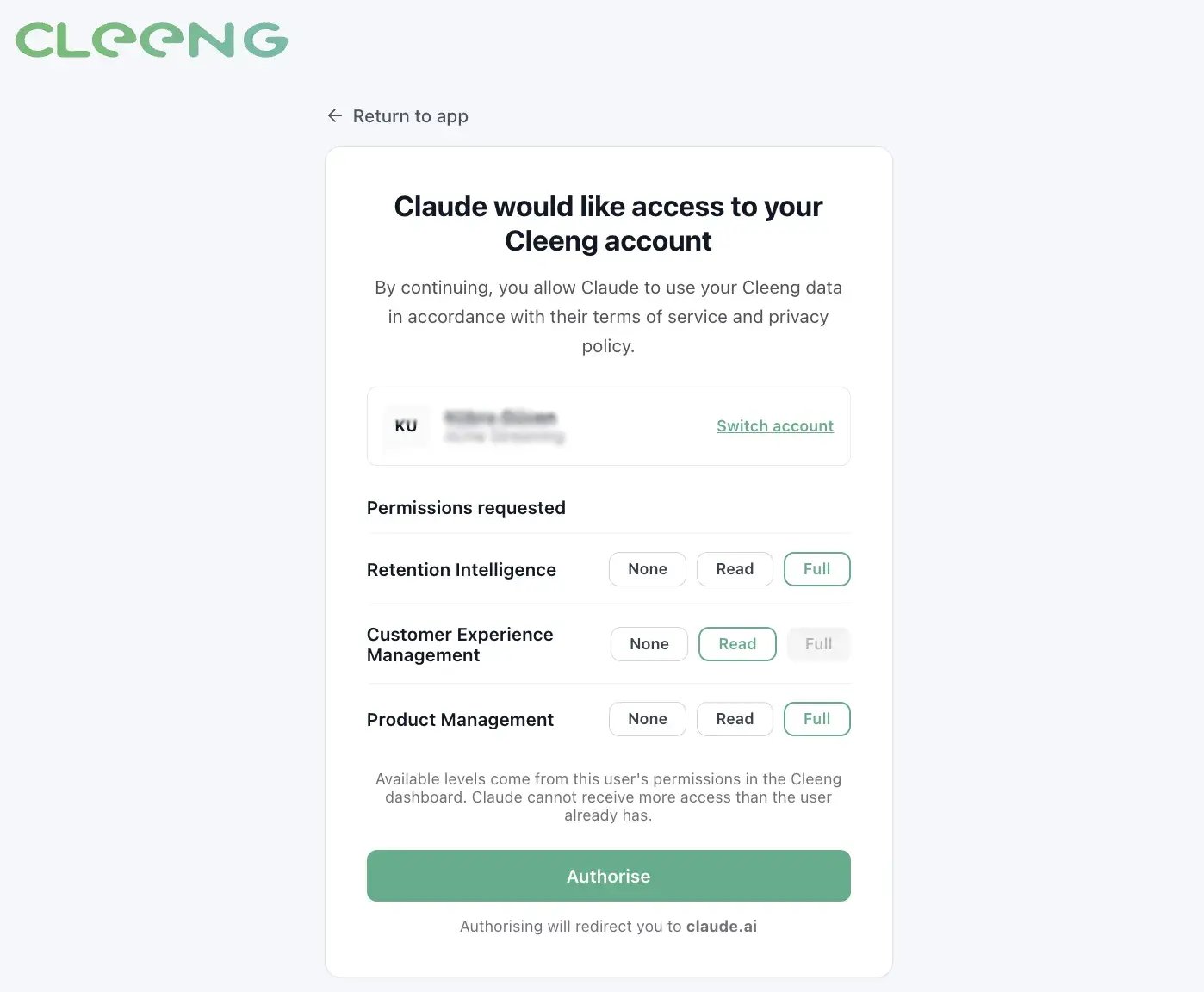
**2. Give permissions** – give the agent permissions and access to certain data and capabilities. You decide what the agent can access, read, edit, and act on.
****
**3. Instruct your agent** – ask a real question in plain language, watch how the work gets done, and adjust as you go.
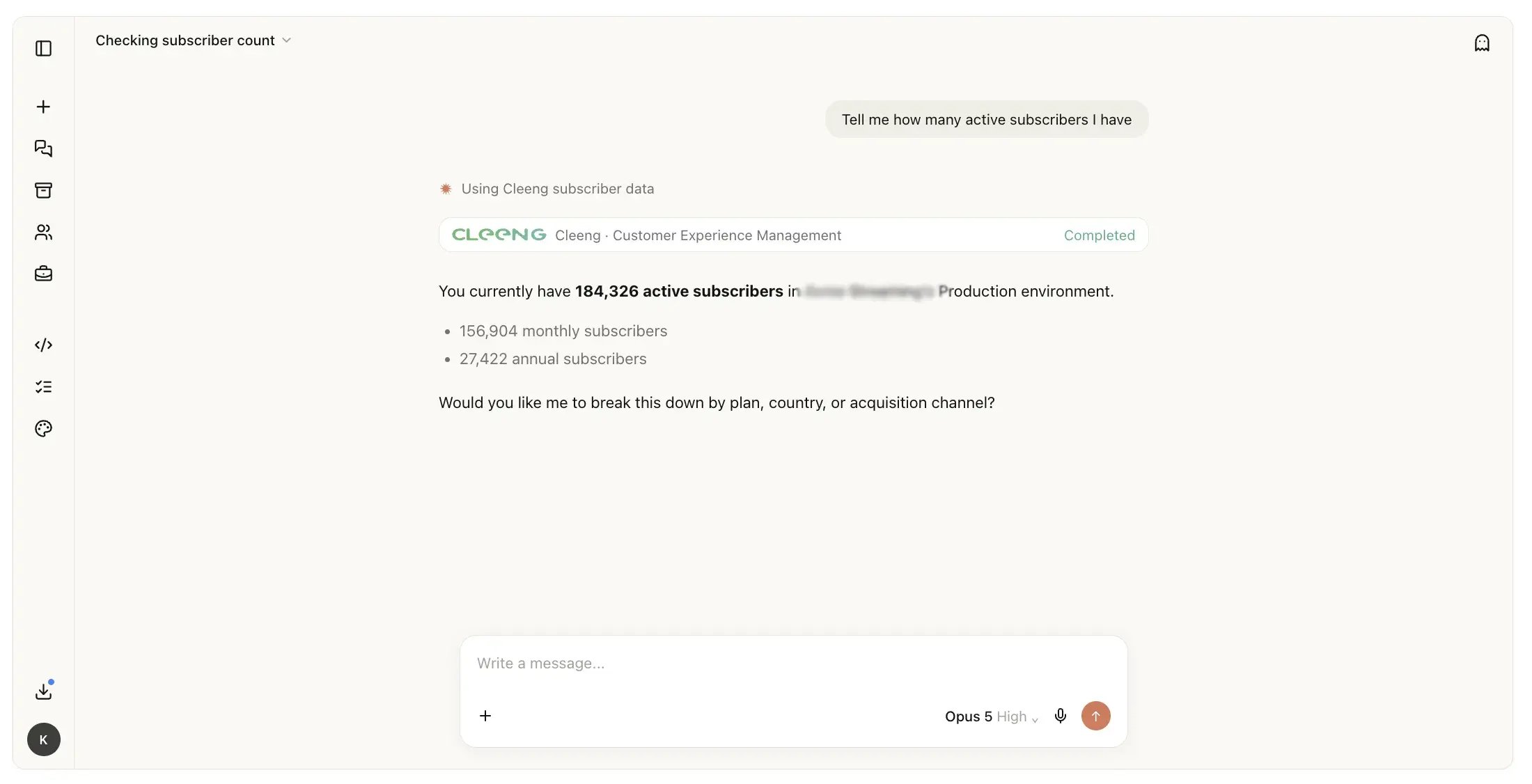
*The Cleeng MCP server is built and hosted by Cleeng. Adding it to your Claude account lets your own Claude assistant read Cleeng data on your behalf, within your existing dashboard permissions. This is not a Cleeng provided AI feature and is not an endorsement of, or warranty regarding, Claude or Anthropic. You are connecting your own AI tool to your own Cleeng data, at your own discretion. Data your Claude account retrieves from Cleeng is subject to your agreement with Anthropic once it reaches Claude.*
## **One connection, not one integration per assistant**
This is the detail that matters most for a dev or config lead comparing options: Cleeng MCP Server is one connection, not a separate build for every assistant your teams want to use, and not a custom integration for every task. The same connection underpins retention intelligence, monetization, integrations, and customer support, so a packaging change, a subscriber lookup, and a churn-risk save all run through the same governed layer, instead of three different point tools each with their own MCP server, their own permissions model, and their own audit trail to check.
## **Cleeng MCP is grounded in data no generic connector has**
An MCP connection is only as useful as what's behind it. A lookup-only MCP server can tell you what's true right now; it can't tell you why, or what's likely to happen next. Cleeng's agents are grounded in multi-channel subscriber data across web, iOS, Android, Roku, and telco, and in Cleeng's own data lake and machine-learning models built over 15 years – not a generic pass-through to whatever data happens to be in the request. That's the difference between an agent that can *look up* a subscriber and one that understands the retention pattern behind them.
## **With Cleeng, you stay in control**
Control doesn't disappear because it's an agent, and it doesn't disappear because there's an open connection either. Permission roles are granted per user, and both what an agent can read and what it's allowed to write are confirmed, not assumed. You can see what happened, who asked for it, and what changed.
Ready to see it in action? [Book a meeting with Cleeng at IBC 2026](https://cleeng.com/events/ibc-2026) or create a free account.
[](https://blog.cleeng.com/hs/cta/wi/redirect?encryptedPayload=AVxigLLXdnN900uIUNXhuzXC3x9EfAzeOnogFBdlbvSbAWqCgvt8i5SrzkYC%2B%2BdIWS4ptGOz2P%2FR0ry6ldvxwhOrP9DIwnyQ3N%2B2cdVR3tYbs1jvWigFVhLjUW%2B3ildGsgBgJORj0HHCndPXyuJtRVUI9OgouODbqx9aYmbiomyqTQ8O3jp6U86Qrj%2F4b4aKAW92lWYdy6ts&webInteractiveContentId=220928526688&portalId=5813983)
## **FAQ**
**What is MCP (Model Context Protocol)?** MCP is an open standard that lets AI tools connect to software and take real action inside it, rather than just retrieving information about it.
**Which subscription and retention tools have their own MCP server?** Several have shipped one in 2026, each covering a different function: RevenueCat (subscriber and entitlement lookups), Klaviyo (email/SMS campaign data), Chattermill (customer feedback data), and Cleeng (the full subscriber retention lifecycle – intelligence, monetization, integrations, and support).
**How is the Cleeng MCP Server different from other subscription MCP servers?** Most existing subscription MCP servers expose one slice of the stack – analytics, marketing data, or feedback. The Cleeng MCP Server connects an assistant to the full subscriber lifecycle through one connection, grounded in Cleeng's own retention data rather than a generic pass-through.
**Which AI tools work with the Cleeng MCP Server?** The Cleeng MCP Server is built to work with assistants like Claude and OpenAI's tools – the ones publishers already use day to day.
**Do I need a developer to set up the Cleeng MCP Server?** No custom integration is required – it's one connection, configured through the same login you already use for Cleeng.
### Popular posts
#### [How to Migrate Subscribers to a New Platform Without Losing Renewals Read more →](https://blog.cleeng.com/how-to-migrate-subscribers-to-a-new-platform)
#### [Meet Cleeng's AI Agent Team: How Launch, Run, and Grow Work Together Read more →](https://blog.cleeng.com/cleengs-ai-agent-team)
#### [Google Play Billing, Done Right: 2026 Guide for Subscription Brands Read more →](https://blog.cleeng.com/google-play-billing-subscriptions)
#### [Agentic AI for Subscriber Retention Is Here: What It Means for D2C & OTT Brands Read more →](https://blog.cleeng.com/agentic-ai-for-subscriber-retention-d2c-ott)
### See your whole business clearly.
Connect your data and watch your live dashboard fill in — no credit card required.
[Start free](https://srm.cleeng.com/register)
### Related posts
#### [ Platform Infrastructure How to Migrate Subscribers to a New Platform Without Losing Renewals **Kübra Güven** · Sep 18, 2026, 1:05:16 PM](https://blog.cleeng.com/how-to-migrate-subscribers-to-a-new-platform)
#### [ Platform Infrastructure Meet Cleeng's AI Agent Team: How Launch, Run, and Grow Work Together **Kamila Palka** · Sep 9, 2026, 4:47:15 PM](https://blog.cleeng.com/cleengs-ai-agent-team)
#### [ Payments, Tax & Compliance Google Play Billing, Done Right: 2026 Guide for Subscription Brands **Kübra Güven** · Aug 31, 2026, 4:15:23 PM](https://blog.cleeng.com/google-play-billing-subscriptions)
Your Subscriber Retention Management® solution
[Contact us](https://cleeng.com/contact)
#### Ask AI for info
- [ChatGPT](https://chatgpt.com/?q=...)
- [Gemini](https://gemini.google.com/app?q=...)
- [Claude](https://claude.ai/new?q=...)
- [Perplexity AI](https://www.perplexity.ai/?q=...)
#### Products
- [Subscriber management and billing](https://cleeng.com/subscriber-management-system)
- [Merchant of Record](https://www.cleeng.com/products/merchant-of-record)
- [Churn Analytics](https://cleeng.com/churniq-churn-intelligence)
- [AI-Enhanced Customer Care](https://cleeng.com/pro)
#### Solutions
- [Streaming and OTT](https://www.cleeng.com/solutions/streaming)
- [Sports](https://cleeng.com/subscription-management-for-sports)
- [Wellness](https://cleeng.com/wellness)
- [Creators](https://www.cleeng.com/solutions/youtube-creators)
- [Enterprise](https://cleeng.com/solutions/enterprise)
- [Small and Medium Businesses](https://cleeng.com/pro)
#### Developer
- [API Reference](https://developers.cleeng.com/reference/apireference-overview)
- [Sandbox](https://srm-sandbox.cleeng.com/register)
- [Tutorials](https://developers.cleeng.com/docs/getting-started-with-cleeng)
- [Integrations](https://cleeng.com/integrations-connectors)
- [Migration](https://cleeng.com/integrations-connectors)
#### About
- [Company](https://cleeng.com/about-us)
- [Blog](https://blog.cleeng.com/)
- [Sustainability](https://cleeng.com/sustainability)
- [Careers](https://cleeng.com/careers)
#### Explore
- [Pricing](https://cleeng.com/pricingpro)
- [My Dashboard](https://srm.cleeng.com/login)
- [FAQ & support](https://publisher.support.cleeng.com/hc/en-us)
#### Customers
- [Who are Cleeng](https://cleeng.com/who-are-cleeng)
- [Get Support](https://cleeng.zendesk.com/hc/en-us/)
Copyright © 2026 Cleeng | All Rights Reserved | [Terms & Conditions](https://cleeng.com/master-service-agreement)
```json
{
"@context" : "https://schema.org",
"@type" : "BlogPosting",
"author" : {
"@type" : "Person",
"name" : "Kamila Palka"
},
"dateModified" : "2026-09-07T04:25:08Z",
"datePublished" : "2026-09-02T13:10:01Z",
"description" : "An MCP server connects AI assistants to your subscription platform. Here's what that means and why Cleeng built one for subscriber management and retention.",
"headline" : "Why MCP Servers Will Transform Subscriber Management (+ Why Cleeng Built One)",
"image" : "https://5813983.fs1.hubspotusercontent-eu1.net/hubfs/5813983/Why%20MCP%20Servers%20Will%20Transform%20Subscriber%20Management%20%28%2B%20Why%20Cleeng%20Built%20One%29.webp",
"mainEntityOfPage" : {
"@id" : "https://blog.cleeng.com",
"@type" : "WebPage"
},
"publisher" : {
"@type" : "Organization",
"logo" : {
"@type" : "ImageObject",
"url" : "https://cdn.prod.website-files.com/624eb5c51026869311f0668a/66b09c7ffb2cada498b8a184_Cleeng%20logo%20-%20tagline%20bottom%20-%20transparent.svg"
},
"name" : "Cleeng"
}
}
```
```json
{
"@context" : "https://schema.org",
"@type" : "BlogPosting",
"author" : {
"@type" : "Organization",
"name" : "Cleeng",
"url" : "https://cleeng.com"
},
"dateModified" : "2026-09-02",
"datePublished" : "2026-09-02",
"description" : "An MCP server connects AI assistants to your subscription platform. Here's what that means, and why Cleeng built one for subscriber retention.",
"headline" : "What Is an MCP Server for Subscriber Retention? (And Why Cleeng Built One)",
"image" : "https://blog.cleeng.com/hubfs/why%20cleeng%20built%20an%20mcp%20server.webp",
"keywords" : "MCP server for subscriber retention, Cleeng MCP Server, Model Context Protocol, connect AI agents to subscription platform, MCP server for subscription business",
"mainEntityOfPage" : {
"@id" : "https://blog.cleeng.com/mcp-server-for-subscriber-retention",
"@type" : "WebPage"
},
"publisher" : {
"@type" : "Organization",
"logo" : {
"@type" : "ImageObject",
"url" : "https://5813983.fs1.hubspotusercontent-na1.net/hubfs/5813983/assets/cleenglogo.svg"
},
"name" : "Cleeng"
}
}
```
```json
{
"@context" : "https://schema.org",
"@type" : "FAQPage",
"mainEntity" : [ {
"@type" : "Question",
"acceptedAnswer" : {
"@type" : "Answer",
"text" : "MCP is an open standard that lets AI assistants connect to software and take real action inside it, rather than just retrieving information about it."
},
"name" : "What is MCP (Model Context Protocol)?"
}, {
"@type" : "Question",
"acceptedAnswer" : {
"@type" : "Answer",
"text" : "Several have shipped one in 2026, each covering a different function: Stripe (payment and customer operations), RevenueCat (mobile subscriber and entitlement lookups), Recurly (an official developer documentation assistant, plus a separate unofficial read-only billing-data server), and Cleeng (the full subscriber retention lifecycle — intelligence, monetization, integrations, and support)."
},
"name" : "Which subscription and billing tools have their own MCP server?"
}, {
"@type" : "Question",
"acceptedAnswer" : {
"@type" : "Answer",
"text" : "Most existing subscription and billing MCP servers expose one slice of the stack — payments, mobile entitlements, or developer documentation. The Cleeng MCP Server connects an assistant to the full subscriber lifecycle through one connection, grounded in Cleeng's own retention data rather than a single-purpose API pass-through."
},
"name" : "How is the Cleeng MCP Server different from other subscription MCP servers?"
}, {
"@type" : "Question",
"acceptedAnswer" : {
"@type" : "Answer",
"text" : "The Cleeng MCP Server is built to work with assistants like Claude and OpenAI's tools — the ones publishers already use day to day."
},
"name" : "Which AI assistants work with the Cleeng MCP Server?"
}, {
"@type" : "Question",
"acceptedAnswer" : {
"@type" : "Answer",
"text" : "No custom integration is required — it's one connection, configured through the same login you already use for Cleeng."
},
"name" : "Do I need a developer to set up the Cleeng MCP Server?"
} ]
}
```
```json
{
"@context" : "https://schema.org",
"@type" : "Blog",
"description" : "Insights and strategies on subscriber retention and D2C subscriptions from Cleeng.",
"name" : "Cleeng Blog",
"publisher" : {
"@type" : "Organization",
"logo" : {
"@type" : "ImageObject",
"url" : "https://cdn.prod.website-files.com/624eb5c51026869311f0668a/66b09c7ffb2cada498b8a184_Cleeng%20logo%20-%20tagline%20bottom%20-%20transparent.svg"
},
"name" : "Cleeng"
},
"url" : "https://blog.cleeng.com"
}
```