---
title: How to Localize Pricing for Global Streaming in 2026
description: Learn how D2C streaming services can set localized subscription pricing across global markets, covering currency, tax, payment methods, and conversion strategy.
image: https://blog.cleeng.com/hubfs/how-to-localize-pricing-for-global-streaming-v1-2400x1260.webp
---
Products
What it does
[Core Subscriber Management and Billing](https://cleeng.com/subscriber-management-system) [Merchant of Record Payments, Tax and Compliance](https://cleeng.com/merchant-checkout-optimization) [ChurnIQ Smart and Predictive Churn Analytics](https://cleeng.com/products/subscription-churn-analytics) [Hi5 AI-Enhanced Customer Care](https://cleeng.com/customer-care-digital-subscriptions)
AI Products
[Cleeng AI Ask questions in plain language](https://cleeng.com/ai) [Cleeng MCP Server Connect Cleeng to your own AI tools](https://cleeng.com/ai/mcp) [Data Intelligence Enriched context for every subscriber](https://cleeng.com/ai/subscriber-data) [Trust & Governance Complete control and auditability](https://cleeng.com/ai/legal)
Solutions
By industry
[Streaming and OTT](https://cleeng.com/solutions/streaming) [Sports](https://cleeng.com/solutions/subscription-management-for-sports) [Wellness](https://cleeng.com/solutions/wellness) [Creators](https://cleeng.com/solutions/youtube-creators) [Gaming](https://cleeng.com/solutions/gaming) [Memberships](https://cleeng.com/solutions/memberships)
By scale
[Enterprise](https://cleeng.com/solutions/enterprise) [Small and Medium Businesses](https://cleeng.com/pro)
For partners
[Agencies & Integrators](https://cleeng.com/solutions/agencies) [B2B2C Platforms](https://cleeng.com/solutions/b2b2c-platforms)
Developers
[Launch Subscriptions](https://developers.cleeng.com/docs/launch-subscriptions) [Build with LLMs](https://developers.cleeng.com/docs/build-with-llms) [Integrate apps](https://developers.cleeng.com/docs/payments_on_mobile_tv_apps_intro) [System status](http://status.cleeng.com/) [Integrations Hub](https://cleeng.com/integrations-connectors) [Migration guide](https://cleeng.com/migrate-to-cleeng) [Certified Partner Program](https://publisher.support.cleeng.com/hc/en-us/articles/22272169788188-Cleeng-Certified-Partner-Program)
Resources
[Publisher Help Center](https://publisher.support.cleeng.com/hc/en-us) [Blog](https://blog.cleeng.com/) [Customer stories](https://cleeng.com/clients) [Events](https://cleeng.com/events) [Research & reports](https://cleeng.com/resources) [Demo Hub](https://cleeng.com/demohub)
[Pricing](https://cleeng.com/pricing)
[Login](https://srm.cleeng.com/auth) [Get started free](https://srm.cleeng.com/auth/register)
[Blog](https://cleeng.com/blog)
# How to Localize Pricing for Global Streaming in 2026
Payments, Tax & Compliance | Kamila Palka | Sep 7, 2026
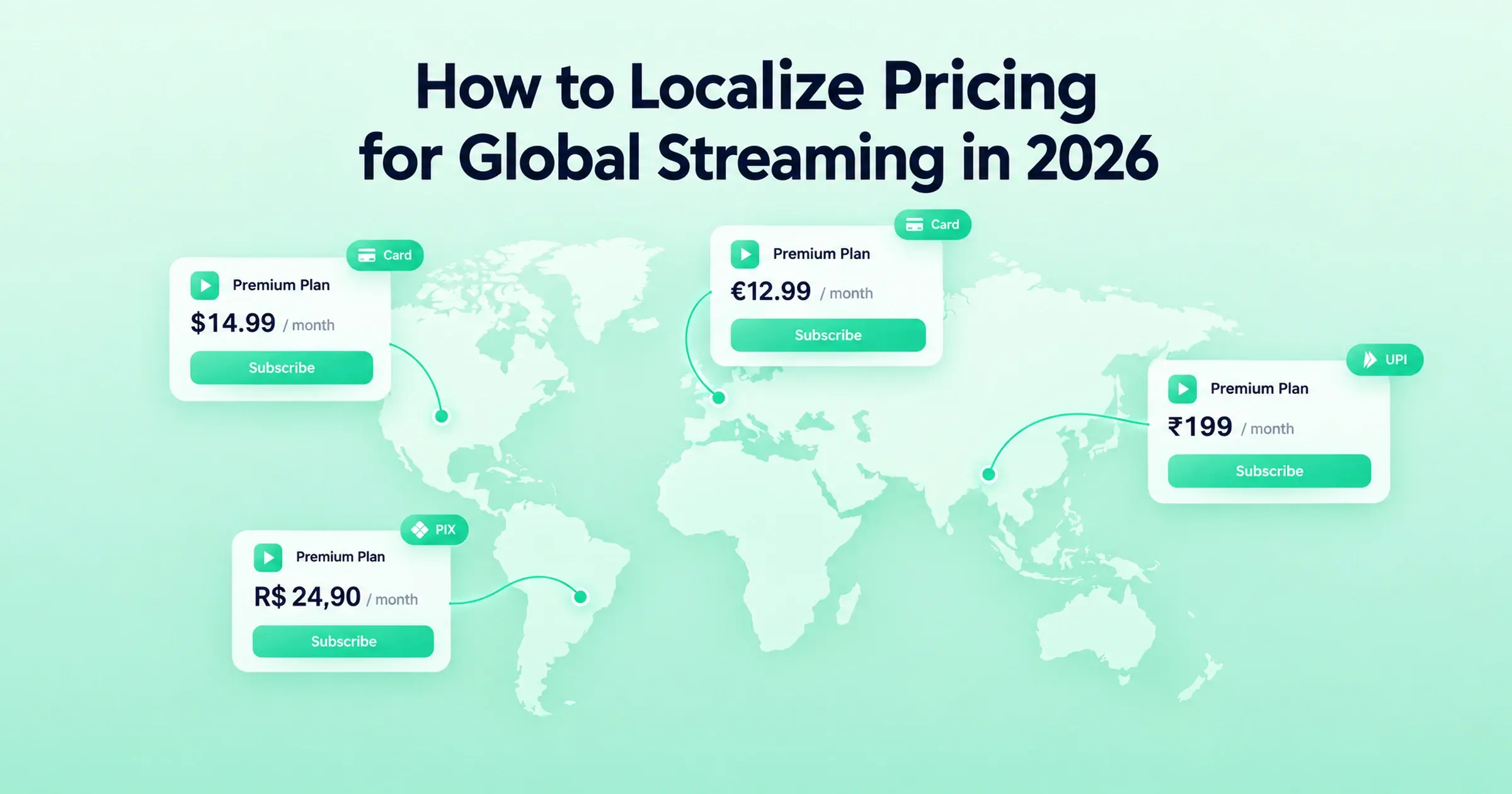
Running a global [D2C streaming service](https://cleeng.com) means facing a hard truth: a subscription price that works in one market can completely backfire in another. When your pricing ignores local standards, currency, and regional payment habits, you lose subscribers before they even reach checkout.
This guide breaks down the entire process of localized pricing for global subscriptions. You'll learn why adjusting prices by market matters, how to approach currency and tax decisions, which [local payment methods](https://blog.cleeng.com/local-payment-methods-for-global-subscription-growth) drive conversions regionally, and what metrics reveal whether your strategy is working.
## Key takeaways: the complete guide to localized pricing for global D2C streaming subscriptions
- Localized pricing goes beyond currency conversion to reflect regional purchasing power and willingness to pay.
- Cleeng helps streaming services manage **multi-currency pricing**, **tax compliance**, and **global payments from a single platform**.
- Local payment methods like Pix Automatico in Brazil can increase conversion rates significantly in those markets.
- Reviewing regional pricing every six months keeps your strategy aligned with currency fluctuations and market shifts.
## What is localized pricing for streaming subscriptions?
Localized pricing means adjusting your subscription rates for different geographic markets. It accounts for local purchasing power, competitive dynamics, payment preferences, and what a fair price looks like in each region.
This goes far beyond currency conversion. Showing a $10 price converted to rupees doesn't make your service affordable in India. True localization means setting a different price point altogether, one that reflects what that amount represents in the local economy.
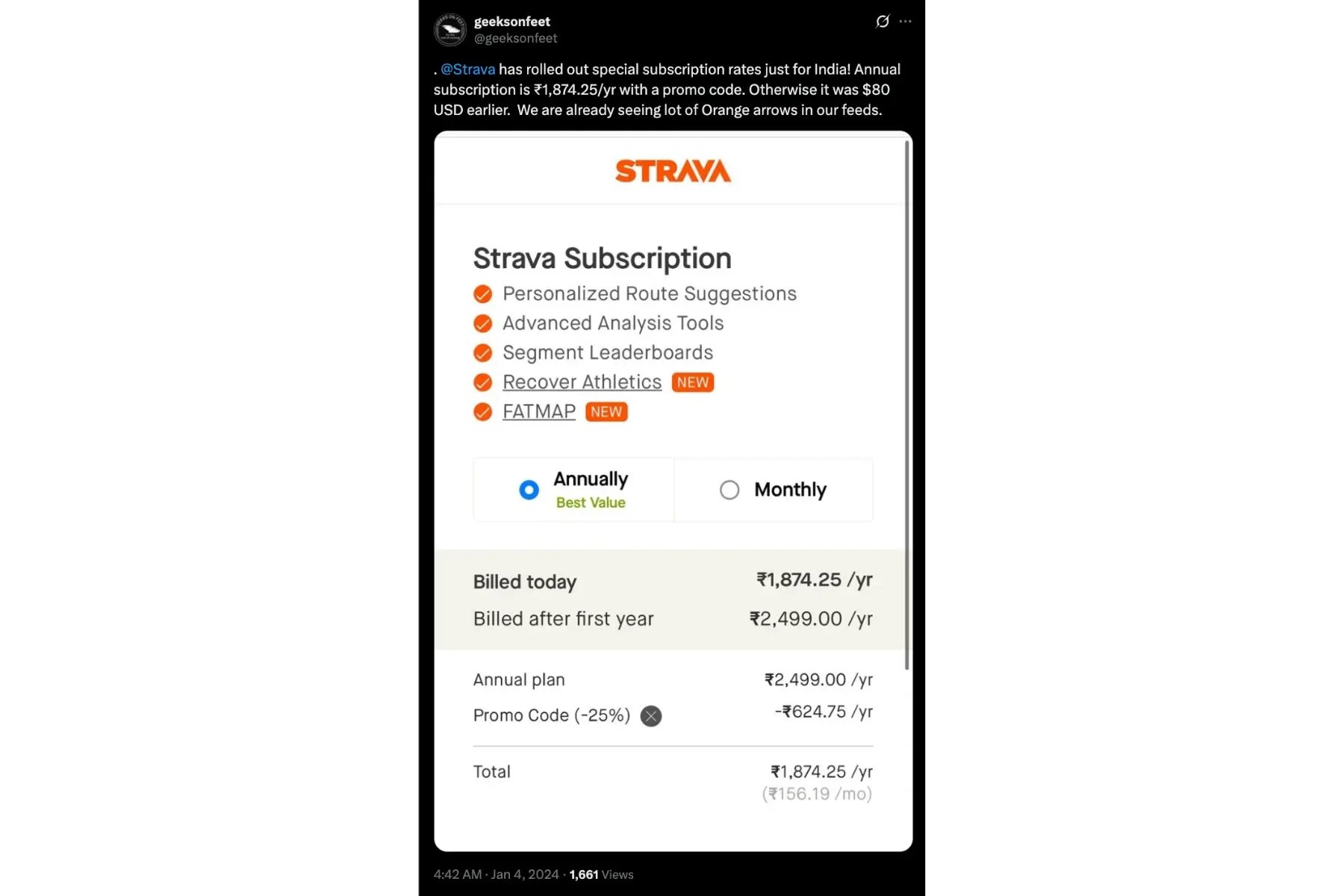*Example of localized pricing adopted by Strava in India*
For [D2C streaming businesses](https://cleeng.com/solutions/streaming), this distinction matters enormously. A subscriber in Jakarta calculating whether your monthly fee equals 20% of their weekly salary will close the tab. Someone in São Paulo seeing a price disconnected from local norms won't even consider signing up. That's why knowing local subscription prices in the regions you want to expand to is key to international success.
## Why does price localization matter for D2C streaming?
According to [Cleeng's 2026 subscription benchmarks](https://cleeng.com/resources/d2c-retention-benchmarks-2026), top-performing brands achieve a 66.1% trial-to-paid conversion rate. So if your home market converts at around 60%, but international visitors convert at 5%, the gap usually isn't about product interest but about pricing that represents a fundamentally different economic ask in different economies. [Localized pricing boosts international conversion rates by up to 4.7x in emerging markets](https://www.artisangrowthstrategies.com/blog/localized-pricing-guide-saas-growth), adding hundreds of new subscribers monthly from traffic you already have. The benefit extends beyond acquisition. Subscribers paying a price that feels fair relative to their income stay longer. A price that feels misaligned with local economic reality leads to faster churn.
## How do you determine the right price for each market?
Setting localized prices requires balancing multiple factors: purchasing power data, local competition, payment method availability, and regulatory requirements. Here's how to approach each one.
### 1. Using Purchasing Power Parity as your starting point
Purchasing Power Parity (PPP) measures what a unit of currency can actually buy in different countries. The World Bank publishes PPP conversion factors annually, giving you a baseline for adjusting prices.
A practical formula looks like this: Local Price = MAX(Base Price × (Local PPP / Base Market PPP), Minimum Viable Price). This ensures you adjust for purchasing power while maintaining a floor that covers your costs.
For example, if your base price is $10 and you're pricing for a market with a PPP ratio of 0.35, raw calculation gives $3.50. Round to a local-friendly number and verify it exceeds your minimum viable price. The result reflects what $10 means in that economy.
### 2. Benchmark discounts by region
Different regions typically require different adjustment levels. Western Europe might need 0-10% adjustments from your base price. Latin America often requires 40-55% reductions. India and South Asia commonly need 60-75% adjustments. Sub-Saharan Africa may require 60-80% reductions.
These ranges reflect what major streaming companies like Netflix and Spotify have discovered through extensive market research. Netflix doesn't just discount in India; they created a mobile-only plan tier that doesn't exist in the US, recognizing that mobile is the primary screen and affordability is the primary barrier.
For example, while Netflix can cost as much as $26.99 per month in the United States, [plans in Pakistan and Egypt offer the lowest rates](https://symlexvpn.com/netflix-price-by-country-comparison/?srsltid=AfmBOoqGjv3V8E5sf6o8gIxTyZkMA54CBVWBOFUMpwsO8KPg0Bm6OmpL), dropping to roughly $2.27 to $2.88 per month.
### 3. Analyzing local competitors
Looking at what established streaming services charge in each target market gives you valuable signal. Companies like Spotify, Netflix, and YouTube Premium have invested significantly in regional pricing research. Their price points indicate what consumers in those regions can and will pay.
## What role do currency and tax compliance play?
Displaying prices in local currency reduces cognitive load for subscribers. When someone sees a price in an unfamiliar currency, they have to know the exchange rate, do the math, and then evaluate whether the amount makes sense. Showing local currency eliminates that friction.
### Managing multi-currency pricing operationally
Running [multi-currency pricing](https://blog.cleeng.com/offer-localization-multi-currency-pricing-for-subscriptions) creates operational complexity. You need systems that handle currency conversion, maintain consistent price points across regions, and consolidate reporting into your home currency.
Cleeng supports 37+ currencies across 230 countries and territories, allowing streaming services to set region-specific prices while keeping financial reports centralized. This means you can maintain psychological pricing (like €9.99 in one market and $9.99 in another) without manual reconciliation. New currencies can be added on request.
### Handling tax variations across jurisdictions
Tax requirements vary dramatically by region. European VAT, Australian GST, Indian GST, and US state taxes all affect your margins and final displayed prices. Some regions require tax-inclusive pricing displays; others show taxes separately.
A [Merchant of Record solution](https://cleeng.com/products/merchant-of-record) can handle tax calculation, collection, and remittance automatically. This offloads the complexity of tracking 13,000+ tax jurisdictions while ensuring compliance with local regulations. You focus on pricing strategy while the platform handles the regulatory maze.
## Which payment methods should you offer regionally?
You can set the perfect localized price and still lose the sale if you don't accept payment methods subscribers actually use. Credit card penetration varies enormously by market, and many regions have dominant local alternatives.
### Key regional payment methods
India has UPI dominating digital payments, with credit cards concentrated mainly in affluent segments. Brazil relies heavily on PIX, with many consumers lacking international. Southeast Asia varies by country: GrabPay, GCash, and bank transfers have different adoption rates across Indonesia, Philippines, and Vietnam.
Offering [local payment methods](https://blog.cleeng.com/local-payment-methods-for-global-subscription-growth) can increase conversion rates where credit cards aren't the default. [Cleeng's payment infrastructure integrates 200+ payment methods](https://publisher.support.cleeng.com/hc/en-us/articles/7770013804444-Customer-Payment-Methods), allowing you to match payment options to regional preferences without building each integration yourself.
## How to structure subscription tiers for global markets?
Different markets may need different plan structures, not just different prices. The subscription options that work in your home market might not match how subscribers in other regions prefer to pay. Here's how to boost your chances for success.
- **Adapt plan length by market**. Some markets prefer monthly flexibility, while others favor annual commitments. In regions with lower purchasing power, weekly subscriptions can work as an entry point. Annual plans at a significant discount appeal to markets where consumers plan budgets further ahead.
- **Creating market-specific tiers**. Netflix's mobile-only plan in India and Pakistan exemplifies market-specific product design. Rather than just discounting their standard tier, they created a product that matches how subscribers in that market consume content.
## How can technology simplify global pricing management?
Managing localized pricing across dozens of markets creates operational complexity. The right technology stack reduces that burden while giving you flexibility to optimize.
Your subscription management platform should support setting local prices per country, adjusting automatically for regional tax differences, displaying prices in local currencies, accepting region-appropriate payment methods, and consolidating reporting in your home currency.
Cleeng's [Core platform](https://cleeng.com/subscriber-management-system) handles these requirements for D2C streaming services. You can create offers, test pricing, and build upgrade pathways while the platform manages the complexity of global operations behind the scenes.
Localized pricing works best when connected to your broader [subscriber retention strategy](https://blog.cleeng.com/how-to-recover-subscription-revenue). Cleeng's retention tools let you identify at-risk subscribers and re-engage them with targeted campaigns, including region-appropriate offers that reflect local pricing realities.
## What common mistakes should you avoid?
Several pitfalls trip up streaming services attempting price localization. Awareness helps you avoid the most damaging errors:
- **Discounting too aggressively**. Applying raw PPP ratios can produce prices that are too low, below what the market would actually pay or below what's sustainable for your business. Set a price floor at 15-25% of your base price. Even in the lowest-income markets, digital products have minimum perceived value.
- **Ignoring payment method availability**. Verify that you accept the dominant payment methods in each market before expecting conversion improvements from pricing changes alone.
- **Treating localization as one-time work**. Remember that markets evolve. A price that worked when you entered a region may become misaligned as local competitors adjust, currencies fluctuate, or purchasing power shifts. Build regional pricing review into your regular operations rather than treating initial setup as the finish line.
## In summary: building a localized pricing strategy that scales
Localized pricing for global streaming subscriptions requires balancing multiple factors: purchasing power data, local competition, payment preferences, tax compliance, and ongoing market monitoring. Done well, it unlocks subscribers in markets your single-price approach silently excluded.
Start with the basics: local currency display and regional pricing tiers based on PPP data. Add region-appropriate payment methods. Monitor conversion and retention by market. Adjust based on what the data reveals.
For D2C streaming services serious about global growth, localized pricing isn't optional. It's the foundation that makes international expansion sustainable. [Cleeng's Merchant of Record solution](https://cleeng.com/merchant-of-record) can handle the operational complexity while you focus on content and subscriber experience.
Create your free account to discover how easy it is to configure localized pricing for streaming with Cleeng.
[](https://blog.cleeng.com/hs/cta/wi/redirect?encryptedPayload=AVxigLLy%2BQ7p5jXXNoCp76MNls%2FfybYtJK%2Bq4LBzhWuu%2FKOjDDDdWCYp5VMpSiN7GkvfsVtat3VOMYjYvMlVeZXbiwrEYxIXPEnwoSVbrxzLn3DocCc%2B0uH82Y4ASyTsEFc1zrqrKuZZdAZKrCyFykfXlArRgznrrdVf6PUYjA1eGpOHZSIR0hYxj1n8Qzzh0E5mV884wOv%2F&webInteractiveContentId=467102591164&portalId=5813983)
### Popular posts
#### [Google Play Billing, Done Right: 2026 Guide for Subscription Brands Read more →](https://blog.cleeng.com/google-play-billing-subscriptions)
#### [International VAT for US Streaming Subscriptions Read more →](https://blog.cleeng.com/international-vat-for-us-streaming-subscriptions)
#### [Stripe vs. Cleeng: Which Subscription Billing Setup Fits Your Business? Read more →](https://blog.cleeng.com/stripe-vs-cleeng-subscription-billing)
#### [Payment Platforms for Subscriptions: Cleeng, Recurly, Chargebee & Paddle Read more →](https://blog.cleeng.com/cleeng-recurly-chargebee-paddle-which-platforms-wins-at-global-subscription-payments)
### Get started free
Create a free account to see what your subscription data could tell you – no credit card required.
[Start free](https://srm.cleeng.com/auth/register)
### Related posts
#### [ Payments, Tax & Compliance Google Play Billing, Done Right: 2026 Guide for Subscription Brands **Kübra Güven** · Aug 31, 2026, 4:15:23 PM](https://blog.cleeng.com/google-play-billing-subscriptions)
#### [ Payments, Tax & Compliance International VAT for US Streaming Subscriptions **Kamila Palka** · Aug 27, 2026, 10:47:30 AM](https://blog.cleeng.com/international-vat-for-us-streaming-subscriptions)
#### [ Payments, Tax & Compliance Stripe vs. Cleeng: Which Subscription Billing Setup Fits Your Business? **Enzo Bermond** · Jul 29, 2026, 11:24:43 AM](https://blog.cleeng.com/stripe-vs-cleeng-subscription-billing)
Your Subscriber Retention Management® solution
[Contact us](https://cleeng.com/contact)
#### Ask AI for info
- [ChatGPT](https://chatgpt.com/?q=...)
- [Gemini](https://gemini.google.com/app?q=...)
- [Claude](https://claude.ai/new?q=...)
- [Perplexity AI](https://www.perplexity.ai/?q=...)
#### Products
- [Subscriber management and billing](https://cleeng.com/subscriber-management-system)
- [Merchant of Record](https://www.cleeng.com/products/merchant-of-record)
- [Churn Analytics](https://cleeng.com/churniq-churn-intelligence)
- [AI-Enhanced Customer Care](https://cleeng.com/pro)
#### Solutions
- [Streaming and OTT](https://www.cleeng.com/solutions/streaming)
- [Sports](https://cleeng.com/subscription-management-for-sports)
- [Wellness](https://cleeng.com/wellness)
- [Creators](https://www.cleeng.com/solutions/youtube-creators)
- [Enterprise](https://cleeng.com/solutions/enterprise)
- [Small and Medium Businesses](https://cleeng.com/pro)
#### Developer
- [API Reference](https://developers.cleeng.com/reference/apireference-overview)
- [Sandbox](https://srm-sandbox.cleeng.com/register)
- [Tutorials](https://developers.cleeng.com/docs/getting-started-with-cleeng)
- [Integrations](https://cleeng.com/integrations-connectors)
- [Migration](https://cleeng.com/integrations-connectors)
#### About
- [Company](https://cleeng.com/about-us)
- [Blog](https://blog.cleeng.com/)
- [Sustainability](https://cleeng.com/sustainability)
- [Careers](https://cleeng.com/careers)
#### Explore
- [Pricing](https://cleeng.com/pricingpro)
- [My Dashboard](https://srm.cleeng.com/login)
- [FAQ & support](https://publisher.support.cleeng.com/hc/en-us)
#### Customers
- [Who are Cleeng](https://cleeng.com/who-are-cleeng)
- [Get Support](https://cleeng.zendesk.com/hc/en-us/)
Copyright © 2026 Cleeng | All Rights Reserved | [Terms & Conditions](https://cleeng.com/master-service-agreement)
```json
{
"@context" : "https://schema.org",
"@type" : "BlogPosting",
"author" : {
"@type" : "Person",
"name" : "Kamila Palka"
},
"dateModified" : "2026-09-25T10:00:58Z",
"datePublished" : "2026-09-07T07:59:13Z",
"description" : "Learn how D2C streaming services can set localized subscription pricing across global markets, covering currency, tax, payment methods, and conversion strategy.",
"headline" : "How to Localize Pricing for Global Streaming in 2026",
"image" : "https://5813983.fs1.hubspotusercontent-eu1.net/hubfs/5813983/how-to-localize-pricing-for-global-streaming-v1-2400x1260.webp",
"mainEntityOfPage" : {
"@id" : "https://blog.cleeng.com",
"@type" : "WebPage"
},
"publisher" : {
"@type" : "Organization",
"logo" : {
"@type" : "ImageObject",
"url" : "https://cdn.prod.website-files.com/624eb5c51026869311f0668a/66b09c7ffb2cada498b8a184_Cleeng%20logo%20-%20tagline%20bottom%20-%20transparent.svg"
},
"name" : "Cleeng"
}
}
```
```json
{
"@context": "https://schema.org",
"@graph": [
{
"@type": "BlogPosting",
"@id": "https://blog.cleeng.com/how-to-localize-pricing-for-global-streaming" "headline": "How to Localize Pricing for Global Streaming in 2026",
"description": "A guide to localized pricing for global D2C streaming subscriptions — covering purchasing power parity, currency and tax compliance, regional payment methods, and common localization mistakes.",
"datePublished": "2026-09-07",
"dateModified": "2026-09-07",
"author": { "@id": "https://www.linkedin.com/in/kamilapalka/" },
"publisher": {
"@type": "Organization",
"name": "Cleeng",
"url": "https://www.cleeng.com",
"logo": {
"@type": "ImageObject",
"url": "https://5813983.fs1.hubspotusercontent-na1.net/hubfs/5813983/assets/cleenglogo.svg",
"width": 600,
"height": 60
},
"sameAs": ["https://www.linkedin.com/company/cleeng/"]
},
"mainEntityOfPage": { "@type": "WebPage", "@id": "https://blog.cleeng.com/how-to-localize-pricing-for-global-streaming" }
},
{
"@type": "Person",
"@id": "https://www.linkedin.com/in/kamilapalka/",
"name": "Kamila Palka Simo",
"jobTitle": "Content Marketing Strategist",
"worksFor": { "@type": "Organization", "name": "Cleeng" },
"description": "Content Marketing Strategist at Cleeng with 7+ years of experience in B2B marketing, content, and demand generation."
},
{
"@type": "FAQPage",
"mainEntity": [
{
"@type": "Question",
"name": "What is localized pricing for streaming subscriptions?",
"acceptedAnswer": {
"@type": "Answer",
"text": "Localized pricing means adjusting your subscription rates for different geographic markets. It accounts for local purchasing power, competitive dynamics, payment preferences, and what a fair price looks like in each region."
}
},
{
"@type": "Question",
"name": "Why does price localization matter for D2C streaming?",
"acceptedAnswer": {
"@type": "Answer",
"text": "Localized pricing boosts international conversion rates by up to 4.7x in emerging markets, adding hundreds of new subscribers monthly from traffic you already have. Subscribers paying a price that feels fair relative to their income also stay longer."
}
},
{
"@type": "Question",
"name": "How do you determine the right price for each market?",
"acceptedAnswer": {
"@type": "Answer",
"text": "Setting localized prices requires balancing multiple factors: purchasing power data, local competition, payment method availability, and regulatory requirements."
}
},
{
"@type": "Question",
"name": "What role do currency and tax compliance play?",
"acceptedAnswer": {
"@type": "Answer",
"text": "Displaying prices in local currency reduces cognitive load for subscribers. Tax requirements like VAT, GST, and state taxes vary dramatically by region, and a Merchant of Record solution can handle tax calculation, collection, and remittance automatically."
}
},
{
"@type": "Question",
"name": "Which payment methods should you offer regionally?",
"acceptedAnswer": {
"@type": "Answer",
"text": "Credit card penetration varies enormously by market, and many regions have dominant local alternatives — India relies on UPI, Brazil relies heavily on PIX, and Southeast Asia varies by country with GrabPay, GCash, and bank transfers. Offering local payment methods can increase conversion rates where credit cards aren't the default."
}
},
{
"@type": "Question",
"name": "How to structure subscription tiers for global markets?",
"acceptedAnswer": {
"@type": "Answer",
"text": "Different markets may need different plan structures, not just different prices. Adapting plan length by market and creating market-specific tiers, like Netflix's mobile-only plan in India and Pakistan, helps match how subscribers in each region prefer to pay."
}
},
{
"@type": "Question",
"name": "How can technology simplify global pricing management?",
"acceptedAnswer": {
"@type": "Answer",
"text": "Your subscription management platform should support setting local prices per country, adjusting automatically for regional tax differences, displaying prices in local currencies, accepting region-appropriate payment methods, and consolidating reporting in your home currency."
}
},
{
"@type": "Question",
"name": "What common mistakes should you avoid?",
"acceptedAnswer": {
"@type": "Answer",
"text": "Common mistakes include discounting too aggressively below a sustainable price floor, ignoring payment method availability in each market, and treating localization as one-time work instead of reviewing pricing regularly as markets evolve."
}
}
]
}
]
}
```
```json
{
"@context" : "https://schema.org",
"@type" : "Blog",
"description" : "Insights and strategies on subscriber retention and D2C subscriptions from Cleeng.",
"name" : "Cleeng Blog",
"publisher" : {
"@type" : "Organization",
"logo" : {
"@type" : "ImageObject",
"url" : "https://cdn.prod.website-files.com/624eb5c51026869311f0668a/66b09c7ffb2cada498b8a184_Cleeng%20logo%20-%20tagline%20bottom%20-%20transparent.svg"
},
"name" : "Cleeng"
},
"url" : "https://blog.cleeng.com"
}
```