For most of the last decade, getting an end-to-end subscription infrastructure followed a fixed script with thousands of steps. You booked a call, someone qualified you, a scoping document appeared, and six weeks later, if the integration went well, you had a subscription platform. Then you had to repeat the same process to set up a payment processor, and again to find a customer support team.
That scenario works for a subscription brand with a launch date and a budget line. It does not work for an independent operator with a wellness library, a regional sports rights deal, or a membership community. In other words, someone who knows exactly what they need and simply wants to start selling doesn’t fit in the script outlined above. For that profile, the sales call isn't a service, but rather a queue.
A year ago we launched Cleeng Pro to remove the queue entirely: end-to-end subscriber management and billing infrastructure with customer support included, self-serve, no sales conversation required. Same platform underneath but with a completely different front door.
Twelve months of data is now in – and here's what it says, including the parts we didn't predict.
1. Self-serve demand for subscription infrastructure is real, and it was underserved
In year one, hundreds of prospect accounts were created on Cleeng Pro – a mix of D2C services and agencies. A solid portion of those became live publishers running real subscriptions on the platform, with no sales support at any point in the journey.
An activation rate is unremarkable in isolation. What makes it interesting is what it actually took to get these publishers live. Cleeng Pro wasn’t just a signup or a lightweight product trial. These publishers had to integrate and launch the full stack: billing, entitlements, checkout, support, unified analytics, and everything else required to run their subscription business.
And yet, none of that consumed a single hour of sales capacity.
There were no discovery calls, no demos, no proposals, no follow-up sequences. The publishers found the product, understood what it could do, decided it fit their needs, and took it from integration to launch entirely on their own. They weren’t just evaluating the product – they were implementing it and starting to make money with it, without ever entering a high-touch sales process.
That’s what makes the result significant: a genuinely complex B2B product was able to move from discovery to implementation to revenue, without sales needing to be in the loop.
The wider signal is in those hundreds of subscription businesses who went looking for infrastructure and expected to be able to buy it themselves. A year ago, the working assumption across this category was that subscription billing is too complex to sell without a human in the loop. The volume says otherwise.
We know now that there is a substantial segment of subscription businesses that will never book a sales call – not because they aren't serious, but because they're moving faster than a sales cycle allows. If self-serve isn't available, they don't wait. They go elsewhere.
2. The median time from signup to a published offer is 7 minutes and 34 seconds
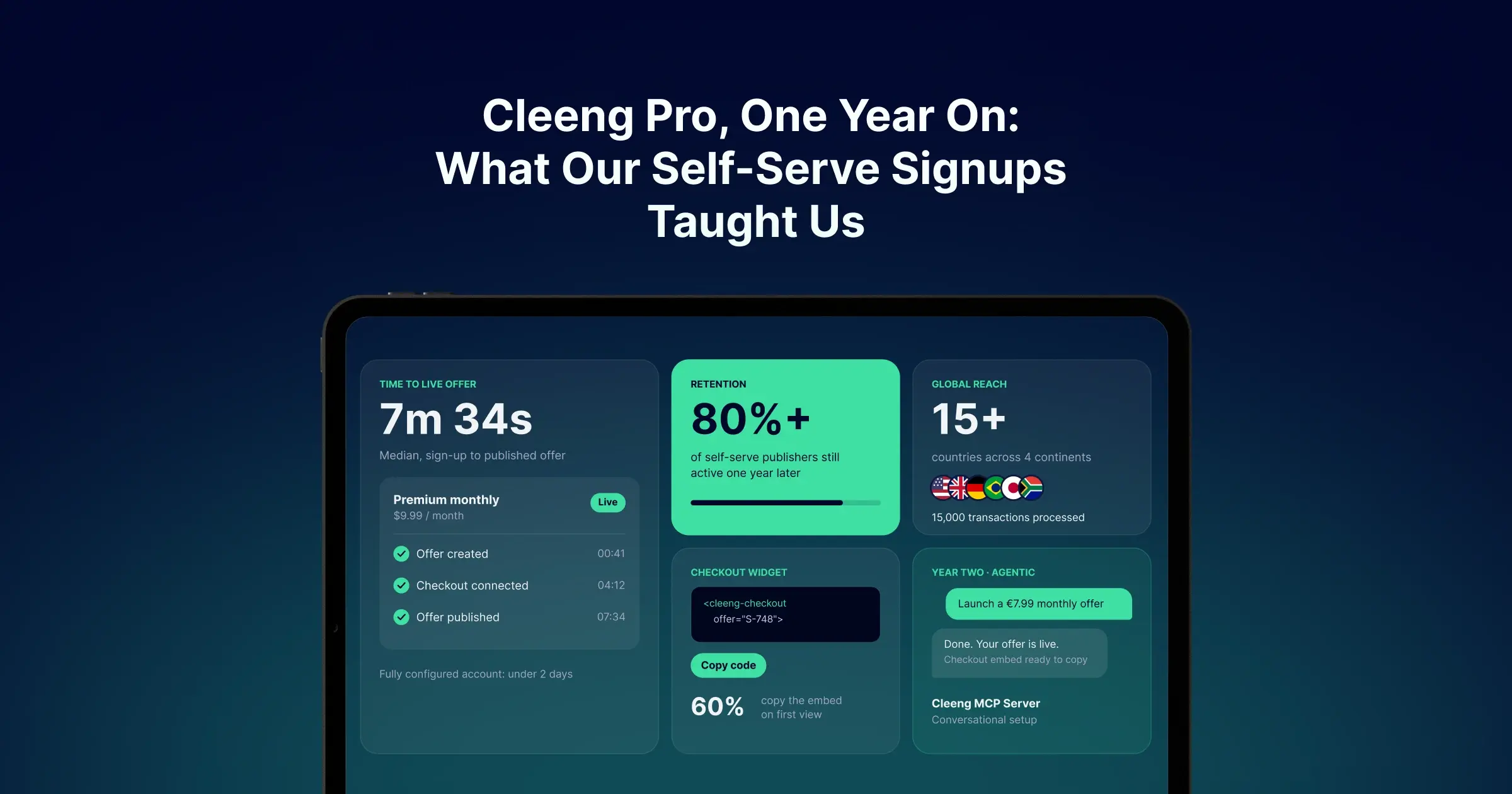
7 minutes and 34 seconds. Let’s give that number a moment. Signup to a live, published product offer – an actual thing a subscriber can buy – in under eight minutes, on average.
Full activation, meaning a completely configured account with branding, payment methods, and flows in production, averages under two days. That gap between eight minutes and two days is mostly human: deciding on pricing, agreeing on copy, migrating users, and setting up the back end of the house. The infrastructure isn't the constraint anymore.
Compare that with the alternative. Custom subscription flows built on top of payment APIs typically take four to eight weeks to reach production, and that estimate excludes QA, compliance review, and the scope changes that arrive whenever billing logic meets payment infrastructure.
Subscription infrastructure has always meant a sales call, a scoping document, and a six-week integration. Cleeng Pro compresses that into a coffee break.
Every week a paywall sits in the backlog is a week without subscriber revenue. When time-to-first-offer drops to single-digit minutes, testing a subscription model stops being a project and becomes a decision you can make on a Tuesday afternoon.
3. Sixty percent of publishers who open the checkout widget page leave with embed code
This is the metric that changed how we think about the product.
Of the publishers who reach the Hosted Customer Flows checkout widget page, 60% leave that page with embed code in hand. They don't bookmark it or schedule a technical review. Instead, they copy the snippet and go to their frontend environment.
That conversion rate tells us something specific about the audience: they are not evaluating whether hosted widgets are a good idea. They arrived already convinced. What they wanted to know is whether they could get one working today, and the answer was visibly yes within the same page view.
It also validates a design decision. The widgets (sign-up, checkout, user account, customer care) are framework-agnostic and deploy with a few lines of embed code. There is no backend to configure and no payment infrastructure to wire up. For a self-serve user with no implementation partner, it's the difference between launching and abandoning the process.
When the path from interest to working code is short enough, the majority of people simply walk it. Friction, no doubt, is what kills most self-serve evaluations.
4. Self-serve is global by default: 15+ countries across 4 continents
Cleeng Pro self-serve publishers span media and membership companies operating in over fifteen countries on four continents, including but not limited to the United States, Mexico, the Netherlands, Austria, Turkey, and Indonesia. During its first year, these self-serve clients generated 15,000 transactions, contributing to the $5 billion total volume Cleeng has processed to date.
We didn't run localized campaigns to get there, which means nobody targeted those markets over the last 12 months. The geography is simply what happens when you remove the requirement that a buyer be reachable by a sales team in a compatible time zone. A subscription business in a market we've never prospected can now find the product, evaluate it in their own language and currency, and launch – while our team is asleep.
This is only viable because the underlying platform was already built for it. As Merchant of Record, Cleeng carries payment processing liability and tax remittance across 13,000+ jurisdictions, and the widgets support multi-language, multi-currency, and local payment methods out of the box. A self-serve publisher in a new market isn't running a lesser version of the product – they're running the same compliance infrastructure a broadcaster runs.
Self-serve distribution reaches markets that sales-led distribution cannot economically serve. The constraint on international growth was never demand but rather the cost of a conversation.
5. A year on, the publishers who activated are still here
More than 80% of activated publishers are still on the platform at the end of year one, from a cohort that arrived with no onboarding support, no implementation services, and no account management.
LAOLA1, Stichting WMC Kerkrade, Mercury Kids Entertainment, Qwest TV and many more – all run subscriptions on Cleeng Pro. These names are not what the phrase "self-serve tier" usually brings to mind. And they are also serving different audiences: sports, cultural programming, kids' entertainment, music…
That runs against the usual expectation for self-serve software, where low-friction signup tends to produce a high-churn cohort. The self-serve selection does much of the work, as publisher who evaluated the product themselves, configured their own paywall, and set their own pricing has already demonstrated both intent and capability. There's no gap between what they were sold and what they got, because they got to experience the platform on their own, from the very beginning.
Self-serve acquisition and durable retention are not a trade-off. The brands that complete a self-serve journey are the ones the product actually fits, and they're the ones who are still here a year later.
6. What year two looks like: agentic activation, benchmarking, and instant migration
Three things we're building on top of what year one taught us.
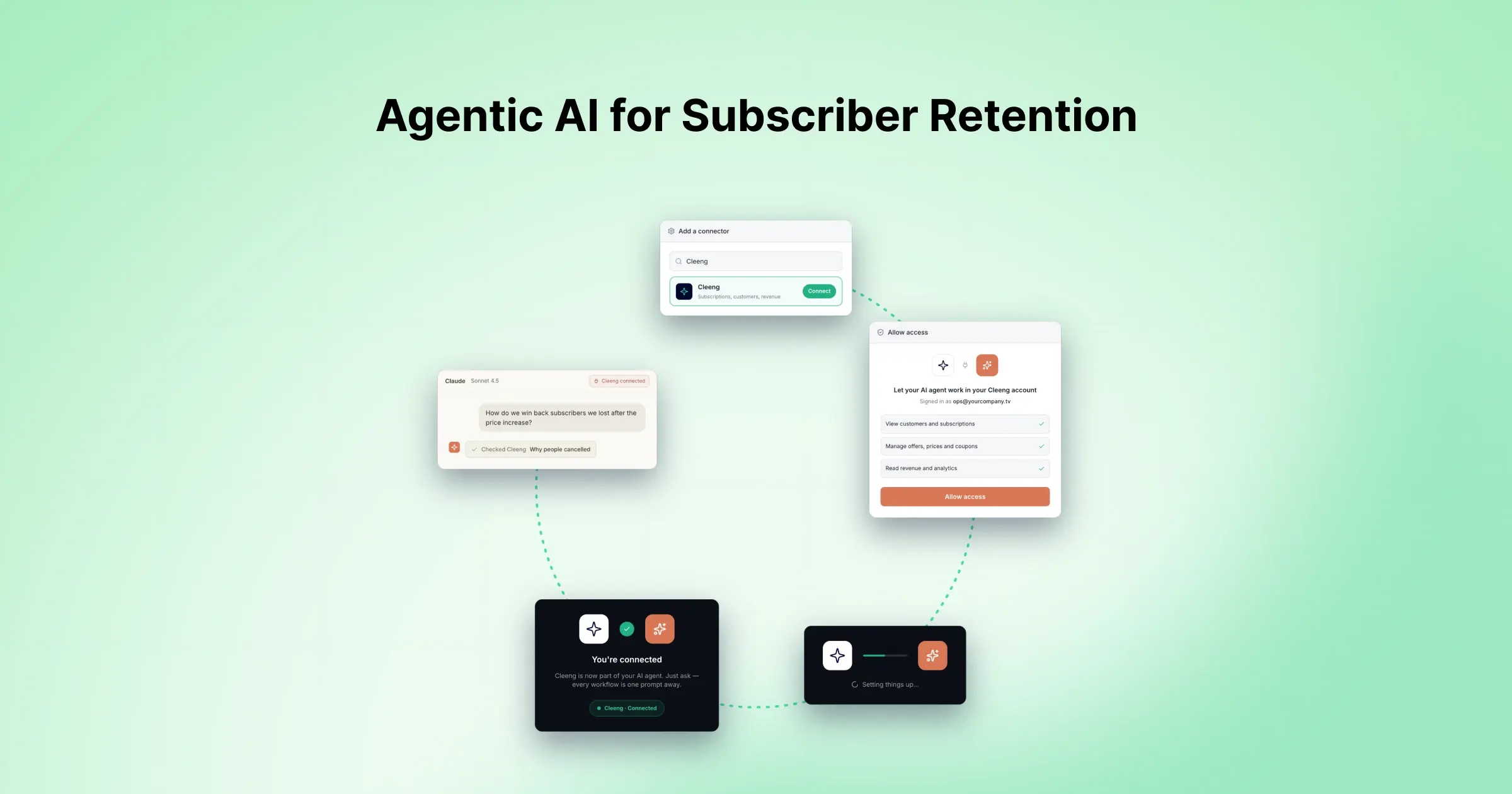
- Activation goes agentic. With the newly launched Cleeng MCP Server, configuration stops being a series of screens and becomes a conversation. A publisher can connect Cleeng to the AI tools they already use and set up offers, pricing, and flows in natural language. If seven minutes to a published offer was the result of removing the sales call, this is what removing the interface looks like. We wrote about why MCP servers change subscriber management in more detail.
- Benchmark your own data, immediately. Publishers should be able to audit their subscriber data and see the benefit against real benchmarks in the first session – not after a quarter of reporting. Knowing your churn is 4.2% is useful. Knowing it's 4.2% against a peer median of 2.8% is actionable.
- One-click migration from Stripe and PayPal. The most common profile in the account creations is a business already selling subscriptions on a payment processor and hitting the ceiling of what a payments tool can do about retention, tax, or subscriber lifecycle. Easy configuration of Stripe and PayPal makes that migration instant rather than a project, which removes the last real reason to stay put.
Year one proved publishers will buy subscription infrastructure without a sales call. Year two is about removing what's left between deciding and running.
Summary
A year ago, launching a subscription paywall on serious infrastructure meant entering someone's sales pipeline. Hundreds of accounts, a solid portion of live publishers, fifteen countries, and 15,000 transactions later, the conclusion is difficult to argue with: a meaningful share of the subscription market wants to buy an end-to-end infrastructure the way they buy everything else – immediately, by themselves, and on their own evidence.
Those subscription business have proven that it’s completely possible to activate in under two days, publish the first offer in under eight minutes, and keep on selling to your audience a year later.
Running a subscription business and tired of waiting for a sales cycle to start selling? Create a free account and see how far you get before your coffee goes cold.